
Aston Martin
- Details
- Parent Category: A
- Category: Aston Martin
- Hits: 31
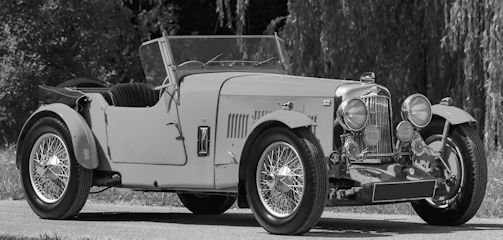
Aston Martin 1.5-litre Mk II
 |
|
| Manufacturer | Aston Martin |
|---|---|
| Production | 1934 to 1934 |
| Class | Sports car |
| Engine | 1.5 L I4 |
The Aston Martin 1.5-litre Mk II was a sports and race car from the 1930s.
History
In 1934 a long chassis appeared carrying full four-seat tourer, coupé and saloon bodies, and in 1935 the Mark II emerged, identified by its chromed radiator grille and featuring a modified engine, still of 1495 cc but with improved crankshaft and valve-gear design.
Aston Martin management divided their time, with Bertelli tending to the sports and racing cars, and Arthur and Gordon Sutherland aiming to give
the somewhat rough-and-ready Aston Martins rather more refinement and sophistication in an attempt to broaden their market appeal.
The car featured an open body placed on the short chassis from the Le Mans. Despite the car having the appearance of a four. seater, the rear seats were in reality little
more than additional luggage space.an extra £30 bought you the saloon version, whose unusually long wheelbase meant that
the passengers in the second row could sit comfortably in front of the rear axle. This feature also allowed the roof line to be lowered, contributing to the car's
sleek lines along drophead coupé incorporating an intricate roof construction was available on the same chassis.
The frame had been strengthened and stiffened and the two front Hartford frictional shock absorbers were mounted transversely rather than longitudinally
so that the outer arms were now directly coupled to the wheel carriers improved the road holding.
The tight-fitting motorcycle-style front mudguards which responded to the steering were retained. This allowed the car's low nose to be kept.
The Mark II's small four-cylinder power unit of an English film butler. once the bulky crankshaft had
The lubrication Systemhad one pump feeding nine Liters a minute to the bearings, while a second forced the oil hack into the tank. Along with the thermostatically-controlled radiator louver in place of the normal wire grille gave the car a top speed of 85 mph the 1.5 Liter, with a compression of 9.5:1, polished ports and two large carburettors’ boosting it to 80 horsepower at 5200 rpm.
The brakes were cable-operated, with Alfin drums and 18-inch wheel rims.
When the team won the TT team prize in 1934 the stage was set for a super sports model named the Ulster in 1935. Offering 80 bhp at 5250rpm and with a top speed of 102 mph, this was a true sports car which did much to confirm Aston Martin's ever-growing reputation. Their influence was first felt in the Mark II, and 166 specimens of the new era were sold between January 1934 and December 1935.
- Details
- Parent Category: A
- Category: Aston Martin
- Hits: 46
Aston Martin Lagonda Series 1
 |
|
|
Manufacturer |
Aston Martin |
|
Production |
1974 to 1975 |
|
Class |
Luxury car |
|
Body style |
4-door GT saloon |
|
Layout |
FR layout |
|
Engine |
5.3 L V8 |
|
wheelbase: |
2910mm |
|
Length: |
4928mm |
|
Height: |
553mm |
|
curb weight: |
1996 kg |
|
Top speed: |
240 km/h (149 mph) |
The Aston Martin Lagonda Series 1 is a sporty luxury sedan by the British car manufacturer Aston Martin, which is derived from the Aston Martin V8 coupé. It appeared as a prototype in 1969 and was built in small series from 1974 to 1976.
History
The Lagonda (in-house: Project MP 230) was a sports car manufacturer that was taken over by David Brown and integrated into Aston Martin, a company belonging to the same group. While Aston Martin was responsible for sports and racing cars, Lagonda covered the market area of high-priced sporty sedans at this time. After the Rapide was discontinued, Aston Martin initially stopped offering any Lagonda models. A four-door version of the coupe DBS V8 was created in 1969 under the name Lagonda; this hatchback limousine initially did not get beyond the prototype stage. The one-off from 1969 was used by CEO David Brown as a private vehicle for some time. It was only after the British investor Company Developments took over Aston Martin in 1972 that the company turned back to the four-door sedan. 1974 production begin. The sedan thus complemented the two-door V8 coupé in the company's model range, which in turn had replaced the DBS V8.

The decision to go into series production of the sedan came at a time when the effects of the first oil price crisis were being felt and Aston Martin again ran into financial difficulties at launch, the Lagonda was expensive at a cost of £14,040, In December 1974 the company was insolvent and did not build a single car in the first six months of 1975. It was not until June 1975 that a consortium of British and North American businessmen took over the business and merged it into Aston Martin Lagonda (1975) Ltd. Production was gradually resumed. Only 21 cars were made in 1975.1976 Aston Martin built the last orders for the four-door sedan; after that their production was stopped.
The new management then prompted the development of a new Lagonda, which stands out visually from the well-known V8 coupe and as an "eye-catcher" With this specification, a four-door notchback sedan with a wedge-shaped body was created according to a draft by William Towns developed within a month and a sensational digital instrumentation that was prone to defects in practice. Aston Martin sold the sedan built from 1974 to 1976 unlike before no longer under the Lagonda brand, but as Aston Martin Lagonda; the term Lagonda had been downgraded to a mere model name. The wedge-shaped limousine presented in 1976 and produced in three series from 1979 also bears the name Aston Martin Lagonda. In order to conceptually distinguish the individual generations from each other, the following differentiation scheme has been established: The Aston Martin Lagonda built from 1974 to 1976 is regarded as Series 1, while the three later series of the wedge-shaped sedan are known as Series 2, Series 3 and Series 4.

The prototype presented in 1969 largely corresponds to the later production vehicles, but differs from them in details. While the production vehicles have the front end of the contemporary V8 Series 3, the front end of the prototype corresponds to that of the DBS coupe. It has four small iodine vapor lamps which are integrated into the radiator cowling along with the turn signal/parking light units of the Ford Cortina Mk. II. In addition, a 5.0 litre version of the eight-cylinder engine was originally installed. Subsequent owners have since replaced this engine with a production model with a displacement of 5.3 litres.
The Aston Martin Lagonda S1 is stylistically and technically a four-door version of the Aston Martin V8 hatchback coupe. That is why the sedan is sometimes referred to in the literature as the 4-Door V8 using many of the parts. The wheelbase is 30.5 cm longer than that of the DBS/V8; The same applies to the total length. The shape of the body is a design by William Towns, a former designer at the Roots Group who was primarily responsible for designing seats at Aston Martin. When Aston Martin began planning the successor to the DB6 Towns developed a design to the proposal from the Italian Carrozzeria Touring, which Aston Martin had first commissioned. In a direct comparison, Towns' design ultimately prevailed over Touring's design.
Conceptually, Towns had planned both a coupe and a sedan from the start. He initially designed the limousine and derived the shorter coupé from it. The production version of the Lagonda S1 is stylistically the same as the Aston Martin V8 Series 3. It shares most of the body panels with it, especially in the area of the front end. Like the V8, the Lagonda S1 has a long bonnet. was inspired here by the 1966 Chevrolet Camaro. The straight sloping roof line, which is particularly characteristic of the V8 coupe and is also found (with a different angle) on the Lagonda S1. The standard sedan has the front section of the V8 Coupé with two round individual headlights.
The Aston Martin Lagonda S1 has an eight-cylinder V-engine whose basic design is the same as that of the DBS V8 and the V8. Aston Martin had developed it from 1963 under the direction of Tadek Marek. The displacement of the production model is 5.3 liters (5341 cm³; bore × stroke: 100 × 85mm). Technically, the engine of the sedan corresponds to the expansion stage that is used in the V8 Series 3 Coupé. It also has four double Weber downdraft carburettors (Tp 42 DNCF ) and has an output of around 208 kW (283 hp; 280 bhp). Some Lagonda S1 later received modified, sometimes heavily tuned engines. At least two cars received a 7.0-litre version of the eight-cylinder engine that was built by Aston Martin tuners RS Williams Ltd. was manufactured and delivers power between 450 and 480 hp. At least one car also received the slightly extended rear end of the V8 Series 4 "Oscar India" with a spoiler lip.
As with the V8, there was a choice of a three-speed automatic transmission from Chrysler (Torque Flite) or a manual five-speed transmission from ZF. Only two vehicles received the ZF transmission.
After the 1969 prototype Aston Martin built eight chassis and bodies-in-white for the Lagonda S1 in 1974, seven of which were completed and sold by 1976. A number of series were produced during the lifetime of the Lagonda, the original Series 1, and the wedge-shaped Series 2,3 and 4. A total of 645 cars were produced in the 12-year production run of the wedged shaped version. The original Series 1 was only produced from 1974 to 1975.This was a long-wheel based, four-door version of the Aston Martin V8 was announced at the 1974 London Motor Show. Designed by William Towns and based on the DBS, it was the first car to wear the Lagonda name since the 1961 Rapide. The 5.3 L V8 engine supplied with a 5-speed manual or automatic transmission. Only seven were sold.
Specification
- Engine: 5.3 L 5,340 cc (326 cu in) DOHC V8, producing 280 bhp (209 kW; 284 PS) and torque 301 lb ft (408 N·m)
- Top speed: 149 mph (240 km/h) and acceleration to 60 mph in 6.2 seconds

- Details
- Parent Category: A
- Category: Aston Martin
- Hits: 55
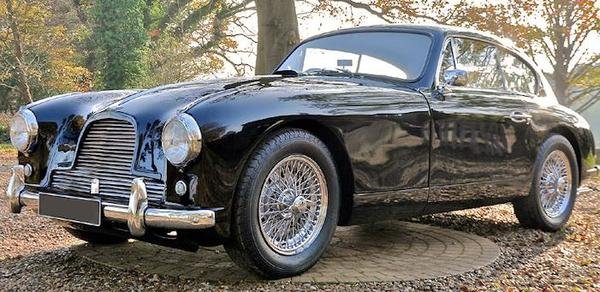
Aston Martin DB2/4
 |
|
|
Manufacturer |
Aston Martin |
|
Production |
1953 to 1957 |
|
Produced |
764 |
|
Class |
Sports car |
|
Body style |
2+2 hatchback 2-seat drophead 2-seat fixed head |
|
Layout |
FR layout |
|
Engine |
2.6 L Lagonda I6 2.9 L Lagonda I6 |
|
Wheelbase |
99 in (2,515 mm) |
|
Length |
169.5 in (4,305 mm) |
|
Width |
65 in (1,651 mm) |
|
Height |
53.5 in (1,359 mm) |
The DB2/4 is a sports grand tourer from the 1960s sold by Aston Martin from 1953 through to 1957.
History
The DB II was been replaced by the DB2-4 which has greatly increased luggage accommodation and two small seats in the rear of the car. The weight of the car with the new body had by some 7 per cent It was based on the DB2 it replaced, available as a Drophead coupe (DHC) and 2+2 hatchback (known by Aston Martin as a Saloon) well ahead of the times. Other changes included a wraparound windscreen, larger bumpers, and repositioned headlights. A handful of Bertone bodied spiders were commissioned by private buyers.
The front end and centre section of the chassis of the newly introduced DB2-4 are identical with the preceding DB II. The frame is a built-up construction of square tubes, and the front wheels are attached by a system of trailing arms in conjunction with vertical coil springs. Similar springs are used at the back of the car, the rear axle being located by single trailing arms and a Panhard rod. It is behind the location point of the rear springs that the changes distinguishing the model are to be found. By modifications to the frame and petrol tank design (and ' by reducing the capacity of the latter from 19 to 17 gallons) it has been possible to provide a clear space above the tank which runs from behind the individually-adjustable front seats to the tail of the car.
The designers have made over the rear axle two small seats which provide room for two children luggage space remains behind the occasional seats, the entire rear section of the body can be opened by lifting it around a hinge placed above the top of the greatly-enlarged rear window.
with the large opening dust-proof and water-tight, and in conjunction with this constructional change the top of the roof has
been lifted slightly so as to provide greater headroom above the occasional seats. So, the luggage accommodation can be more than doubled. by folding down the back of the rear seats
The Lagonda engine was initially the same dual overhead cam straight-6 designed by W. O. Bentley used in the Vantage version of the DB2. Displacement for this VB6E engine was 2.6 L (2,580 cc/157 in³), giving 125 hp (93 kW). The torque of the engine has been increased by 91 per cent. and that the power unladen ton has actually gone up from 95 to 119 b.h.p. The main mechanical features of the engine remain unchanged. With deep iron casting gives 360 degrees support for the four main crankshaft bearings which together with the shaft are inserted end wise into the block. The main casting also divides the outer walls of the water jackets, the cylinder liners being individually inserted and readily replaceable when necessary. The cylinder head carries two valves each 30 degrees from the vertical, the six separate inlet ports lying on the inside of the engine with six exhaust ports on the right-hand side. Two overhead-camshafts are used, driven by a duplex chain from the front of the engine Mixture is fed to the engine by two horizontals S.U. carburetors, each in turn drawing air through separate Vokes-type filters. The power is transmitted through a four-speed David Brown gearbox giving synchromesh on the upper three ratios, and choice of three final back-axle ratios is provided, the alternatives from the 3.73: 1,4.1 and 3.5: 1 respectively.
In September 1953 for the Saloon & April 1954 for the Drophead, a 2.9 L (2,922 cc/178 in³) VB6/J version was used, pushing power to 140 hp (104 kW) allowing the car 120 mph (193 km/h).
Of the 565 Mark I models produced, 102 were Drophead Coupe models. Three works cars were prepared for the 1955 Monte Carlo Rally and two for the Mille Miglia, but the company's focus was on the sports-special DB3 model.
- Performance: 2.9 litre
- top speed of 118.5 mph (190.7 km/h)
- acceleration from 0-60 mph (97 km/h) in 10.5 seconds.
- fuel consumption of 23.0 miles per imperial gallon (12.3 L/100 km; 19.2 mpg-US)
Mark II
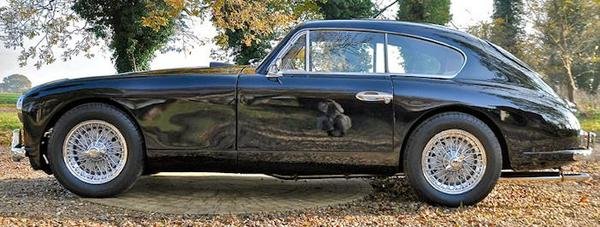
The Aston Martin DB2/4 Mark II model was released in 1955 and offered an optional large-valve, high compression (8.6:1) engine with 165 horsepower (123 kW). Small tailfins, bubble-style tail lights similar to those on the Morris Minor, and more chrome are additional improvements. Additionally, the horizontal split line for the bonnet was moved from being at door sill height to being at the top of the front wheel arch. Along with the continuing Drophead, a new 2-seat Fixed Head Coupé (FHC) was introduced. Only 34 of the 199 Mark II cars—David Brown's personal preference—used the redesigned coupe body.
Three Mark II chassis were sent to Carrozzeria Touring in Italy to become Spider models. Touring would later help Aston with the Superleggera design of the DB4.

The Aston Martin DB2/4 In Film and T.V
A drophead coupé (DHC) appeared in the Alfred Hitchcock film The Birds.

- Details
- Parent Category: A
- Category: Aston Martin
- Hits: 53
Aston Martin DB 2
 |
|
| Manufacturer | Aston Martin |
|---|---|
| Production | 1950 to1953 |
| Produced | 411 |
| Successor | Aston Martin DB2/4 |
| Class | Sports car |
| Body style | 2-seat coupé 2-seat drophead |
| Layout | FR layout |
| Engine | 2.6 L Lagonda I6 |
| Wheelbase | 99 in (2,500 mm) |
| Length | 162.5 in (4,130 mm) |
| Width | 65 in (1,700 mm) |
| Height | 53.5 in (1,360 mm) |
The Aston Martin DB2 is a sports car from the 1950s sold by Aston Martin from May 1950 to April 1953.
History
The production DB2 debuted at the New York Auto Show in April 1950. The Aston Martin DB2 was a major advancement over the previous 2-Litre Sports model it replaced, the prototype for the DB2 appeared as one of three Aston Martins at the 1949 24 Hours of Le Mans. The car was based on Claude Hill's tube-frame chassis, created for the 2-Litre Sports "DB1", with a closed coupé body design by Frank Feeley. with a dual overhead cam straight-6 in place of the previously-used pushrod straight-4. A light car, so that with a tuned engine suitable for running on 80 octanes. With accommodation for two, or possibly three people, and ample luggage space, The finest quality leather is used for the upholstery the seat squabs fold forwards so that luggage may be stowed in the rear part of the car The front seat has a center armrest, but if this is raised there is sufficient width between the doors to carry three persons although the possibility of doing so is largely dependent upon the buyer choosing the steering column gear lever which is an alternative to the centrally positioned control In 1954 an enlarged version was introduced, known as the 'DB2/4' and incorporating two occasional seats in the back of the cabin for use by children.

The details include many fittings specially designed and made by Aston Martin to replace the proprietary products normally employed. In the case of the heater element, however, this is a standard Smiths circulatory and screen demisting element placed behind the handsome walnut facia panel which, in addition to the clock and speedometer, has a rev-counter, oil capacity gauge, fuel gauge, oil pressure gauge, water thermometer, and ammeter. These are centrally mounted, and there are glove lockers of reasonable capacity at each side of the panel together recesses in the doors for maps and small items. There is a lock for the spare wheel housing and the wheel itself is mounted horizontally with an easily operated.
The Aston Martin DB2 handles in the way which you expect from the name. the body is a largely stressed skin assembly with an ingenious system of reinforcement, the whole being mounted on the frame through four Silent-bloc bushes. The entire front end of the chassis is exposed when the bonnet is raised, for accessibility or maintenance work to be required the first 49 cars used a square three-part grille in front with large rectangular side vents. This was soon updated with the more familiar integrated, rounded Aston Martin grille with horizontal slats. The dual fuel tank filler caps are anti-theft concealed within the body and the flaps which open to give access to them are controlled from within the body so that, when the latter is locked. With complete weather protection, interior heater for a long-range touring car. Later in 1950, a Drophead Coupé (DHC) variant was introduced. With at least 100 built.

The car featured a 2.6 L engine that was derived from Lagonda, and was designed as a closed coupé sports-saloon. A later drophead coupé model was also introduced, accounting for only a small amount of the model's total sales. The six-cylinder engine performance is relatively moderately rated with an output of 105 b.h.p. at 5,000 r.p.m equivalent to 2.36 h.p. per sq. in. of piston area and over 115 m.p.h top speed. built with a barrel-type crankcase construction with the counterbalanced four-bearing crankshaft and its bearing housings inserted end-wise, detachable cylinder liners in direct contact with the water, and a twin-camshaft cylinder head in which the exhaust-valve guides also make direct contact with the cooling water.
Performance: Aston Martin DB2
- Cubic capacity: 2,580 c.c.
- Max BHP : 105 b.h.p.@ 5,000 r.p.m,
- B.h.p. per sq. in. piston area: 2.365
- Peak piston speed ft. per min: 2,590 ft. per min.
- Piston area, sq. in. per ton: 40.2
- Top gear m.p.h. per 1,000 r.p.m: 21
- Litres per'ton-mile, dry: 3,360
The power is transmitted through a normal single-plate clutch to the D.B. four-speed gearbox, a feature of which is the choice of gear ratios which The rear axle is fitted with a hypoid bevel gear, and in conjunction with the 16-in. rims of the knock-off detachable wire wheels type. The front and rear suspension units are practically identical with previous Aston Martin cars, the Panhard rod is so positioned as to bring the rear roll center in. below hub level.
The frame design follows the lines developed on the earlier Aston Martin four-cylinder 2-1itre car, but has been improved beam stiffness where the triangulated arrangement at
the front end is joined to the rear frame members, the latter in turn being considerably stiffened by the unique constructional methods employed in the body-work.
In total 411 DB2s were produced through to 1953.
Aston Martin DB2 in The Fast and the Furious Film from 1954

- Details
- Parent Category: A
- Category: Aston Martin
- Hits: 52
Aston Martin DBS V8
 |
|
|
Manufacturer |
Aston Martin Ltd. |
|
Production |
1969 to 1972 |
|
Built |
408 |
|
Class |
sports car |
|
Body style |
Grand tourer 2-door coupe |
|
Layout |
FR layout |
|
Engine |
4.0 L DOHC I6 |
|
Transmission |
Borg-Warner automatic or 5-speed manual |
|
Wheelbase |
2,610 mm (102.8 in) |
|
Length |
4,585 mm (180.5 in) |
|
Width |
1,830 mm (72.0 in) |
|
Height |
1,330 mm (52.4 in) |
|
Dry weight |
3,800 1b, 1,723 kg |
| Cost New |
£5,744 (GB) |
| Max speed |
160 mph (257 km/h) |
The Aston Martin DBS V8 is a GT car produced by the British manufacturer Aston Martin Lagonda Limited from 1967 to 1972.
History
The DBS was intended as the successor to the Aston Martin DB6, although the two ran concurrently for three years. Powered by a straight-6 engine, it was produced from 1967 until 1972, eventually being phased out in favor of the Aston Martin Vantage the DBS was the last Aston Martin to be built under David Brown's control. As with all traditional Aston Martins, it was entirely hand built with each car requiring 1,200 manhours to finish.Although David Brown had left the company, he had overseen development of this model.After the end of the David Brown era, the model got a new front end and was sold under the name Aston Martin V8 Saloon.
Aston Martin had already designed a larger two-door saloon for V8 applications. The engine was still not ready, however, so in 1967 the company released the DBS with the straight-six Vantage engine from the DB6.The Tadek Marek's V8 was ready around two years later, and then Aston Martin released the DBS V8 .At the London Motor Show in September 1969, Aston Martin presented the DBS V8 with a new light-alloy eight-cylinder engine, the origins of which date back to 1965 ,this engine. In particular, has the bore of the six-cylinder (96 millimeters) was retained so that the same pistons could be used to save costs with the new V8 engine. Marek's V8 engine displaced 5.3 L and used Bosch fuel injection .With this 5340cc V8 engine, this variant being known as the DBS V8. At the time, it was the fastest 4-seater production car in the world. The new model was fitted with light alloy wheels (as opposed to wire wheels on the DBS) and ventilated brake discs. Automatic transmission was offered as an alternative to the ZF 5 speed manual gearbox. The DBS V8 was produced until May 1972, after which it was given a single headlamp front end and was renamed to AM V8. Some features of the V8 model are the larger front air dam and larger and wider wheels, The tail lights were taken from the Hillman Hunter.
With the demise of the straight-six Vantage in 1973, the DBS V8, now restyled and called simply the Aston Martin V8, became the company's mainstream car for nearly two decades.

The engine had a displacement of 5.3 liters and delivered 350 hp in this first version The DBS V8 could hit 60 mph (97 km/h) in 5.9 seconds and had a top speed of nearly 160 mph (257 km/h). However, the consumption was extremely high.
PERFORMANCE
- Top speed 160 mph (257 km/h)
- Speed in top at 1,000 rpm: 26 mph, 41.8 km/h
- Fuel consumption: 13 m/ imp gal, 10.8 m/ US gal
- Max speeds: 47 mph, 75 km/h in 1st gear; 76 mph, 122 km/h in 2nd gear; 111 mph, 178 km/h in 3rd gear; 136 mph, 219 km/h in 4th gear; 161 mph, 259 km/h in 5th gear

The Aston Martin DBS De-Dion axle layout showing its three-point rubber mounted hypoid unit cradle and inboard disc brakes with separate hand-brake calipers. Drive transmitted by two roller spline drive shafts with sealed for-life universal joints to 52 mm splined wheel hubs. The De-Dion tube is located by parallel trailing arms and Watt linkage supported by coil springs and adjustable rate lever type shock absorbers.
In 1969, David Brown had a four-door sedan made based on the DBS. This was a body version that was in William Towns' design concept from the start. The vehicle was designated Lagonda DBS V8 . The car was already equipped with the eight-cylinder of the DBS. It initially remained a one-off until 1974 .In total 402 DBS V8 car were built.
BODY coupé; doors: 2; seats: 4: front seats: separate, reclining backrests: details: adjustable two-positions clutch, brake and accelerator pedals, leather upholstery, electrically-heated rear window, electrically-controlled windows 8 track radio system. option air-conditioning system, Chrysler-Torqueflite automatic gearbox .


