
AC
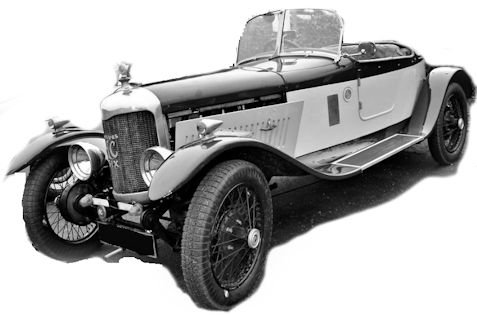
AC Montlhery
|
Manufacturer |
AC Cars |
|
Production |
1926 |
|
Class |
sports car |
|
Engine |
straight six |
|
Transmission |
4-speed manual |
|
Wheelbase |
111 in (282 cm); |
Designed by John Weller. it featured a three-speed gearbox in unit with the back axle and a disc clutch. During the war Weller had designed an advanced, light, 2-litre, 6-cylinder engine, which had alloy pistons and block, with wet steel liners, and a chain- driven overhead camshaft, and an experimental unit had been constructed in 1919 thus providing the later A.C. slogan 'The First Light Six'.
One was used by Selwyn Francis Edge, after he left Napier. He effectively took control Of AC in 1922, whereupon Weller left. His legacies included the transaxle and a six-cylinder engine that was to serve AC until 1963. Both were used in the Montlhery Sports Six.Straight six
Previewed at the 1919 London Motor Show, but not in production until 1922, Edge now got this engine into production by 1922, and it was to continue to be made by A.G., with modifications of course the same engine was usec up until 1963. It was marketed in the same chassis as the 4-cylinder cars, and it sold gently until 1926 when serious production of the 2-litre 'sixes' got under way, the 'fours' being phased out in 1928.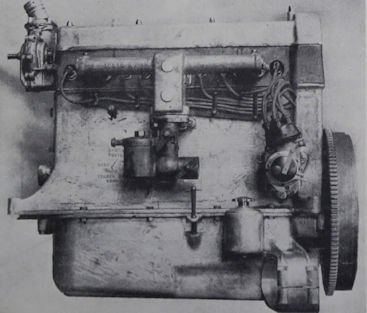
The engine war advanced. An light aluminium block and sump to bring the weight down and a chain driven Overhead camshaft; initially it developed 40 bhp, and by the end of the 1920s Output had been raised to 66 bhp, while for the mid-decade records a 65 bhp version was used. The bore and stroke are 65 mm. and 100 mm. (approximately 2.56in. x 3-937in.), giving a swept volume of 1,991 c.c. and an R. A.C. rating of 15-72. As fitted to the standard chassis, the engine develops 40 h.p. at 3,000 r.p.m., while that fitted to the sports chassis develops 66 at 4,000 r.p.m. The engine presents a clean, accessible and attractive exterior, and the accessories are all conveniently placed. It embodies many interesting features, certain of which novel in a vehicle of this size and class. Cylinder liners, for instance, are used, the cylinder block being a single aluminium casting formed in one with the top half of the crankcase. This casting is in fact the engine body proper, and carries the crank- shaft and main bearings. For the entire length of their working stroke the six liners are surrounded by the cooling water, which is contained in the single rectangular water jacket. There is therefore no contact between the liners and the jacket, except at their lower ends, the upper ends being spigoted into the combustion chambers which are formed in the detachable monobloc cylinder head.
The clutch is of the single plate, or, more correctly, the three-plate type, and drives by intermediary shaft to the enclosed propeller-shaft, the torque tube being anchored at a central tubular frame cross member. The gear box, aspreviously mentioned, is integral with the rear axle. Four-wheel brakes were fitted.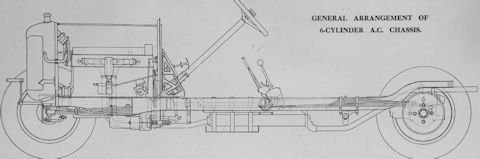
Meanwhile, the Company had entered for the J.C.C. 200 Miles Race every year from 1921 to 1924 with both 4- and 6-cylinder cars, their best result being a third place in 1923. In 1925 they built a special ohc, 6-cylinder racing-car for an attempt on Edge's own 1907 World 24-hour record. The car was taken to the Montlhéry track outside Paris where it scored a handsome success at 82 mph, being driven solo by Thomas Gillett for the whole period. the exploit providing the addition to the A.C. range next year of the splendid triple carburettor. 6-cylinder Montlhéry' sports model. which was guaranteed for 85 mph. Breaking Edge's 24-Hour record S.F. Edge had set the 24-Hour record in 1907, and his associate Thomas Gillett broke it in 1925, averaging 85.28 mph/137 kmh at Montlhéry. model named for it was a neat sports car, guaranteed to reach 85 mph/136 km.
Hon. Victor Bruce and W.J. Brunell 2-litre's victory in the Monte Carlo Rally. Nevertheless, the Company was in financial trouble in 1929; Edge left. and it went into voluntary liquidation.
to be later reformed in 1930 by the brothers.Hurlock.
AC Royal Six
 |
|
|
Manufacturer |
AC |
|
Production |
1926 to 1928 |
|
Class |
Sports Car |
|
Body style |
2 -door / 4-door saloon, drophead coupé, tourer |
|
Layout |
FR layout |
|
Engine |
1991cc straight six |
|
Curb weight |
2,912 lb (1,321 kg) |
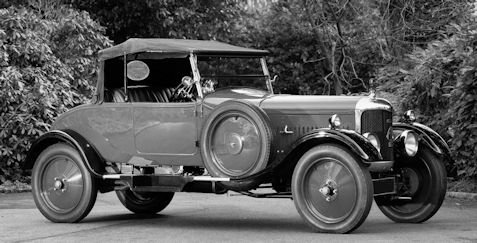
The AC Royal was a British car from the 1920s, this came built like many cars from the time with ash-framed bodt structure covered with lightweight aluminium outer panels, but still the cheapest model in the range from the time.
The Famous AC cars after World War l. Four-cylinder engines were used at first, joined by a six in 1920. An advanced six Designed by John Weller, the 1.5 litre six-cylinder engine was an advanced unit,with aluminium alloy block and crankcase. wet cylinder liners and a cast-iron cylinder head. The slightly inclined Overhead valves were operated by a single over-head camshaft 1922 Capacity went up to 1991 cc and power to 40 bhp.
The cars in which the six-cylinder engine was fitted (there was also a 1.5 litre four until 1927) with rounded radiators and bodies often of polished aluminium,Front wheel brakes did not come until 1927, and apart from racing cars there was no four-speed AC until 1933. when the old the-speed box in unit with the rear axle gave way to a conventional. four speed. in 1928 the name Aceca appeared for the first time, as a drophead coupé; this was priced at £475, while the cheapest model in the range was the Royal open 2/3-seater at £350. Power output had been increased to 56 b.h.p. from 40 and the crankshaft line was stiffened by the addition of a fifth main bearing.
AC Brooklands Record Car
|
Years |
1922 |
|
Class |
Race Car |
|
Body |
Single Seat |
|
Engine |
427 cu in (7.0 L) V8 |
|
Wheelbase |
90 in (2,286 mm) |
|
Transmission |
three-speed manual gearbox |
|
Suspension |
quarter-elliptic springs, front and rear. |
|
wheelbase |
106.3 in (270 cm) |
|
Track |
front and rear, 46 in (117 cm). |

The AC Brooklands record car ,was famed for being the first light car to cove more than 100 miles in the hour, and several other records at Brooklands.
History
The little AC company Of Thames Ditton in Surrey their factory was at Thames Ditton, only a few miles away from the famous Brooklands Track. S.F. Edge, the famous pre-war Napier salesman, joined the firm in 1921. He went about building a more racing image for the company, first starting with a team of six cars in the 200 Mile Race at Brooklands.
Making a name at Brooklands .Although all had racing bodies, three of the 1921 team cars used fairly standard side valve Anzani engines, while the Other three had single-ohc units derived from the company's six-cylinder engine. With 16-valve heads they gave 42 bhp, but all three retired. AC's best place was Stead's 8th in aside valve car. In June, 1921, at Brooklands, Hawker covered the flying half-mile at 105.14 m.p.h. and same distance from a standing start at 61.43 m.p.h., both of which were world-class records. In 1922 the Ohc cars failed again, but this was compensated by successes in record breaking.
An aircraft maker's body One of the AC drivers was the famous pilot and aircraft manufacturer Harry Hawker, and most of the racing cars of the early 1920s carried bodies made by his company at nearby Kingston-on- Thames. A.C. put polished aluminium airship-tail sports bodies designed by Weller that were highly streamlined, they had aluminium panelling on wood frames in 1992 a particularly low-slung car was made with cowled radiator and a 16-valve engine tuned to give 55 bhp. With this car J.A. Joyce drove 101 miles 696 yards (163.04 km) in one hour. This was the first car under 1.5 litres to cover more than 100 miles in one hour. The car returned to the works, where power output was pushed up to 64 b.h.p. and Kaye Don then covered just over 94 miles in the hour. A team was formed by the works to have a crack at the Double-12 and 200 miles Brooklands races, but although they won their class in the 1922 Double-12 race at a record average of 71.23 m.p.h., in general, the team cars suffered from lack of adequate preparation for the longer events.
AC Cobra Mark III

| Production | 1965 to 1967 |
|---|---|
| Class | Sports car |
| Body | Roadster /fastback |
| Engine | 427 cu in (7.0 L) V8 and 4.7 L (289 cu in) |
| Power | 345 b.h.p. at 4,600 r.p.m. |
| Wheelbase | 8 ft. (96 in.) |
| Length | 14 ft. 6 in. (174 in.) |
| Width | 5 ft. 7 in. (67 in.) |
| Height | 4 ft. 3 in. (51 in.) |
| Weight | 3,143 lb. |
| Top Speed | 150 m.p.h. |
The AC Cobra Mark III was built in Britain from 1965 to 1967 with 4.7 L (289 cu in) V8 engine also some with 427 cu in (7.0 L) V8 .
History
By 1965 and Shelby began to drop the 7-litre Ford engine into an even thrther revised chassis. The basic min tube frame remained but the tubes grew bigger; still more important was the introduction of twin wishbone and coil-spring suspension at each corner replacing the transverse leaf springs. With Ford brain power behind Shelby, the installation
successful. but few were sold in Europe. With the termination of the A.C.Shelby contract and the sale of the name Cobra to Ford, A.C. were left a more than adequate chassis for the 4.7-litre engine: the same chassis, lengthened. provides the basis for the Frua bodied 42S convertible, a superb car in the luxury tradition of A.C.
The AC Cobra Mark III was built until 1967 The engine a V.8 high performance unit manufactured by Ford Motor Co. of America. The front suspension comprises twin wishbones by highly specialised thin wall casting techniques developed by Ford America to reduce weight. Identical to 428 Convertible, but wheelbase 6 in shorter. The new car also had wide wings and a larger radiator opening for cooling.
Traditional British sports body constructed in 16- and 18-gauge aluminium; leather trim, with carpets to choose. Demountable hood and tonneau; large luggage boot; fuel tank 15 Imp. gal.; spare wheel under luggage locker; maximum speed 150 m.p.h. Dimensions: weight 2,282 lb.; length 13 ft., width 5 ft. 8 in, height'4 ft. 1 in, with soft top erected; wheelbase 7 ft. 6 in., track, front 4 ft. 7 in., rear 4 ft. 6 in.
Inside Carpets are fitted to the floor and transmission tunnel and the seats are upholstered in leather; the door locks at the rear of the panel are operated by a simple leather pull-strap and you have to open the sidescreen and pull the strap to undo the door from the outside. There is a number of instruments on display, The wheel spokes obscure the lower edges of the speedometer and rev-counter the horn operation,a bar in the back of the indicator stalk. There is no padding on the painted metal facia top and its flat surface reflects on to the screen. There is a glove locker on the facia but the rest of the luggage has to go in the boot on top of the spare wheel with 3.9 cu.ft. of luggage space.
The soft hood is held on top of the screen by two pins in the centre which slide into a channel, and at the edges by over-centre clips. Press studs hold it down round the base of the hood, and there is a rubber sealing strip inside; tensioning is provided by a hoop hinged to the main arch. The fabric and the side screens fit into a bag.and takes around two minutes to put back up.Visibility is good with the soft top; the screen pillars are thin and there is plenty of clear sheet in the fabric. With the hood up there are few draughts until you move the sliding sidescreen forward, which is necessary in traffic. On the move you can get cold air in by ram effect at foot level; this is controlled by knobs at either end of the facia. For hot air you have to use the two-speed fan since the system is a recirculatory one; there are flaps at foot level and the screen outlets demist the screen quite quickly.
From 1953, the two-seater body has basically similar with a revised nose coming with the Zephyr engine option and ever wider wing flares along with an ever wider track. With 271 bhp in 21cwt of car, the 289 is extremely fast The unit is extremely tractable and it has an excellent gearbox. Although the cornering attitude of the car is largely dictated by the throttle at road speeds, the way the power is put through to the road, particularly on wet surfaces, is quite remarkable. it is not too impractical but a 15 mpg thirst and frequent servicing might put one off using it as a every day car. You are unlikely ever to get better than about 17 mpg which gives a usable range on the 15-gallon tank of about 220 miles.l
Engine: V.8 built by the Ford Motor Co. of America, 7,016 c.c. along with a high-performance engine also available, providing 400 bhp with single 4-barrel 780 CFM Holley carburettor. at 5,750 r.p.m. at extra cost.
Capacity 4,727 c.c. (289 cu. in.) with bore and stroke (4.00 x 2.87 (101.6 x 72.9 mm.) ,crankshaft carried on 4 main bearings, lead bronze bearing shells to mains and big ends, compression ratio 11:1, 4-choke Holley carburettor, 270 b.h.p. at 5,850 r.p.m. with 6,500 as recommended maximum; lubrication by pressure pump to bearings; aluminium pistons; Salisbury limited slip differential 3.54 ratio, Borg Warner 4-speed all synchromesh gearbox, ratios 2.20, 1.66, 1.31, 1.00; chassis, suspension, steering and brakes, identical to 428 Convertible, but wheelbase 6 in. shorter.
The gearbox has such excellent ratios and the short stubby gear lever. The pedals are well placed for heel-and-toeing and there is room for the left foot beside the clutch. resting on a piece of floor.The heavy clutch with a long travel itself grips smoothly and well but its long travel more final
drives are Salisbury 4HU with limited-slip differential.
PERFORMANCE: 289 cu in
- Fuel consumption: 19 ml imp gal, 15.8 ml us gal
- Max speed: 150 mph, 241.5 kmlh
- Max power (SAE): 270 hp at 5,750 rpm
- Max torque (SAE): 312 1b ft, 43.1 kg m at 3,400 rpm
- Max engine rpm: 7,000
- Specific power: 57 hp/l
- Power weight ratio: 7.9 lb/hp, 3.6 kg/hp
- Acceleration standing 1/4-mile 14 sec, 0—50 mph (O—80 km/h) 4 sec

AC 2-Litre
 |
|
|
Manufacturer |
AC |
|
Production |
1947 to 1956 |
|
Built |
1,284 produced |
|
Class |
Sports Car |
|
Body style |
2 -door / 4-door saloon, drophead coupé, tourer |
|
Layout |
FR layout |
|
Engine |
1991 cc I6 ohc 74 bhp (55.2 kW)/76 bhp (56.7 kW) |
|
Transmission |
4-speed manual |
|
Wheelbase |
117 in (2,972 mm) |
|
Length |
184 in (4,674 mm) |
|
Width |
67 in (1,702 mm) |
|
Height |
61 in (1,549 mm) |
|
Curb weight |
2,912 lb (1,321 kg) |
The AC 2-Litre was a luxury car built by AC of Thames Ditton in Surrey, England. between 1947 and 1956.
History
AC produced a modern style to hide the traditional engineering.Much of the detail was new. The X-braced chassis frame, with beam front and rear axles, was fresh. The 17in wheels hid a Girling hydro-mechanical braking layout, and for the first time on an AC there were hydraulic dampers.The alloy block/iron head overhead-cam engine, almost into its fourth decade, used triple SU carbs and was mated to a Moss gearbox. The 2-litre's two-door saloon body was framed in wood with aluminium panels.
The AC 2-Litre is an exclusive and stylish saloon offered by AC of Thames Ditton in Surrey, England. A car made-to-measure at the Thames Ditton factory that produced, a hand-made and finely finished product. With true British craftsmanship. The 2-Litre A.C. Differences from previous model with new windscreen frame and now the absence of rear wheel spats (covers). As from 1953, four-door saloons were sold. In addition, as from 1949, a small number of drophead coupés and "Buckland" tourers were produced.
The car changed very little during its ten-year production run, The 2-door, 4-light sports saloon with an aerodynamic look is off a close full 5-seater design. Incorporating a luggage boot in the tail, this body, which is built in the A.C. works, has a framework of seasoned wood and is built with a body of paneled in aluminum’s bonnet, hinged down the center, is lockable, and allows easy access to the engine for adjustments. Quality Interior with leather upholstery and walnut dash for instrument panel and window capping, with driving comfort and excellent all-round vision are good. The wheel size did increase slightly to 16 in (406 mm) in 1951.

The aluminum paneled body on a wood frame was fitted to a conventional steel chassis with rigid axles front and rear with semi-elliptic leaf springs with, for the first time on an AC, hydraulic dampers. Until 1951 the car had a hydro-mechanical hybrid braking system, hydraulic at the front and cable at the rear with 12 in (305 mm) drums.
1947 2-litre engine which has been modernized with a view to a higher power-output. The A.C. has never been a cheap car, but one hand-
built and Possessing a quality and charm of appeal to a specialized clientele.The light rigid chassis frame of the new 2-litre, underslung at the rear, is of cruciform construction incorporating box-section for strength. Sound and orthodox suspension has been decided upon in the shape of half-elliptic springs all round. A.C.'s haveproved in this new car, that without recourse to intricate suspension systems and adventurous chassis designs, it is possible to produce a thoroughly stable and roadworthy vehicle, possessing a sparkling performance and just that quality which assures long life and pride of ownership. At the front are found Wood- head Monroe piston-type dampers, whilst Girling hydraulic shock absorbers restrain the rear springs. The brakes, which operate in 12 in. diameter drums, are of the Girling hydro-mechanical design providing a powerful braking performance for only light pedal pressure. A Hardy Spicer needle-type propeller shaft powers the rear axle of hypoid spiral bevel pattern.
A smart drophead coupé followed in 1949, a four-door saloon in 1953. Over time there were improvements such as a power boost to 85bhp, all- round telescopic dampers, a full
hydraulic braking system, and 16in wheels in 1951, The most startling innovation was the launch of the Buckland Tourer in 1949, an open-top five-seater with cutaway dpory, This was lighter and more but still no sports car.
The 2-Litre always struggled to gain an image. Once the Ace sports car appeared, it faded into the background. From 1954, only 42 cars were produced, the last in 1958. In spite of the rust- resistant bodywork there seem to be surprisingly few survivors, mainly as they are a source of replacement engines for more valuable Aces and pre-war cars.
The engine, as has been said, is of the well-tried and well- known design basically, but has undergone considerable development to produce 74 b.h.p. The light alloy cylinder block has been retained in conjunction with wet cast iron cylinders liners
The light rigid chassis frame of cruciform construction incorporating box-section for strength. sound and orthodox suspension with half elliptic springs all round with front Wood-head Monroe piston-type dampers, whilst Girling, hydraulic shock absorbers at the rear springs. A Borg and Beck dry single-plate clutch transmits the power to a 4-speed gear box
with synchromesh engagement for the upper three ratios. To Power the rear wheels, all fitted with Chromium hub discs are fitted. with A Hardy Spicer needle-type propeller shaft powers the rear axle of typical hypoid spiral bevel type.

The AC 2-litre engine, which continued to be offered in other AC models until 1963. The engine, of the well-tried previous design, but has undergone more development to now produce 74 b.h.p with the triple S.U. carburetors light wet liner, aluminum cylinder block, six-cylinder 1991 cc engine has been retained in conjunction with wet cast iron cylinder liners, as also has the chain driven overhead camshaft system for valve operation, this unit first offered by the company in the AC 16, way back prewar in 1922. However, post war in 1947 the engine was increased again in 1951 to 85 bhp (63.4 kW) which was more than twice the 35 bhp (26.1 kW) claimed for engine's original application.

The AC 2-litre had a top speed of 80 mph (130 km/h) and could accelerate from 0-60 mph (97 km/h) in 19.9 seconds. A fuel consumption of 23 miles per imperial gallon.
Performance:
- Max. b.h.p., 74 at 4.500 r.p.m
- b.h.p. per sq. in. piston area, 2.41
- Top gear, m.p.h. per 1,000 r.p.m., 17.24
- Top gear, m.p.h. at 2.500 ft./min
- Piston speed, 65.5 litres per ton mile, dry, 2,680.


