
Audi
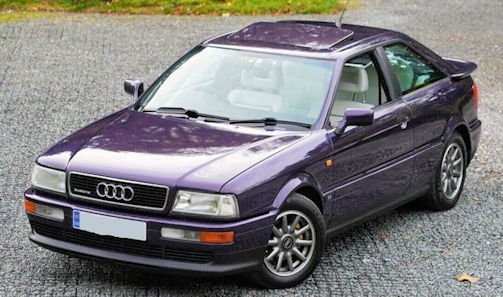
Audi Coupe B3
 |
|
|
Production period: |
1988 to 1996 |
|
Class : |
Sports car |
|
Body versions : |
Coupé |
|
Engines: |
Gasoline : 2.0-2.8 Liters |
|
Length: |
4366 mm |
|
Width: |
1716 mm |
|
Height: |
1375 mm |
|
Wheelbase : |
2555 mm |
|
Curb weight : |
1170-1400 kg |
The Audi Coupé B3 (Type 89) is a sports coupe based on the Audi 80 B3 (also Type 89), which was manufactured from autumn 1988 to the end of 1996 and sold into 1997.
History
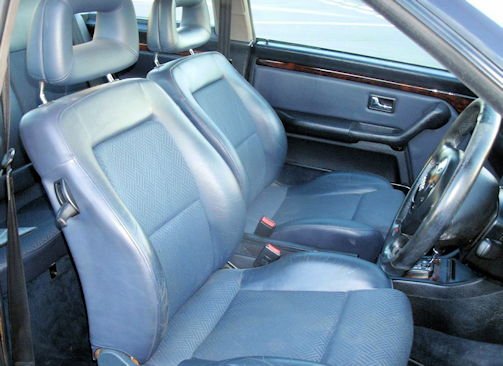
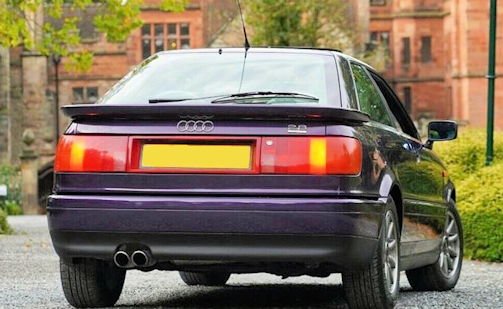
The second series of the Audi Coupé is based on the presented in August 1986 Audi 80 B3 (Type 89), but was in contrast to the first series a completely independent development with optical parallels to the Audi 80. The hatchback also used here has a large, in the roof hinged tailgate and folding rear seat backrests, the sill lies above the rear lights, the modified bumper is painted in body colour. Based on these design features, which ensure a high body rigidity of the Audi Coupé, later the first Audi convertible was built .
In July 1991, the coupe was subjected to a facelift. For example, the front end of the Audi 80 B3 was changed to the front of the Audi 80 B4, which was introduced in the autumn of 1991 . At the same time, the range of engines was changed. It accounted for the five-cylinder engine with 20 valves. For the already introduced in 1990 in the Audi 100 C4 2.8-liter six-cylinder came to use.
In July 1994 then still accounted for the 2.3 -Liter five-cylinder, which was replaced by the already introduced in August 1992 2.6-liter six-cylinder. Only the 5-cylinder 20V turbo in S2 remained until the end of production. To make the conversion tastier, the six-cylinder engines had a little more power over the 5-cylinder variants.
Range
- Audi Coupe 1.8, 2.0E, 2.2E, 2.3E,2.6E,2.8E.16V,20V
- Audi Coupe S2
Drive types
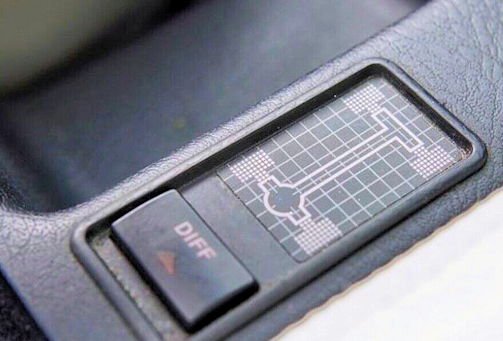
- The Audi Coupe was equipped with front-wheel drive and five-speed gearbox, optional were the models 2.0E, 2.3E, 2.3 20V and 2.8E with four-speed automatic transmission (2.0E with 3A / AAD engine only three gears), or the models 2.3E, 16V , 20V, 2.6E, 2.8E with four-wheel drive quattro available.
- The Coupe S2 was only offered with four-wheel drive, the model with ABY engine has a six-speed gearbox, but in the last gear is no longer translated as the five-speed gearbox from the 3B.
Updates
- 10.1988: Presentation of the second Audi Coupé with 2.3E and the 20V engines
- 09.1990: Introduction of the S2 , already with the optics of the later Audi-80-B4-series (hood integrated in the bonnet, etc.).
- 07.1991: Facelift for Coupé. The optics is taken over by the S2, however without its bumper, which came only to the model year 1993.
- 09.1991: Introduction of the 2.8-liter V6 engine.
- 08.1992: Introduction of the 2.6-liter V6 engine.
- 12.1996: Production of the Audi Coupé is discontinued.
Audi 100 Coupe C1 (Type F105)
 |
|
|
Production period: |
1968 to 1977 |
|
Class : |
Sports car |
|
Body versions : |
Sedan , coupe |
|
Engines: |
Petrol :1.6–1.9 liters (59–85 kW) |
|
Length: |
4398-4635mm |
|
Broad: |
1729-1750mm |
|
Height: |
1370-1421mm |
|
wheelbase : |
2560-2675mm |
|
curb weight : |
1050-1120kg |
|
successor |
Audi 100 C2 |
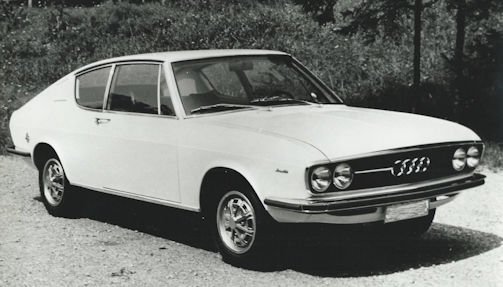
The Audi 100 C1 (type F104 or as a coupé F105) is a passenger car of Auto Union GmbH and from 1969 Audi NSU Auto Union AG. The vehicle with a longitudinally installed four-cylinder in-line engine and front-wheel drive was built from October 1968 as a four-door sedan, the two-door version followed in October 1969. Production of the Audi 100 Coupé S, later in 1969 and began production in July 1970.
After 827,474 units were produced, the C1 was replaced in 1976 by the completely newly developed Audi 100 C2.
History
The history of the creation of this car is considered unusual. Essentially, those responsible at Volkswagen in Wolfsburg thought they had acquired another assembly plant in Ingolstadt for the VW Beetle, which was still selling well at the time, with the Daimler-Benz subsidiary Auto Union, which was then threatened with bankruptcy by the mid-1960s. The lack of free capacities there were filled with the assembly of the VW Beetle. The poorly selling DKW F 102 was revised and equipped with a four-stroke engine. The Auto-Union brand Audi was created with this car, which was referred to internally as the “Audi F103”. new. The CEO Heinrich Nordhoff decreed that no more new models should be developed in Ingolstadt.
Ludwig Kraus, who worked at Daimler-Benz until 1963, did not believe in the future of the VW Beetle and developed a new model at Auto Union under the name Audi 100 without the knowledge of the VW board of directors and mostly after work. Nordhoff only got the finished car finally presented. With the Audi 100, a computer-calculated body was developed for the first time in the development of a series vehicle using the finite element method. The plan was to produce a one-off run of 100,000 vehicles, but demand was so great that 827,474 vehicles were made by the end of production.
The secret development of this model was ultimately the reason that Audi remained as an independent brand. In the early 1970s, Audi's modern and easy-to-sell vehicles saved Volkswagen Werk AG, which was struggling with sales problems. With the Beetle and its derivatives up to the VW 411 with air-cooled rear engine, this had technically maneuverer into the sidelines and was only possible by resorting to developments by the subsidiary Audi NSU (VW K 70 - 1970 and Audi 80 - 1972, from 1973 also as the VW Passat) able to expand their range in a short time to modern models with water-cooled front engines and switch to front-wheel drive.
In 1971, production of the Audi 100 was relocated to the former NSU plant in Neckarsulm.
The pricing of the first-generation Audi 100 was quite unusual as from its launch in October 1969 to January 1972, the two-door sedan was just as expensive as the four-door and was remarked that "the two-door sedan itself looks like an elegant coupe"; the design effort for the two-door model with particularly large doors and large rear side panels was also unusually high, which could explain the high pricing policy.
The body welded to the frame-floor assembly was stylistically similar to that of the Audi F103, but significantly larger. The chassis was basically the same, but instead of torsion bar suspension, the front axle was fitted with high-lying coil springs with concentric telescopic shock absorbers (spring-damper unit) with stabilizer. This made it possible to lower the passenger compartment and improve handling. The somewhat dated torsion bar suspension was initially retained on the torsion crank rear axle, but in 1973 the switch was made to a spring-damper unit with coil springs. Rack and pinion steering and dual circuit brake with discs at the front and drums at the rear were further features of the chassis.
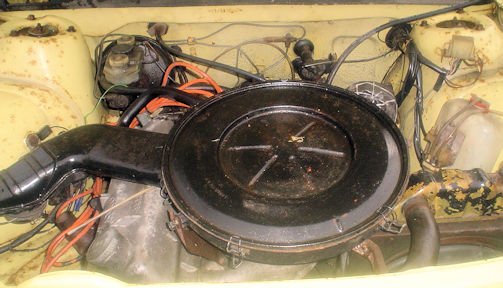
Initially, all cars were fitted with four-cylinder engines with displacements of 1.8 l to 1.9 l. They were based on the Audi F103 's engine, adopted from Mercedes, a conventional side-camshaft, pushrod design that, while reliable and economical, but was also rough-running. In 1974 Audi replaced the weakest of the 1760 cc engines with a 1588 cc overhead cam EA827 engine from the new Audi 80.
As early as October 1969, eleven months after the presentation, the Audi 100 LS received a more powerful carburettor at the same time as production of the two-door sedan started, two of which were also installed in the new Audi 100 Coupé S (type F105) from October 1970. From April 1970, the Audi 100 LS was optionally available with a three-speed automatic transmission from VW for a surcharge.
By September 1971 for the new 1972 model year, all sedans received a hatch over the fuel filler cap on the rear right-side panel and the range of engines and equipment was rearranged. The new basic engine was the 1.8-liter engine with 85 hp (63 kW) at 5100 rpm with a compression ratio of 8.5:1 for normal petrol. For a surcharge, it could be combined with the better LS equipment. Audi thus replaced the normal petrol engine of the Audi 100 with 80 hp (59 kW) at 5000 rpm with a compression ratio of 9.1:1 and the premium petrol engine of the Audi 100 S with 90 hp (66 kW) at 5500 rpm Minute with a compression ratio of 10.2:1. In the still available engine with 100 hp (74 kW) at 5500 rpm for the Audi 100 LS for premium petrol, the compression has been reduced for quieter and smoother engine running. The Audi 100 GL with the same 1.9-liter engine as in the 100 Coupé S was the new top-of-the-range sedan model; However, due to a reduced compression (10.0:1 instead of 10.2:1), the power dropped from 115 hp (85 kW) at 5500 rpm to 112 hp (82 kW) at 5800 rpm. The Audi 100 GL received the radiator grille with twin headlights already familiar from the coupé as standard. Just like the coupé, it could be equipped with the three-speed automatic transmission for an extra charge. For the first time, power steering appropriate for the vehicle class was available for all models for an additional charge.
In September 1973, the entire series for the 1974 model year underwent several changes: the front end was revised, fenders and bonnet were designed more angular and all models received a radiator grille made of plastic. Only minor changes were made to the rear of the sedans, the most striking being the new rear lights, which are divided horizontally throughout; the rear of the coupe remained unchanged. The rear wheel suspension was also changed: spring-damper units with coil springs replaced the transverse spring bar. Furthermore, all models received a wiping interval switch as standard and seat belts (on the GL and Coupé S, automatic seat belts with head restraints). A central connector for the VAG diagnostic system introduced in mid-1971 was installed in the engine compartment.
The model series underwent the last major changes in August/September 1974 for the 1975 model year: the front disc brakes were previously on the inside of the gearbox/differential, where they could easily get oily; Audi moved them outwards to the usual position on the wheels. However, their diameter had to be reduced from 280 (291 for the top models) to 257 millimetres. The two circuits of the brake hydraulics were split diagonally instead of a front and a rear circuit. All versions also received wider 5J × 14 rims, which until then had been reserved for the 1.9-litre models. At the same time, the Audi 100, like the Audi 80, received a negative scrub radius. Because the new floating saddle-disc brakes required more space, new, bulbous wheel discs with smaller hubcaps were also required. For the 1975 model year, the saloon also received modified bumpers with black plastic caps on the sides.
At the same time, Audi replaced the basic engine: the weakest version of the 1.8-liter OHV engine was replaced by the nominally equally powerful 1.6-liter EA-827 engine, which was already in the Audi 80; here it could be combined with the simple L and the higher quality LS equipment. However, it had weaker torque, was hardly more economical due to a higher speed level and was not available with power steering. Also in the 1975 model year, the standard steering wheel gearshift was omitted from the 1.8-liter models, it was replaced by the centre gearshift, which had previously been subject to a surcharge.
While the Audi 100 C1 in Europe was replaced by the successor Audi 100 C2 (type 43) in the summer of 1976, production for the North American market continued until March 1977. A total of 827,474 vehicles were built, of which 30,687 were the Audi 100 Coupé S.
Audi 100 Coupé S
The coupe version of the Audi 100 C1 declined, as did the sedan, on the initiative of Ludwig Kraus, who wanted a coupe in the revived Audi lineup. The body design was shaped by a then young Hartmut who later became Head of Design at Volkswagen in the 1990s. When developing the Audi 100 Coupé S, it was decided not to deviate too far from the original design dictated by the sedan. The debut of the Audi 100 Coupé S took place in September 1969 at the IAA in Frankfurt, but the actual market launch took place more than a year later, i.e. in October 1970.
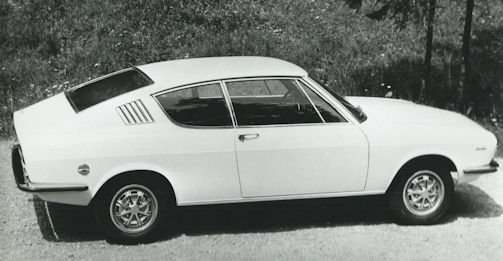
Based on the sedan, the wheelbase was shortened from 2675 to 2560 mm, with no new pressing tools being required to produce the frame floor system. In addition, the rear overhang has been shortened by 127 mm. In order to realize the sporty hatchback coupé, the A-pillar and doors were also redesigned. The rear pillar carried large ventilation slots. The hatchback made the car 67 mm flatter than the sedan. The passenger compartment has been reinforced with a reinforced bulkhead area, stiff side members as outer rocker panels and a cross member in the rear area. The front received new split round headlights, a solution that was introduced for the first time in the coupe and was only offered as an option in the sedan the following year. The tire dimension grew from 165 to 185 mm in cross-section, but still with 14-inch diameter rims. In addition, the front disc brakes were now ventilated and had four-piston callipers.
The Coupé S was given the 1.8-liter engine with a displacement of 1.9 Liters. The increase in displacement resulted in an increase in output to 115 hp at the same speed. Initially, a 100 hp variant was also to be included in the coupé range, but ultimately the larger engine was the only choice.
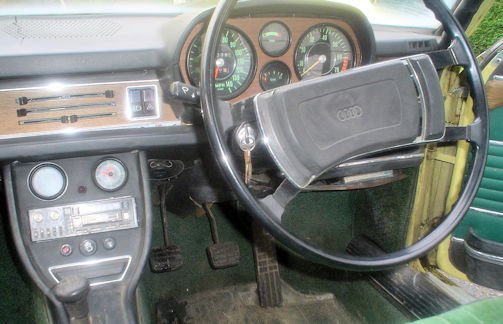
The interior of the Audi 100 Coupé S looked neater than that of the sedan. It contained, among other things, a partially upholstered wooden dashboard, seats with headrests and a 4-spoke sports steering wheel, which - exclusive to this series - was also slightly height-adjustable (the vertical deflection of the adjustment was 4 centimetres).
The first further development of the Audi 100 Coupé S came a year after its market launch in October 1971, when the car was also available with an optional 3-speed automatic transmission. At the same time, instead of two carburettors, the 1.9-liter engine received only one, so the power, albeit slightly, dropped to 112 hp. These changes, and all that followed, paralleled those experienced by the Audi 100 sedan, including modifications to the 1973 body to meet US crash test regulations, complemented by careful restyling both in the same and in the following year, as well as updates to the chassis and braking system.
In 1976 there was a test vehicle fleet for purely electric vehicles called EEP (Audi with RWE and Varta). "The 100 (C1) battery-powered electric experimental car was then manufactured to test different accumulators, which could be recharged via a "coupling device" (socket) near the front (US) bumper." In the summer of 1976, the last Audi 100 Coupé S rolled off the assembly line in Neckarsulm.
In South Africa, where the 100 was also built, the 100 was available as an L, LS, GL and S coupe. Local production began towards the end of 1972; 33,000 units were built in South Africa by October 1976. The GL received a vinyl roof and the lettering GL on the C-pillar. The coupé was no longer produced. The LS and GLS were special versions of the L and GL, with silver paint, automatic transmission and special red interior. The L and LS have a 75 kW (102 PS; 101 PS) DIN 1760 cc engine, while the GL and GLS have the larger 84 kW (114 PS; 113 PS) 1871 cc engine.
In the United States, the Audi 100 appeared in 1970 as the LS with a 1.8-liter SAE engine with 115 hp (86 kW) and a choice of two or four doors. For 1972 the engine was enlarged to 1.9 litres but SAE net power dropped to 91 hp (68 kW). There was a base and a GL model, as well as an automatic transmission. For 1974 the model line was again limited to the 100 LS, but with the larger safety bumpers. For 1975, power was increased to 95 hp (71 kW) by switching to fuel injection. Standard equipment was improved while prices went up. Until about May 1977, the Audi 100 was still produced exclusively for the USA parallel to the successor. In August 1977, the new Audi 5000 the 100, although 537 vehicles were still sold in 1978. The coupe was not available in the United States.
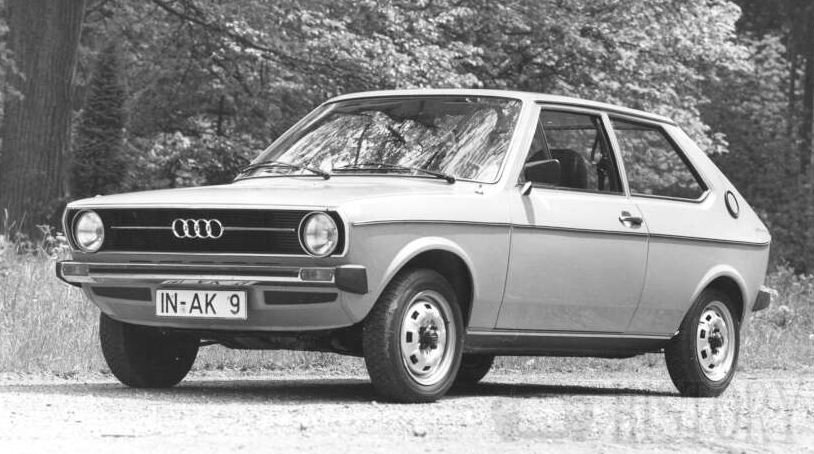
Audi 50
 |
|
|
Production period: |
1974-1978 |
|
Class : |
Motor Car |
|
Body versions : |
hatchback |
|
Engines: |
1.1–1.3 liters (37–44 kW) |
|
Length: |
3512mm |
|
Width: |
1560mm |
|
Height: |
1344mm |
|
wheelbase : |
2335mm |
|
curb weight : |
685-700kg |
The Audi 50 is a small car with front-wheel drive . The Audi NSU Auto Union AG vehicle (internal: Type 86) was manufactured from the summer of 1974 to mid-1978 and sold only in Europe.
History
It was largely identical in construction to the less well-equipped VW Polo I , which was built from 1975 to 1981. Both models were produced on the same line at the Volkswagen plant in Wolfsburg by Audi NSU Auto Union AG at the former NSU factory in Germany and at the giant Wolfsburg plant by Volkswagen.
The Audi 50 took only 21 months from the draft to the first production vehicle. On October 26, 1974, the Audi 50 was presented to dealers.The car was offered as a three-door hatchback with a 1,093 cc (66.7 cu in) petrol engine, producing either 37 kW (50 PS; 50 bhp) or 44 kW (60 PS; 59 bhp) for the LS and GL models, respectively.
The car with a displacement of 1093 cc was available as the Audi 50 LS with 37 kW (50 hp) and was designed for regular gasoline . With better equipment it was called the Audi 50 GL , had 44 kW (60 hp) and the higher-compression engine needed premium petrol.
- PERFORMANCE:1,092 cc
- max power (DIN): 50 hp (36.8 kW) at 5.800 rpm
- max torque (SAE): 56 1b ft. 7.7 kg m (75.5 Nm) at 3,500 rpm
- max engine rpm: 5,800
- power-weight ratio: 30.2 lb/hp (41 'lb/kW), 13.7 kg/hp (18-6 kg/kW)
- acceleration: 0-50 mph (0-80 km/h) 9.6 sec
- consumption: 37.2 m/imp gal, 30.9 m/US gal, 7.6 1 x 100 km.
In August 1976, the Audi 50 GLS replaced the previous GL. The LS could now also be ordered with the more powerful 60 hp engine.
- PERFORMANCE: 50 GLS
- ENGINE compression ratio: 9.5:1
- max power (DIN): 60 hp (442 kW) at 6,000 rpm
- max torque .(DIN): 62 1b ft
- max engine rpm: 6,000
- power-weight ratio: 25.2 lb/hp '(34.2 lb/kW), 11.4 kg/hp (153 kg/kW).
From August 1977, an engine with a displacement of 1.3 liters (1272 cc) was installed in the more powerful variant with 44 kW.
With simple equipment and a smaller engine, the VW Polo came onto the market in the spring of 1975 as an economy version of the Audi 50. Its engine produced 29 kW (40 hp) from a displacement of 900 cm³, the stroke had been reduced from 72 to 59 mm. Instead of an automatic starter on the carburetor , as in the Audi, there was a manually operated choke . As standard, the Polo only had drum brakes , also on the front axle, and cross-ply tires .
More powerful engines and better equipment were not offered for the Polo until the following year. At the beginning of 1977, the Polo, which was still in production, was joined by the Derby notchback variant , which was also developed by Audi in Ingolstadt .For strategic marketing reasons, the VW Group removed the Audi 50 from its model range in July 1978 after only four years and 180,828 units had been produced. metallic paint and sunshine roof as options.
Production numbers
180,822 of the Audi 50 were produced:
|
Year |
1974 |
1975 |
1976 |
1977 |
1978 |
|
number |
22,146 |
84,343 |
53,536 |
15,584 |
5.213 |
Audi S2
 |
|
|
Production period: |
1990 to 1995 |
|
Class : |
Sport car |
|
Body versions: |
Saloon , station wagon ,coupe |
|
Engines: |
Gasoline : 2.2 liters (162-169 kW) |
|
Length: |
4401-4510 mm |
|
Width: |
1695-1716 mm |
|
Height: |
1375-1385 mm |
|
Wheelbase : |
2548-2597 mm |
|
Curb weight : |
1420-1560 kg |
The Audi S2 is a vehicle made by Audi .This was built between the fall of 1990 and the end of 1995 as a sedan , avant and coupe in a total of 9488 copies.
History
The Audi quattro's official replacement is the S2 Coupé. The name was inspired by the Audi Sport quattro S1 / E2 rally car. The S2 comes with quattro permanent four-wheel drive as standard. The Coupé S2 was created in partnership with Konrad Schmidt Motorsport GmbH, with whom they also competed in the German Touring Car Championship in 1990 with the Audi V8 quattro DTM, and hit the market in September 1990 for 72,450 DM. It's based on the Audi Coupé B3 and is the series' flagship model. As a result, the B3 coupe's image should improve, as it has sold substantially less than its predecessor, the Audi Coupe B2. The production of the Audi Coupé S2 was discontinued in December 1995 after 7370 produced vehicles.
The body of the Coupé S2 is largely based on the coupe B3. The front end was redesigned with a hood with integrated grille, which debuted similarly in the Audi V8 . Thus took the S2 coupe already 1990 the optics for the new Audi 80 B4 , which came 1991 to the market, ahead. sedan and Avant are visually based on their standard versions of the Audi 80 B4. All S2 versions received a front bumper with integrated front spoiler and a slightly revised rear bumper. The S2 emblems on the front grille and the rear of the vehicle also reveal the S2.
The standard equipment includes, among others, the Procon-ten safety system as well as ABS , a headlight cleaning system, a central locking system and electric windows. Inside are sports seats and a three-spoke sports steering wheel with incorporated S2 emblem installed. In addition, three additional instruments can be found in the center console on which oil temperature, oil pressure and the vehicle electrical system voltage can be read. These instruments were deposited on the Audi S2 in light gray.
The Audi Avant S2 came in February 1993 on the market. It followed in July 1993, the sedan, which was sold under the name Audi S2. Both are based on the Audi 80 B4 . The Avant S2 was built from 1993 to 1995 a total of 1812 made. In 1993 and 1994, only 306 sedan saloons left the factory. In 1995, the sedan was no longer built. The production of the Avant S2 ended together with that of the Audi 80 B4 in 1995.
Engine
The engine of the Coupé S2 ( MKB : 3B) is derived from the engine of the last-built Audi quattro 20V (MKB: RR) and was also installed in the Audi 200 quattro 20V. He initially provides 162 kW (220 hp). Due to the space of the B3 coupe body, however, the engine peripherals had to be adjusted. Thus, the intake and exhaust tracts were redeveloped and the air duct of the oil cooler was changed. The vehicle is equipped with two lambda-sensor- controlled catalytic converters and thus complies with the Euro 1 emission standard . Furthermore, the fully electronic engine management adapts independently to the operating conditions throughout the entire engine running time.
In 1992, the coupe S2 was a facelift. So now the engine (MKB: ABY) (derived from the AAN engine from the Audi S4) was used. This produces 169 kW (230 hp) and has a torque of 350 Nm. For a short time, an overboost function produces a torque of 380 Nm. In addition, the ignition system (single ignition) and the boost pressure control differ from the previously used engine. The five-speed manual has been replaced by a six-speed manual transmission, in which the last gear, however, is no longer translated, than that of the five-speed derivative. This engine use since its launch in 1993, Avant and sedan.
The ABY engine is a revised version of the 3B engine. The hull engine has generally stayed the same. In addition to the lack of overboost of the ABY has the 3B a mechanical ignition distributor (ABY: single ignition) and the underbody was adapted for the catalysts, which the driver's seat had to be changed.
Audi A4 DTM
 |
|
|
Production period: |
2004-2011 |
|
Class : |
race car |
|
racing series |
DTM |
|
Body versions : |
Saloon |
|
Engines: |
Gasoline: 4.0 liters (about 340 kW) |
|
Length: |
4800 mm |
|
Width: |
1750 mm |
|
Height: |
1250 mm |
|
Wheelbase : |
2750 mm |
|
Curb weight : |
1050 kg |
Audi A4 DTM is the name of prototype racing car of the German car manufacturer Audi , which was designed for exclusive use in the DTM .
History
The A4 DTM was manufactured in six stages of development, bearing the internal production names R11 , R12 , R12 plus , R13 , R14 and R14 plus . The A4 DTM replaced the Abt-Audi TT-R , which was used between 2000 and 2003 in the series. From 2004 to 2011 , the A4 DTM competed against the DTM AMG Mercedes C-Class and in the first two years against the Opel Vectra GTS V8 .
After the Abt team had used a privately-developed Abt-Audi TT-R in the years 2000 to 2003 and won the title in the 2002 DTM season with Laurent Aïello , 2004 saw Audi return to the DTM as a factory team. The successful debut in the series ended with all titles (driver, team, manufacturer rating) of the championship.
As with all racing cars of the DTM, the shape of the body of the A4 DTM is reminiscent of a production vehicle, here on the Audi A4 . Is the prototype constructed with a monocoque - chassis of carbon fiber reinforced plastic with integrated 70-liter fuel tank. Since the refueling at this time still in the race was compulsory, not as from 2012, a 120-liter tank was installed. The A4 DTM is powered by a 4-liter uncharged V8 engine with an air restrictor of around 340 kW (≈ 460 hp) and a maximum torque of more than 500 Nm. The power is delivered via a multi-plate clutch with three carbon fiber reinforced discs to the sequential six-speed sports transmission, which is combined with the adjustable disc locking differential on the rear axle in a housing. All wheels are individually hung on double wishbones , the internal spring-damper units are operated by push rods and rocker arms. The tires were supplied by the former DTM standard supplier Dunlop and had the dimensions front: 265/660-R18, rear: 280/660-R18.



