
Autobianchi
- Details
- Parent Category: A
- Category: Autobianchi
- Hits: 59
Bianchi (IVF Fabbrica Italiana Velocipedi Edoardo Bianchi)
Automotive manufacturer Milan Italy 1885

Bianchi known as Fabbrica Italiana Velocipedi Edoardo Bianchi once also a major Italian automobile and motorcycle manufacturer, founded in Milan in 1885 by Edoardo Bianchi later as AutoBianchi.
History
Bianchi was first born as a small workshop for the construction and repair of earl velocipedes cycles, the company's activity expanded, from 1899, to the motorized vehicle sectors, initially through the production of motorcycles and subsequently of cars, under the corporate name of Fabbrica Automobile e Velocipedi Edoardo Bianchi.

Edoardo Bianchi is said to have made a motor quadricycle as early as 1889, and his first true car followed in 1899.This was a voiturette with a single cylinder of French De Dion origin, a tubular frame dating from Bianchi's interest in the bicycles which he had built since 1885, coil ignition and shaft drive. This little car made small impression even in Italy, but the same could not be said for the Giuseppe Merosi-designed Bianchi’s that followed in 1904. From then until 1909 they were big, well made, conventional machines with four pair-cast cylinders, side valves in a T head, low-tension magneto ignition, steel frames, honeycomb radiators, four forward speeds, and double-chain drive—in other words, they followed the Mercedes pattern closely.
By 1901 Edoardo Bianchi concentrated a good part of his time in the design of an elegant small car, the Bianchi 8 HP and by in 1903 Bianchi began the manufacture of a series of exclusive cars, reserved for a wealthy clientele, handcrafted and with quality materials and finishes, among the first luxury cars in the world to populate city streets, until then travelled only by horse- drawn carriages, wagons, and steam powered trams. Soon after Guiseppe Merosi joined Bianchi as engineer to develop the motorcar side of the business. In 1902, Bianchi moved into a new factory in the via Ninio Bixio, and the first Bianchi with a four-cylinder engine appeared in 1904, Most of Bianchi's output consisted of touring cars, though in 1907 a J20 hp racing car with a
oversquare 7992 cc four-cylinder engine with overhead valves competed without any major success in the Coppa Florio and Kaiserpreis. A 6424-cc derivative ran in the Targa Bologna in 1908; the Bianchi competition drivers were Carlo Maserati (eldest of the six fratel/I Maserati) and Edoardo Bianchi's right-hand man, Gian Fernando Tomaselli.
Driven by the constant growth of its activities, the company rapidly implemented important investments also in the industrial field, adding a new factory in Viale Abruzzi to the first factory in via Bixio in Milan, and in 1906 a production site in Brescia, intended solely for the construction of trucks; but given the reduced sales margins in this first phase of his experience in the field of industrial vehicles, the same was closed in 1908. However, in the following years Bianchi received numerous awards, nationally and internationally, such as the " Gran Prix" at an event held in Buenos Aires as well as the "diploma" from the Ministry of Industry at the Turin International Exhibition (1911) the year in which he was also present at the London Exhibition.
Shaft drive began to replace chain in 1909 (the year in which Merosijoined the new ALFA company), though the massive 70/ 80 hp of 1911, with an overhead cam 9557 cc engine, was still chain-driven. Prior to this Bianchi had built huge side-valve fours of 11,305 cc and 10,598 cc; their smallest pre-Great War machine was an 8/12 hp four of just 1244 cc.

By 1914 the company also still produced bicycles, and motorcycles and also the time active in the field of aircraft engine manufacturing. From the outset, Bianchi dedicated itself to cycle racing, then car racing and, from the 1920s, to motorcycling. The 4390 cc Tipo C of 1912—15 with a sporting 'Prince Henry' variant catalogued in 1913.The 1920s saw the continuation of production of cars a popular overhead-valve 1287 cc four-cylinder was current in 1925-7. A 2731 cc straight-eight, the V3, was built from 1928—9, with a derivative, the 2905 cc S8, current from 1930—34. The ultimate Bianchi, the S9, was a 1452 cc four, offered with streamlined "Viareggio" saloon coachwork.
Car production having been interrupted in conjunction with the outbreak of the Second World War (the last model in the price list was the famous Bianchi S9), the company intensified its work processes in the mechanical sectors, Officine Metallurgiche Edoardo Bianchi, which became particularly important in the Desio factory, inaugurated in 1937. Also expanding the activities in the field of trucks and vehicles for military use, developing the Miles among many examples, in addition to the Supermil 500 three-wheeler and the VM 6C special vehicle and for the Royal Italian Army. Continuing the supply of bus chassis to some companies in the sector, until the bombings undermined the production processes in the factories, above all in the production centre in viale Abruzzi, which turned out to be the hardest hit. Attempts to revive Bianchi production with new designs after World War II failed, partly because of the great demand for bicycles and motorcycles, partly through the high cost of developing new cars.
After the war, despite the economic and managerial difficulties that arose following the death of the founder Edoardo, Bianchi managed to recover, contributing to the reconstruction and motorization of Italy with the Bianchi na, a 125 cm³ light motorcycle and the Aquilotto , a moped whose loose engine was also available for sale to be applied to bicycles. Trying to venture into the marketing of small goods transport vehicles, with the Supermil 49 three-wheeler model, presented in 1948 and equipped with a brand new 500 cm³ and 18 HP power unit. Although linked to a niche production and relatively limited to the construction of trucks (including the models: Audax , CM 54 , Fiumaro and Visconteo ), in the mid- fifties became an independent company partly controlled by the company and after an initial union of forces with Pirelli and Fiat , which gave birth to Autobianchi in 1955 , allowing the company to return to the car sector, was totally sold to the other two partners together with the Desio plant in 1958 .However, the marque was revived in 1955 with Fiat and Pirelli backing, as Autobianch.
In 1958 Bianchi, transformed to all intents and purposes into a financial group made up of various companies, ceased operations in the historic headquarters in viale Abruzzi, selling the ownership of the area to a real estate company, which built a residential complex instead of the factory buildings.
The assembly lines of the cycling and motorcycle branches are transferred with those of the Edoardo Bianchi Metallurgical Workshops to an industrial portion of the former Caproni Air Force in via Fantoli, a Milanese district on the outskirts of Taliedo .Shortly thereafter, the profound crisis in the motorcycle sector of the 1960s caused Bianchi to enter a serious financial crisis, which at the end of 1964 led to the company's declaration of liquidation; sanctioning, at the same time, the conclusion of each corporate division born from the spin-off of Officine Metallurgiche Edoardo Bianchi.
Today it is part of the Swedish group Cycleurope AB and mass production no longer takes place in Italy, where part of the design and assembly of high-end models has been maintained.
- Details
- Parent Category: A
- Category: Autobianchi
- Hits: 27
Autobianchi Stella
 |
|
|
Class |
Sports car |
|
Body style |
Spider 2-door cabrio |
|
Layout |
RR layout |
|
Engine |
767 cc ,791cc I4 OHV |
|
Transmission |
4-speed manual |
|
Wheelbase |
78.74 in, 2,000 mm |
|
Length |
144.49 in, 3,670 mm |
|
Width |
56.30 in, 1,430 mm |
|
Height |
48.82 in, 1,240 mm |
|
Dry weight |
1,323 1b, 600 kg |
The Autobianchi Stellina is a rear-wheel-drive spider type sports car produced by Autobianchi from 1963 to 1965.
History
The Stellina was the first production Italian car built in fiberglass from the Italian automaker, Autobianchi (a subsidiary of the Fiat group). Its most obvious advantages were its resistance to rust and its light weight and ease of construction. Built for only two years, 1964 and 1965. It was based on the mechanicals of the chassis Fiat 600D, but had a unique unibody structure.
With sleek styling penned by Luigi Rapi, the Stellina was first presented as a prototype at the 1963 Turin Motor Show, and went on sale a year later with a price tag of almost a million lira.
The chassis frame was of boxed type in steel, with the fiberglass applied to the various guides. The first defect was, paradoxically, the difficulty in repairing the car, given the presence of a not very organized repair network. Many advised against the purchase of a car that had a great value, from a stylistic and also mechanical point of view, given that it explored a new philosophy in the automotive field. However, production was soon standardized as in all spiders of the time: canvas roof (the Hardtop was not present; although some prototypes were actually put on the market) with plastic rear window, glossy colours contrasting with the interior, interiors treated in imitation leather, brown or black (only available on red; other colours were not available even on request). Among the few options a radio, white wall tires, luggage rack in chrome Abarth muffler, Borrani spoked wheels.

The first series was produced with only 343 built with the 767-cc engine.
After two years, given the drop in sales, it was thought that the lack of success was due to the low power for a sports type car, Autobianchi tried to adapt the Stellina, presenting what would unofficially be the second series, as it would not have supplanted the production of the 750, and around 200 examples were produced as the Stellina 800. As the name suggests, the modification consisted in the elaboration of the engine, with a slight increase in the displacement to 792 cm³. However, the 800 cm³ increased the car's power to just 31.5 hp.
PERFORMANCE: Stellina 767cc
- max power (SAE): 32 hp at 4,800 rpm
- max torque (SAE): 40 1b ft, 5.5 kg m at 2,800 rpm
- max number of engine rpm: 4,800
- Specific power: 41.7 hp/l
- Engine capacity: 46.80 cu in, 767 cu cm
- Fuel consumption: 46.3 m/imp gal, 38.6 m/US gal, 6.1 1 x 100 km
- Max speed: 71.4 mph, 115 km/h
- Power-weight ratio: 41.2 lb/hp, 18.7 kg/hp
- Acceleration (max load): 0—50 mph (0 —80 km/h) 22 sec
Despite the later engine changes, the Stellina and Stellina 800 were identical. The engine mainly gained power at low-medium revs, increasing the maximum speed, given the lightness of the bodywork, by 10 km/h (125). However, in the same period the Stellina 800 was introduced, with the frame branded 100DB/1 to avoid confusion.
PERFORMANCE: Stellina 800 791cc
- Engine capacity: 48.31 cu in, 791.76 cu cm
- Fuel consumption: 42.8 m/imp gal, 35.6 m/US gal, 6.6 1 x 100 km
- Max speed: 77.6 mph, 125 km/h
- Max power (SAE): 34 hp at 5,000 rpm
- Max torque (SAE): 40 1b ft, 5.5 kg m at 2,800 rpm
- Max number of engine rpm: 5,000
- Specific power: 42.9 hp/l
- Power-weight ratio: 42.8 lb/hp, 19.4 kg/hp
- Acceleration (max load): 0—50 mph (0 —80 km/h) 19 sec
Production
Only 502 examples of the "Stellina" were produced in the two versions, of which 350 were registered in Italy and the rest were exported until production ceased in 1965, when Fiat launched a, slightly larger, similar Fiat 850 Spider.

- Details
- Parent Category: A
- Category: Autobianchi
- Hits: 20
Autobianchi Bianchina Giardiniera
 |
|
|
Class |
Motor Car |
|
Body style |
station wagon and van |
|
Layout |
RR layout |
|
wheel base |
76.38 in. 1.940 mm |
|
Engine |
499 cc ohv straight-2 17.5 hp |
|
Length |
125.39 in, 3,185 mm |
|
Width |
51.97 ln. 1.320 mm |
|
Height |
53.31 in, 1.354 mm |
|
Dry weight |
1,180 1b, 535 kg |
The Autobianchi Giardiniera was a small car from the Italian automaker Autobianchi in the 1960s and 1970s
History
The Autobianchi Giardiniera is a small supermini type car produced by the Italian automaker Autobianchi, based on the Fiat 500 Giardiniera. It was available in various configurations: station wagon and van. Car was produced from 1970 to 1977. It was also marketed as the Autobianchi Bianchina Giardiniera. The assembly was transferred to the Desio house in the last months of 1967.
The Autobianchi brand at the beginning of 1968, three years after the launch of the Fiat 500 series F. In addition to the specifications of the F, excluding the modifications to the doors the Giardiniera adopted black air intake grilles and the exterior rear view mirror. The rear side windows, changed from sliding, two pieces, became openable one piece. In addition to the doors, a special feature of the Giardiniera was the rear hatch, which also included a portion of the roof, hinged on the left side. Both of these will be used until the end of production.
The Giardiniera was initially produced together with the Bianchina Panoramic. Alongside the commercial van variant with large load compartment by 1975 the sedan ceases to be produced, but the Giardiniera still continues as a utility until 1977.
PERFORMANCE: Autobianchi Giardiniera
- max power (DIN): 17.5 hp at 4.600 rpm
- max torque (DIN) t 22 1b ft. 3 kg m at 3.200 rpm
- specific power: 35.1 hp./l
- power-weight ratio: 67.5 lb/hp, 30.6 kg/hp
- acceleration: standing 1/4 mile 30.8 sec, 0-50 mph (0-80 km/h) 40 sec
- speed in top at 1,000 rpm: 12.9 mph, 20.7 km/h
- fuel consumption: 54.3 m/ imp gal, 45.2 m/ US gal, 5.2 1 x 100 km.

- Details
- Parent Category: A
- Category: Autobianchi
- Hits: 51
Autobianchi Bianchina
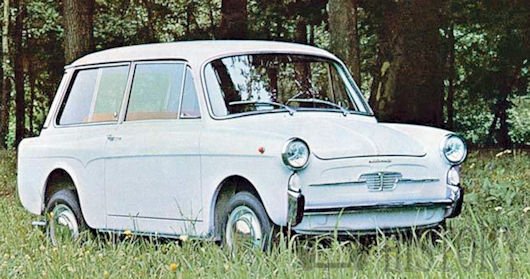 |
|
|
Class |
Motor car |
|
Body style |
Berlina (saloon) |
|
Layout |
RR layout |
|
Engine |
|
|
Transmission |
4-speed manual |
|
Wheelbase |
1,840 mm (72 in) (All) |
|
Length |
3,020 mm (119 in) (Berlina, Cabriolet) |
|
Width |
1,340 mm (53 in) (All) |
|
Height |
1,320 mm (52 in) (All) |
|
Curb weight |
530 kg (1,170 lb) (Berlina) |
The Autobianchi Bianchina is a small car produced by the Italian automaker Autobianchi, based on the Fiat 500.
History
It was available in various configurations: Berlina (saloon), Cabriolet (roadster), Trasformabile (convertible), Panoramica (station wagon), and Furgoncino (van).
The car was presented to the public on 16 September 1957 at the Museum of Science and Technology in Milan.
Initially it was proposed in the only 3-box bodywork, defined as " Transformable ", equipped with rear fins, abundant chrome and a canvas sunroof. Given the good success, Autobianchi decided to expand the range and improve its characteristics. In 1959 the engine power increased to 17 hp, while in 1960 the convertible and Panoramica versions were launched.
The first was a real open car with a canvas top (the Trasformabile had a simple but large canvas sunroof and fixed side pillars) was also made available in the Special version with two-tone paintwork and an engine boosted to 21 HP. (499 cm³ and 21 HP compared to 479.5 cm³ and 17 HP); compared to the Trasformabile, the hinging of the doors brought to the front also changed, while the second is a station wagon with a 499 cm³ (22 HP) sole engine and extended wheelbase, derived from the New 500 Giardiniera from Fiat.
Initially, the car was equipped with the smallest Fiat engine, air-cooled 479 cc producing 15 PS (11 kW). In 1959, the engine power was increased to 17 PS (13 kW) and in 1960, the cabriolet version was launched.

In the same year, the Trasformabile, whose engine cylinder capacity was increased to 499 cc (18 hp), was made available in a Special version with bi color paint and an engine enhanced to 21 PS (15 kW). Transformabile featured fixed B-pillar and partial roof, as the rest of the opening was covered with foldable fabric hood. Cabriolet version had no B-pillar. Also, this was the only version to feature suicide doors.
In 1962 the Trasformabile was replaced by the sedan version with a closed roof and 4 seats. The engine and chassis (short wheelbase) were the same as the Transformable. Unlike the other versions in the price list (Panoramica and Cabriolet), the 4-seater could be chosen in the basic version (with 18 HP engine) or Special. The latter, better finished and equipped, was recognizable by the two-tone paintwork (with the roof in a contrasting color), the chromed door window frames and the 21 HP engine. In the same year, all versions adopted a platform with the passenger foot area, to improve space
In 1965, a minor facelift was made. In France, the models were sold under different names: the Berlina became the Lutèce, the Familiare the Texane, and the Trasformabile was marketed as the Eden Roc., in addition to a very slight restyling (front frieze, redesigned dashboard with faux wood insert and some other revised interior details), which involved all versions, the 4-seater and Cabriolet variants adopted the F -type engine, optimized in various components.
In 1969 the Bianchina went out of production, replaced by the " Giardiniera”. At the same time as the production activity of the Bianchina Panoramica, Fiat, shortly before becoming the full owner of the Desio company, transferred the production of the Fiat 500 Giardiniera to Autobianchi in 1966. The Giardiniera, later sold under the name of " Autobianchi Giardiniera " was produced in Desio until 1977. Despite the adoption of the "Autobianchi" brand, it was substantially identical to the original Fiat model from which it derived.
PERFORMANCE: Late Models
PERFORMANCE: 499cc
engine capacity: 30.48 cu in. 499.50 cu em
fuel consumption: 54.3 m/imp gal, 45.2 m/US gal, S.2 1 x 100 km
max speed: 60.9 mph. 98 km/h
max power (SAE): 22 hp at 4,600 rpm
max torque (SAE): 25 1b ft, 3.5 kg m at rpm
max engine rpm: 4.600
specific power: 44 hp/l
power-weight ratio: 53.1 lb/hp, 24.1 kg/hp
Bianchina Special Berlina
max power (SAE) 25 hp at 4,600 rpm
max torque (SAE) 27 1b ft, 3.7 kg m at 3,500 rpm
power-weight ratio 47.2 lb/hp, 21.4 kg/hp
acceleration (max load) O—50 mph (O—80 km/h) 23 sec, 92 oct
fuel consumption 49.5 m/imp gal, 41.3 m/US gal, 5.7 1 x 100 km
max engine rpm 5,100
specific power,50 hp/l

The variants of the Bianchina
Convertible (Trasformabile): it was the first version to debut in 1957 and the only one to be produced in the early years (i.e., until the arrival of the Panoramica and Cabriolet in 1960). Characterized by the doors hinged behind, the Trasformabile was a small three-volume 2-seater equipped with a large canvas sunroof that also incorporated the rear window (in Plexiglas). Aesthetically, this version was recognizable by the rounded C-pillar and the three chrome strips behind the door. It was produced until 1962.
4 seats Berlina (saloon): it was the last version to be introduced in the range in 1962. The logic of the 4 seats must be seen in the context of the thought of the Italian motorist of the sixties, who considered the family cars (now station wagons) as "work" cars. In the wake of these considerations, Autobianchi, alongside the Panoramica (favored by the long wheelbase), included the 4-seater in the range. Made as a closed version of the Cabriolet (therefore with a short wheelbase), to which a metal roof with rather squared shapes was added (to ensure a certain rear roominess), this version was the most appreciated by the public thanks to the characteristic shape of the rear window, practically vertical, and inserted in a protective "pagodina", which guaranteed a greater habitability than that of the contemporary "500". It was produced until 1969.
Panoramica (station wagon): based on the mechanics of the Fiat 500 Giardiniera, it was undoubtedly the version that required the most technical effort: wheelbase lengthened by 10 cm, sole motor rotated by 90 °. Practical (thanks to the tailgate and the good luggage compartment), habitable and not without a certain elegance, the Panoramica was produced until 1969.
Cabriolet (roadster): it was undoubtedly the more "frivolous" version of the little Autobianchi and, as such, was enriched by a greater number of chrome and shiny profiles. Currently it is the rarest version (about 3150 copies produced) and most sought after by enthusiasts. The mechanics were identical to that of the Transformable and the Sedan. From 1960, in addition to the canvas top, a more protective hard top could be fitted in winter. Production ceased in 1969.
Van (Furgoncino): based on the Panoramica, a van version was created, available in 2 variants: low roof and high roof. These two versions were substantially different from each other: the first retained the body of the Panoramica (with the appropriate modifications, such as the elimination of the rear windows and the rear seats), the second shared only the front part of the body with the original model., while the rear part, "van", had a specific design (a solution that Fiat would have re-proposed in the seventies with the Fiorino).
The complete list of variants produced from 1957 to 1969 is:
- 1st series convertible (1957-59): 479.5 cm³ - 15.0 HP
- 2nd series convertible (1959-60): 479.5 cm³ - 16.5 HP
- 3rd series convertible (1960-62): 499.5 cm³ - 17.5 HP
- 3rd Special series convertible (1960-62): 499 cm³ - 21.0 HP
- Cabriolet D (1960-65): 499.5 cm³ - 21 HP
- Cabriolet F (1965-69): 499.5 cm³ - 21 HP
- Panoramic (1960-69): 499.5 cm³ - 18.7 hp
- Convertible overview (1960-69): 499.5 cm³ - 22.0 hp
- 4 seats D (1962-65): 499.5 cm³ - 17.5 HP
- 4 seats F (1965-69): 499.5 cm³ - 18.0 HP
- 4 seats D Special (1962-64): 499.5 cm³ - 21.0 HP
- 4-seater F Special (1965-69): 499.5 cm³ - 21.0 HP
- Normal roof van (1960-69): 499.5 cm³ - 22.0 hp
- High roof van (1960-69): 499.5 cm³ - 22.0 hp

- Details
- Parent Category: A
- Category: Autobianchi
- Hits: 149
Autobianchi A112 Abarth
| 1971 to 1984 | |
|---|---|
 |
|
| Overview | |
| Manufacturer | Autobianchi |
| Production | 1971–1984 |
| Designer | Marcello Gandini at Bertone |
| Body and chassis | |
| Class | Supermini (B) |
| Body style | 3-door hatchback |
| Powertrain | |
| Engine |
982 cc OHV I4 1050 cc OHV I4 |
| Transmission | 4-speed manual 5-speed manual |
| Dimensions | |
| Wheelbase | 2,038 mm (80.2 in) |
| Length | 3,230 mm (127.2 in) |
| Width | 1,480 mm (58.3 in) |
| Curb weight | 670 kg (1,477 lb) |
The A112 Abarth, introduced in September 1971 at the same time as the Elegant. It was prepared by the motorsports division of the Fiat Group, at first with a 982 cc engine, obtained by increasing the stroke, coupled to a sportive exhaust, a twin carburetor, and a different camshaft. In 1975, displacement was increased to 1,050 cc, while power climbed from 58 HP to 70 HP at 6600 rpm, for a weight of only 700 kg (1,540 lb).
The two engines were offered in parallel until production of the smaller unit ended in late 1976. The 1975 model was also the first A112 to use a 5-speed manual gearbox. These changes turned the A112 into a nervous machine, much admired by young performance enthusiasts.
PERFORMANCE: A112 Abarth 1,050 cc
- max speed: over 96 mph, 155 km/h
- max power (DIN): 70 hp (51 kW) at 6,600 rpm
- max torque (DIN): 64 1b ft. 8.8 kg m (87 Nm) at 4,200 rpm
- max engine rpm: 7,000; 66,7 hp/l (49.1 kW/l)
- power-weight ratio: 22.1 lb/hp (30 lb/kW), 10 kg/hp (13.6 kg/kW);
- acceleration: standing /4 mile 18.6 sec
- speed in top at 1,000 rpm: 16.8 mph, 27 km/h
- consumption: 36,7 m/imp gal, 30,5 m/US gal, 7.7 100 km at 75 mph, 120 km/h

The car was entered in various rallying events throughout Europe and even spawned a one-make trophy: the Campionato A112 Abarth spanned eight editions, from 1977 to 1984, and adopted contemporary Group 1 rules, which meant nearly-stock cars. Some famous Italian rally drivers, including Attilio Bettega, Fabrizio Tabaton and Gianfranco Cunico, were among the winners of the championship. The increasing popularity of the A112 in historic rallies and hillclimbs led to the reintroduction of a one-make trophy, called Trofeo A112 Abarth, in 2010. Abarths have often led hard lives, having been preferred by young owners with aggressive driving styles. Formula One driver Olivier Panis is one of many to have crashed an A112 Abarth.
Developments
First series: October 1969 - March 1973
In September 1971 . A performance edition "Abarth" was introduced
Second series: March 1973 - early 1975
In March 1973 the A112 received a makeover. The grille was new, with a larger mesh, and the bumpers were now of rubber with chrome insert The Abarth received a new chess pattern upholstery.
Third series: early 1975 - November 1977
In 1975 the third series arrived. redesigned taillights - with integrated reversing lights on the Elegant and Abarth. The Abarth also received a new larger 1050 cc engine ("70HP"), . All engines were still pushrod units, derived from the old tipo 100 engine first introduced in the Fiat 600. In 1976. This was the last model to have the diamond shaped turn signals on the front fenders, with later models receiving more orthodox rectangular ones.
Rayton Fissore showed (and then sold) a special-bodied version of the A112 called "Otas" in 1976, with aerodynamically styled bodywork reminiscent of that of the Porsche 928.
Fourth series: November 1977 - 1979
In November 1977 The most obvious difference is a slightly taller roof, with a marked edge around the sides. This improved interior habitability considerably.
Fifth series: 1979 - 1982
In July 1979 the car underwent another styling modification, receiving large black plastic cladding on the rear, surrounding new taillights, and new side trim and bumpers. The grille was also new, and there was black plastic wheelarches to link all of the plastic parts together. The extractor vents behind the rear side windows were also larger, of black plastic, and wrapped around the pillar. The Abarth also received the new five-speed gearbox, as well as new alloy wheels and foglights as standard. The fifth gear was an overgear, while the ratios of the four lower speeds and the final gearing remained unchanged. The front turn signals were moved from the front of the fenders to a spot just in front of the leading edge of the doors, while a small badge denoting the trim level appeared in the turn signal's old place
Sixth series: 1982 - 1984
A lot of the plastic excesses of the fifth series were reversed for the sixth series, which was introduced in the autumn of 1982. New smoother bumpers, removal of the wheelarch trim, and a less heavy grille treatment brought back some of the original elegance of the A112, while the interior was also completely renovated. The sixth series also received new body-colored vents on the C-pillar, and the front corner lights were incorporated into the top of the bumper.

Seventh series: 1984 - 1985
The seventh series, presented in 1984, only saw minor changes, largely remaining the same as the sixth. The taillights were again redesigned and were now joined by a reflective strip. The rear license plate was relocated to the bumper and the dashboard received modifications, more noticeable in the better equipped. The Abarth received standard front foglights, which were optional on the other versions. The Abarth also has red seatbelts, and the Abarth received alloys,The front corner lights were now white, instead of orange as before. (standard) heated rear window, rear window wiper-washer, reclining backrest headrests, tinted glass, iodine headlamps and rev counter .


