
Alpine
Alpine A350 F1 car
 |
|
|
Constructor |
Alpine |
|
Category |
Formula 1 |
|
Squad |
Alpine- Gordini |
|
Designed by |
Richard Bouleau |
|
Chassis |
Tubular with polyester body |
|
Motor |
Gordini 3.0 Liter naturally aspirated V8 |
|
Transmission |
Hewland DL200 manual 5-speed |
|
Weight |
540kg |
|
Fuel |
Elf |
|
Tyres |
Michelin |
|
Debut |
French Grand Prix 1968 |
|
Drivers |
Mauro Bianchi |
The Alpine A350 was a Formula 1 race car created jointly by Gordini and Alpine at the request of Renault, produced between 1967 and 1968 and used in the 1968 French Grand Prix.
History
Driven by the French company Elf, Alpine decided to enter Formula 1 by building a single-seater in Dieppe and calling it the A350. Designed by Richard Bouleau and some Michelin engineers, it was equipped with an innovative semi-independent suspension system similar to the modern "push rod" with the front wishbones arranged in a parallelogram which reduced body roll and maintained the trim of the car flat when cornering. It was tested on the tracks of Zolder and Zandvoort by Mauro Bianchi and he himself declared that the car's handling was extraordinary. Powering the A350 was a 3.0-litre Gordini engine with V8 architecture producing around 310bhp.
While the car was about to be fielded for the 1968 French Grand Prix, Renault, which controlled part of Alpine, opposed its participation, judging the V8 engine supplied by Gordini not up to par with the other cars due to a lower power of about 100 HP compared to the contemporary Cosworth DFV used on most of the other single-seaters and that Formula 1 was not part of Renault's competition program plans. The project was therefore abandoned and the only A350 produced was subsequently destroyed.
Alpine A500 F1 car
 |
|
|
Constructor |
Alpine-Renault |
|
Category |
Formula 1 |
|
Designed by |
Andre de Cortanze |
|
Chassis |
tubular steel, part of the monocoque reinforced with duralumin |
|
Motor |
Renault EF1 1.5 V6 Turbo |
|
Transmission |
Hewland FG 400 6-speed manual gearbox |
|
Fuel |
Elf |
|
Tyres |
Michelins |
|
Drivers |
Jean-Pierre Jabouille |
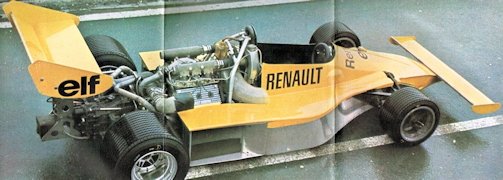
The Renault-Alpine A500, was a Formula 1 single-seater jointly created by Gordini and Alpine at the request of Renault, produced between 1975 and 1976 and used to debut the turbo engine in Formula 1. later this engine was mounted on the Renault RS01.
History
The car was tested on many circuits, including Dijon and Jarama with Jean Pierre Jabouille as test driver. Subsequently, Jean-Pierre Jaussaud and René Arnoux will test the car. André de Cortanze worked on the project, who designed the Alpine chassis, Francois Castaing on the V6 turbo engine and Macel Hubert on aerodynamics.
Due to various problems that the single-seater suffered from, such as the delay of the turbo, the overheating of the engine caused by the same and the precarious road holding, the single-seater remained in the prototype state.
The main feature of the A500 is the engine, which as per the regulations of the time provided for a maximum displacement of 1.5 litres for supercharged engines; the French technicians of Gordini chose the six-cylinder V derived from the F2, which was increased to 1492 cm³ and supercharged with a Garrett turbine. On the dyno it delivered 500 HP at 11,000 rpm and was mounted on a car specially made by Alpine. In addition to the turbo, the car made its debut with Michelin radial tires.
Alpine GT4
 |
|
|
Make |
Alpine-Renault |
|
Class |
Sports Car |
|
Body type |
coupe |
|
Engine |
4 cylinders 1108-1255cc |
|
Production |
from 1962 to 1969 |
|
Produced |
261 |
|
Wheel base |
89.37 in, 2,270 mm |
|
Length |
159.45 in, 4,050 mm |
|
Height |
49.21 in, 1,250 mm |
|
Width |
59.05 in, 1,500 mm |
|
Dry weight |
1,323 1b, 600 kg |
|
Design |
Chappe et Gessalin |
The Alpine GT4 was a sports car produced from 1962 to 1969 by the French car manufacturer Alpine (or Alpine-Renault).
History
The GT4, first appeared in 1962, was a refined version of the A110; it also offered two makeshift rear seats and was destined to inherit the A108 2+2, a model that met with little success. It was a car intended for a clientele that loved low-priced sports cars. It had brilliant performance, was fun to drive yet easy to control. The 2+2 GT4 coupe body is manufactured by Chappe et Gessalin.
Presented at the Paris Salon, it took up the lines of the 2+2 Small, shapely car with lack of frontal air-intake due to rear-mounted engine. Bonnet is flat and slopes gently down to wrap under bumper with raised central portion. Headlamps set beneath transparent fairings and corrected some aesthetic imperfections such as, for example, the design of the tail which was considered not very elegant; the problem was solved by redesigning the entire rear line, making it less heavy and better in tune with the sleek shape of the front.
In practice, the relationships with the A108 resided only in the similarity of the bodywork integral in plastic material: the GT4 was a completely new car since the chassis and mechanics were borrowed directly from the Renault 8 as in the case of the A110 These versions were slightly longer than the original and featured a newly developed central steel backbone beams and backbone type chassis. In fact, the GT4 was also known as the A110 L, where the letter L stood for "long", to underline the 16 cm lengthening of the wheelbase necessary to offer two slightly more comfortable seats than those offered by the A108 2+ 2. The GT4 was in fact the longest Alpine series produced, the first to exceed 4m in length.
The GT4 was initially equipped with the 956 cm³ 4 - cylinder engine coming from the R8. This engine delivered 51 HP at 5100 rpm and pushed the car to a maximum speed of 155 km / h thanks to the lightweight structure and fiberglass body.
In 1964, the GT4 received the 1108 cm³ engine of the R8 Major and boosted to 66 hp. This version was called Version 70 and its maximum power was obtained through the adoption of an oversized carburettors of 2 Solex C 40 PHH horizontal or 2 Weber horizontal twin barrel carburettors. Along with Optional 5-speed mechanical gearbox.

In 1965 there was a new update: with the 100 version, the 1.1 -litre engine of the GT4 was further boosted to 95 HP at 6500 rpm thanks to two twin-barrel carburettors; that is, the engine of the R8 Gordini 1100 was adopted. The GT4 in 1966 received a new 1296 cm³ engine with two double body carburettors, capable of guaranteeing a maximum power of 115 HP at 6800 rpm. In this configuration, the speed was close to 220 km/h. The front suspension was independent, wishbones, coil springs, rubber elements, anti-roll bar, with telescopic dampers at the rear independent, swinging semi-axles, trailing radius arms, coil springs, air rubber elements and telescopic dampers. Brakes of disc type (diameter 10.24 in, 260 mm) and servo.
The last evolution was in 1967; the 1255 cm³ engine was adopted, capable of delivering 105 HP, of the R8 Gordini 1300, with power therefore lower than the previous year's model but delivered in a less brutal way to make driving smoother. Like the A110 and the A108, the GT4 was also produced under license in other countries, for example Mexico.
The GT4 had a long production run but as few were built around 261 units were only sold in total and was discontinued in 1969.
PERFORMANCE: 1,108cc
- Engine capacity: 67.61 cu in, 1,108 cu cm
- Fuel consumption: 28.2 m/imp gal, 23.5 m/US gal, 10 1 x 100 km
- Max speed: 111.8 mph, 180 km/h 5 speed max speed 136.7 mph, 220 km/h
- Max power (SAE): 95 hp at 6,500 rpm
- Max torque (SAE): 72 1b ft. 10 kg m at 6,000 rpm
- Max engine rpm: 6,800
- Specific power: 85.7 hp/l
- Max speeds: 34.2 mph, 55 km/h in 1st gear; 52.8 mph, 85 km/h in 2nd gear; 79.5 mph, 128 km/h in 3rd gear; 111.8 mph, 180 km/h in 4th gear
power-weight ratio: 13.9 lb/hp, 6.3 kg/hp

Alpine A108
 |
|
|
Builder |
Alpine-Renault |
|
Class |
Sports Car |
|
Main type |
Berlinetta |
|
Other versions |
coupe and convertible |
|
Production |
from 1958 to 1964 |
|
Engine |
845 cc ohv water cooled I4 37 hp (28 kW) 904 cc ohv water cooled I4 53 hp (40 kW) 998 cc ohv water cooled I4 |
|
Transmission |
3-speed manual 4-speed manual 5-speed manual |
|
Layout |
RR layout |
|
Produced |
236 (version made in France only) |
|
Length |
from 3,850 to 3,980 mm |
|
Length |
from 1,460 to 1,480 mm |
|
Height |
from 1,130 to 1,220 mm |
|
Wheelbase |
from 2,100 to 2,160 mm |
|
Mass |
from 530 to 600 kg g |
|
Assembly |
Dieppe (F) |
|
Style |
Giovanni Michelotti |
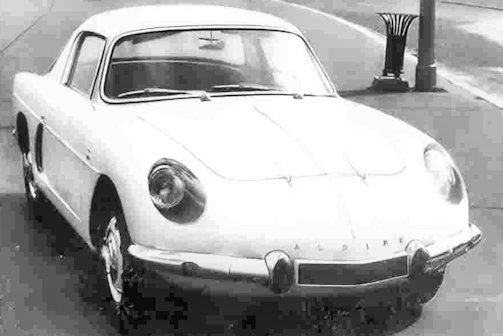
The Alpine A108 is a sports car produced from 1959 to 1965 by the French car manufacturer Alpine.
History
The first two prototypes of the A108 were unveiled in January 1957 in the form of a sedan and a convertible. And it was in this last body configuration that the A108 was initially launched on the market in 1958 at the Paris Motor Show. It was the first of a number of different body variants for the A108. The second version was the A108 Berlinetta, also presented in Paris in 1959 as a direct heir to the A106.
The A108 was the transition model from the already brilliant A106, which it replaced, to the glorious A110. The tubular frame was initially taken from the first, later replaced by a central beam structure, while the general lines of the car body were anticipated from the second, especially by observing the Berlinetta version, low and tapered, with a sloping front end equipped with faired headlights, the rear wheel arches with a flattened design, the shape of the side glass surfaces almost identical and the rear part with a wraparound rear window. However, the rear also shows the main stylistic differences compared to the more famous A110, but also compared to the A106which preceded it. These differences are the conspicuous double "hump" camber on the tail which incorporates the slits for cooling the engine, but also the large full-width grille, used to vent the hot air coming from the engine compartment. Another difference are the rear fins, not excessively showy, but clearly distinguishable. Aside from the pavilion, these same characteristics are also found in the cabriolet version presented the year before and whose body was designed by Giovanni Michelotti starting from the shapes of the A106 Cabriolet. However, there are also obvious differences in some points. This is the case of the rear camber without "humps", or of the rear wheel arch, which in the Berlinetta has a conspicuous recess behind the wheel.
There are some perplexities regarding the naming of the car: in fact, if the A106 was so called because it mounted 4CV -derived engines mainly signed 1063, the A108 which mounted Dauphine -derived engines (and closely related to those of the 4CV) signed 1090 should have been called A109. No one knows the reason for this inconsistency, and after all not even the patron Rédélé himself has ever provided an explanation on the matter. The basic structure of the first A108 was of the tubular type, light and resistant to stress. A body made of fiberglass panels is fixed to this structure. The suspension solutions provided for a front axle with wishbones and a rear axle with oscillating axle shafts, while the braking system is a drum brake on the four wheels.
The engine, saying that it derives from that of the Dauphine: in fact, it is the 845 cm cylinder directly derived from that of the Dauphine Gordini and which in the A108 is only slightly less powerful (38 HP against 40). The change it was a 4-speed manual, but some specimens will also be fitted with 3 or 5 speeds. And in some specimens, the engine also changed: some specimens in fact mounted a 904 cm3 and 54 HP unit, or a 998 cm 3 70 HP unit. These values, combined with the reduced weight, allowed for remarkable performance: the A108 stretch ranged from 145 to 185 km/h depending on the versions and engines.
- PERFORMANCE: 845 cu cm
Engine capacity: 51.68 cu in, 845 cu cm;
Fuel consumption: 35.3 m imp gal, 29.4 m US gal, 8 1 x 100 km;
Max speed: 93.2 mph, 150 km h
max power (SAE): 50 hp at 5000 rpm
max torque (SAE): 41 1b ft,5.7 kgm at 1800 rpm
acceleration standing 1/4 mile 18 sec
max number of engine rpm: 6500
specific power:59.2 hp
max speed in 1st gear: 27.3 mph, 44 km/h; max speed in 2nd gear: 44.1 mph, 71 km/h; max speed in 3rd gear: 66.5 mph, 107 km/h max speed in 4th gear: 93.2 mph, 150 km/h - PERFORMANCE: 904 cu cm
Engine capacity: 55.29 cu in, 904 cu cm;
Fuel consumption: 33.2 m imp gal, 27.8 m US gal, 8.5 1 x 100 km;
Max speed: 96.3 mph, 155 km h
max power (SAE): 55 hp at 5300 rpm
max torque (SAE):43 1b ft, 6 kgm at 5300 rpm
max number of engine rpm: 6500
specific power: 60.8 hp l
power-weight ratio: 24.5 lb/hP'
11.1 kg/hp; useful load: 706 1b, 320 kg
acceleration: standing mile 19 sec
speed in top at 1000 rpm: 15.5 mph, 25 km/h.
max speed in 1st gear: 27.3 mph, 44 km h; max speed in 2nd gear: 44.1 mph, 71 km/h; max speed in 3rd gear: 66.5 mph, 107 km/h; max speed in 4th gear: 96.3 mph, 155 km n
Changes
The first year of production of the A108 saw first the launch of the convertible and then that of the Berlinetta. In 1959 the range was further expanded with the arrival of the A108 2+2, characterized by a totally redesigned car body, the work of the Chappe et Gessalin coachbuilder, more angular, with a higher roof, longer wheelbase and a narrow space for two people small body behind the two front seats. This version, if frontally betrayed the kinship with the A108 Berlinetta, for the rest of the car was strongly influenced in style by the Renault Florida and the Renault Caravelle, especially in the tail, very similar, and in the rear part of the side, furrowed by a groove that recalled the one present in the two Renault convertibles. In 1960 the convertible was slightly redesigned: the most evident update concerned the headlamp housings, now integrated into the fenders. For the occasion, the car was renamed A108 Cabrio Sport, while the so-called A108 Coupé Sport entered the price list, which was nothing more than a convertible equipped with a fixed hard-top. But the updates were not limited to this: the whole range was produced from 1960 onwards, giving up the tubular frame in Favor of a new central beam frame in steel.
In France, the Alpine A108 was produced until 1964, but since the A108 also used the mechanics of the Dauphine, Alpine decided to have it also produced in foreign countries where the Dauphine itself was already produced, i.e., in Spain (at Renault-FASA), in Bulgaria (at the Bulgaralpine), in Mexico and finally also in Brazil. In these countries, Rédélé managed to sell his projects relating to the car and therefore the A108 could also be appreciated by several markets. The Brazilian version was called Willys Interlagos and collected several victories in many Brazilian car races of the time. It was also the most successful A108 from a commercial point of view, since 1,500 units were produced since 1962, the year it was marketed, compared to only 236 units of the French version. The Interlagos was discontinued in 1966, when the French A108 had already been off the list for some years and its heir, the A110, was already beginning to establish itself as the new car to beat.
Willys Interlagos
The A108 was also produced in Brazil, thanks to an agreement with Willys-Overland. Renamed as Willys Interlagos, the model was built in three versions: Berlinetta, coupé, and convertible. The car also had a successful racing career. From 1962 to 1966, a total of 822 Interlagos were made in São Bernardo do Campo, São Paulo.
The history of Interlagos has its roots in the late 1950s, when the Brazilian subsidiary of Willys-Overland made an agreement with the house of Losanga for the local production of the Dauphine. In 1961 the house from Dieppe joined the agreement between the two manufacturers and Willys-Overland acquired the manufacturing license for the A108, which however was marketed in the South American country as Willys Interlagos, from the name of the ' Brazilian circuit of the same name. The production of Interlagos was divided into two fundamental phases: during the first phase, which lasted just a year, the main technical difference between the Interlagos and the A108 was in the fact that the Brazilian model was produced exclusively using the self-supporting chassis of the Dauphine, while the European versions knew a transition from the tubular frame to the central beam one. However, the latter solution was adopted by the Interlagos produced during the second phase, from 1962 onwards. The production of the Interlagos lasted another four years, until 1966. In total, about 300 Interlagos specimens were produced with monocoque chassis and over 860 specimens with central beam chassis. In 2014, the lines of the Interlagos were reinterpreted to give life to the AW380 Berlinetta concept, still with the Willys brand, although the latter has not been active for decades now. The car body of this concept was created by a collaboration between the Maggiora body shop, the Viotti body shop, Fast Design and the designer Emanuele Bombol. The car was equipped with a 3.8-litre twin-turbo 6 -cylinder capable of delivering a maximum power of 610 HP. The AW 380 Berlinetta it also came to production in small series. 110 specimens were produced at a price of 380,000 euros each. The production was entrusted to the Maggiora body shop.
Alpine A310
| 1971 to 1984 | |
|---|---|
 |
|
| Overview | |
| Manufacturer | Alpine |
| Production | 1971–1984 |
| Body and chassis | |
| Class | Sports car |
| Body style | Coupé |
| Layout | RR layout |
| Powertrain | |
| Engine | 1,605 cc A2L/A3L I4 (1600 VE/VF) 1,647 cc A6M I4 (1600 VG) 2,664 cc PRV V6 |
| Transmission | 5-speed manual |
| Dimensions | |
| Wheelbase | 227 cm (89 in) |
| Length | 418 cm (165 in) |
| Width | 164 cm (65 in) |
| Height | 115 cm (45 in) |
| Chronology | |
| Predecessor | Alpine A110 |
| Successor | Renault Alpine GTA/A610 |
The Alpine A310 is a sports car built by French manufacturer Alpine, from 1971 to 1984.
History
Dieppe-based Alpine, once an independent company specialising in faster Renaults, later a Renault subsidiary, established a fine competition history with the Alpine A110 winning the 1973 Monte Carlo Rally and World Rally Championship. The successor was the Alpine A310, initially powered by tuned 17TS/Gordini four-cylinder engine, still rear-mounted. The maximum power reaching 127 PS (93 kW; 125 hp), thanks to the use of 2 twin-barrel 45 DCOE Weber carburetors.
The first model of the A310, built 1971-1976, was a car with a four-cylinder engine and six frontlights. In 1976 the A310 was restyled by Robert Opron and fitted with the more powerful and newly developed 90-degree 2,664 cc V6 PRV engine, as used in some Renaults, Volvos and Peugeots.

1972 Alpine A310 rear view
The basis of the A310 was a hefty tubular steel backbone chassis, clothed in a fiberglass shell. Like the ill-fated De Lorean DMC-12, which used the same PRV powertrain, the engine was mounted longitudinally in the rear, driving forward to the wheels through a manual 5-speed gearbox. With 149 bhp (111 kW) on tap, the A310 PRV V6 was Renault's performance flagship capable of 220 km/h (137 mph) and acceptable acceleration. The tail-heavy weight distribution gave handling characteristics similar to the contemporary Porsche 911. Beginning with model year 1981 (in late 1980), the rear suspension was shared with the mid-engined Renault 5 Turbo. Rather than the previous three-lug wheels, the A310 also received the alloys used for the 5 Turbo, albeit without the painted elements.
OPTIONAL ACCESSORIES tinted glass; leather upholstery; metallic spray.
In the later Models (1983-1984) of the A310 a "GTPack" which was inspired from the Group4 A310 racing cars would be developed, it gained wheel arches, larger spoilers front and rear. A few Alpine A310 V6 GT Pack Kit Boulogne was built (27), the PRV-V6 was bored out to a 2.9 L motor was modified by Alpine, fitted with 3x Weber 42DCNF carburetors that pushed power to 193 hp (144 kW).
Production
| A310 four-cylinder | |
| 1971 | 120 units |
| 1972 | 575 units |
| 1973 | 666 units |
| 1974 | 344 units |
| 1975 | 306 units |
| 1976 | 329 units |
| TOTAL | 2 340 units |
| A310 V6 | |
| 1976 | 140 units |
| 1977 | 1 220 units |
| 1978 | 1 216 units |
| 1979 | 1 381 units |
| 1980 | 1 138 units |
| 1981 | 1 284 units |
| 1982 | 1 095 units |
| 1983 | 1 139 units |
| 1984 | 663 units |
| TOTAL | 9 276 units |
Production models
A310 4-cylinder model variants 1971–1976
Alpine A310 1,647 cc 4 cylinders PERFORMANCE
max power (DIN): 95 hp (69.9 kW) at 6,000 rpm:
max torque (DIN): 94 1b ft. 13 kg m (127.5 Nm) at 3.000 rpm
max engine rpm: 6,300; 57.7 hp/i (42.4 kW/l)
max speeds: (1) 37 mph, 60 km/h; '(2) 58 mph, 94 km/h; (3) 81 mph. 131 km/h; (4) 109 mph, 175 km/h; (5) 119 mph, 192 km/h
power-weight ratio: 19.5 lb/hp (26.5 lb/kW), 8.8 kg/hp (12 kg/kW)
speed in top at 1,000 rpm: 21.6 mph, 34.7 km/h
consumption: 21.7 m/imp gal, 18.1 m/US gal, 13 Ix 100 km.
A310 1600 Series 1 (55L fuel tank, 3 stud suspension, 4-cylinder engine, 5 speed transmission)
| Model | Years | Engine | Transmission | Power | Admission | Weight |
|---|---|---|---|---|---|---|
| VE | 1971–1974 | 1605 cc (R17TS Injection) | type 365-10 | 125 hp (93 kW). DIN à 6000 tr/min | carburetors - twin 45 DCOE weber | 840 kg (1,852 lb) |
| VF | 1973–1976 | 1605 cc (R17TS Injection/Gordini) | type 365-10 | 127 hp (95 kW). DIN à 6450 tr/min | Injection - electronic direct Bosch D-Jetronic | 825 kg (1,819 lb) |
| VG | 1975–1976 | 1647 cc (R17 Gordini) | type 365-24 | 95 hp (71 kW). DIN à 6000 tr/min | carburetors - single weber, double throat 32 Weber DAR7 | 825 kg (1,819 lb) |
A310 V6 model variants 1977–1985
PERFORMANCE A310 V6 | Series 1 1977–1980
power (DIN): 150 hp (110.4 kW) at 6,000 rpm; max (DIN): 151 1b ft, 20.8 kg m (204 Nm) at 3,500 rpm
max speeds: 1 39 mph, 62 km/h; (2) 63 mph. 102 km/h; (3) 99 mph. 159 km/h; (4) 140 mph, 225 km/h
power-weight ratio: 14.9 lb/hp (20.3 lb/kW), 6.8 kg/hp (9.2 kg/kW)
acceleration: standing 1/4 mile 15.4 sec;
speed in top at 1,000 rpm: 22 mph, 35.4 km/h
A310 V6 | Series 1 1977–1980 : 2664 cc (R 30 TS) V6 | manual transmission 4-speed (type 367-05) > 5-speed (type 369-02) Power 150 hp (110 kW). DIN à 6000 tr/min | 1 carburetor single throat Solex 34 TBIA and 1 carburetor double throat Solex 35 CEEI 3 stud R30 inspired suspension. | Weight 980 kg (2,161 lb). | Fuel Tank 62 L.
A310 V6 | Series 2 1981–1985 : 2664 cc (R 30 TS) V6 | manual transmission 5-speed (type 369-02) Power 150 hp (110 kW). DIN à 6000 tr/min | 1 carburetor single throat Solex 34 TBIA and 1 carburetor double throat Solex 35 CEEI. 4 stud R5 Turbo inspired suspension, restyled exterior, new bumpers | Weight 980 kg (2,161 lb). | Fuel Tank 62 L.
A310 V6 "Pack GT" 1982–1985 : 2664 cc (R 30 TS) V6 | manual transmission 5-speed (type 369-02) Power 150 hp (110 kW). DIN à 6000 tr/min | 1 carburetor single throat Solex 34 TBIA and 1 carburetor double throat Solex 35 CEEI. 4 stud R5 Turbo inspired suspension, flared arches, aerodynamic kit, larger wheels etc. | Weight 980 kg (2,161 lb). | Fuel Tank 62 L.
A310 V6 "Pack GT Boulogne" 1982–1985 : 2849 cc (Volvo) V6 | manual transmission 5-speed (type 369-02) Power 193 hp (144 kW). DIN à 6000 tr/min | 2 carburetor triple throat vertical Weber 46 IDA. 4 stud R5 Turbo inspired suspension, flared arches, aerodynamic kit, larger wheels, etc.
Production numbers
| Year | Engine | Model | From | To |
|---|---|---|---|---|
| 1971 | 4-cylinder carburetors | 1600 VE | 001 | 0010 |
| 1972 | 4-cylinder carburetors | 1600 VE | 0011 | 0550 |
| 1973 | 4-cylinder carburetors | 1600 VE | 0551 | 1200 |
| 1974 | 4-cylinder injection | 1600 VF | 21185 | 21750 |
| 1975 | 4-cylinder injection | 1600 VF | 21751 | 22016 |
| 1976 | 4-cylinder injection | 1600 VF | 22017 | 22137 |
| 1976 | 4-cylinder simply carb | 1600 VG | 40000 | 40386 |
| 1977 | V6 | 2700 VA | 43015 | 43795 |
| 1978 | V6 | 2700 VA | 43796 | 45089 |
| 1979 | V6 | 2700 VA | 45090 | 46355 |
| V6 GR IV | ||||
| 1980 | V6 | 2700 VA | 46356 | 47683 |
| 1981 | V6 | 2700 VA | 47710 | 48847 |
| 1982 | V6 | 2700 VA | 48848 | 49960 |
| 1983 | V6 | 2700 VA | 49961 | 52093 |
| V6 GT | 2700 VAA | |||
| 1984 | V6 | 2700 VA | E0000001 | E0001781 |
| V6 GT | 2700 VAA | |||
| 1985 | V6 | 2700 VA | F0000324 | F0001874 |
| V6 GT | 2700 VAA |
A 1977 Alpine A310 Featured on the UK car restoration show Wheeler Dealers,
episode 4, series 9 (2012).


