


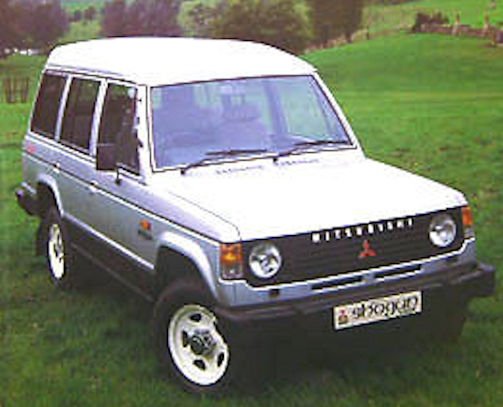
Mitsubishi Pajero Shogun 1st generation (L040)
 |
|
|
Production period: |
1982-1991 |
|
Body versions: |
wagon, Cabriolet |
|
Engines: |
Petrol engines: 2.6-3.0 litres (76-104 kW) |
|
Length: |
3995-4650 mm |
|
Width: |
1679 mm |
|
Height: |
1849-1890 mm |
|
Wheelbase: |
2350-2695 mm |
|
Curb weight: |
1510-1935 kg |
The first Pajero came on the European market in early 1983, while in Japan it was introduced about half a year earlier.
The Mitsubishi Pajero 1st gen is a SUV of Japanese Mitsubishi Motors, which was in production from the spring of 1982 to 1990. From the beginning of 1983 this was also now available worldwide. Since then, the car was built in four generations.
The name was borrowed from Leopardus Pajero’s, which lives in rough mountainous areas of South America. The Pajero came to public fame with its numerous successes in the world's toughest motorsport rally, the Paris-Dakar Rally.
In the United Kingdom, the model is called Shogun while In Spanish-speaking countries, as well as in North America, the Pajero has the name Montero.
The first generation had the same chassis as the pickup L200 and the minibus L300 and was later reissued by Hyundai as a Hyundai Galloper with a light facelift.
Already in the 1980s Mitsubishi and Chrysler worked together. In America, the Pajero was also available from Dodge and was then called Dodge Raider.
It was equipped as standard with switchable four-wheel drive. There is also an off-road gear and surcharge for a differential lock. The front wheels are individually hung on double wishbones, at the rear of a rigid axle with semi-elliptic leaf springs. The Pajero is the first off-road vehicle equipped with ventilated disc brakes at the front.

For outdoor lovers, the short version of the Pajero was also offered open at the same retail price as the closed version. The original shred roof with three plastic windows has many opening options. So, you can roll up both sides and the rear window independently. Some manufacturers also offered hardtops in different versions. The Pajero successfully participated in the Dakar Rally.
Today, the vehicles of the first generation in Europe have almost completely disappeared from the streets, especially due to rust problems.

Engines
Initially Type 4D55 2.3 L Row 4 cylinder SOHC Diesel engine Same as (75 ps) turbo With, G63B type 2.0 L series 4 cylinder SOHC Gasoline engine (110 ps) was installed. A G63B type 2.0 L series 4-cylinder SOHC gasoline turbo (145 ps) was added to the minor change.
The diesel turbo changed to 2.5 L and expanded to type 4D56 (85 ps), and the gasoline engine was also Type 6G72 3.0L V-type 6 cylinder The SOHC 12 valve (150 ps) also appeared. Later, the 4D56 type of Intercooler With turbo (94 ps).
Suspension
suspension Initially the front Double wishbone and Tortion bar spring independent suspension, rear Semi-elliptical leaf spring type Axle suspension Adopted. Later super sports and wagon rear 3 links and Changed to coil spring axle suspension.
Four-wheel drive system Based on rear wheel drive, transfer FR-based 4WD system that conveys drive to the front wheels Integrated with transfer Side transmission A part-time drive method with a built-in is adopted. Therefore, the front wheel is equipped with a manual free hub that has manually ON OFF for the drive. There are also many models that later carry the AUTO free hub on the front wheel axle, mainly for passenger use (a hub that is automatically locked when the forward rotation drive is on the axle. On the contrary, even if the vehicle was shifted to 4WD, there was a drawback that the lock would come off FR if the vehicle revered back).

