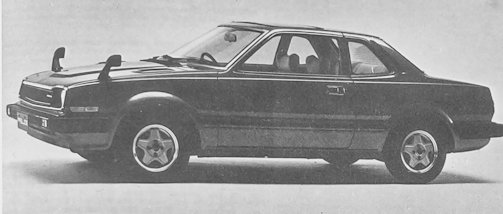
Honda Prelude First Generation
 |
|
|
Production period: |
1978 to 2002 |
|
Class: |
sports car |
|
Body versions: |
Coupe |
|
Engines: |
1.6L 1.8L |
|
gearbox: |
5 speed or 2 speed Auto |
|
wheel base: |
91.34 in, 232 cm |
|
length: |
161.02 in, 409 cm |
|
width: |
64.35 in, 163.5 cm |
|
height: |
51.97 in, 132 cm |
The Honda Prelude first generation is a mid - range sports coupe made by the Japanese automaker Honda from 1978 to 1983. it was further built until 2002. There were five generations.
History
In 1978, the first generation of the Honda Prelude was presented as a sports coupe based on the Accord (type code SN). This was the third Honda series in addition to the Civic and the Accord. From this model, the company Tropic made Crailsheim in 1981 to 1983, built convertibles a total of 47 were made.
The Prelude is 13.41 ft (4.09 metres) long, just a little shorter than the Accord at 13.51 ft (4.12 metres). The Prelude is a 'three-box' car with luggage boot, whereas the Accord is a 'two-box' with hatchback and folding rear seat. Although the two models share a similar mechanical layout, the Prelude is an entirely new car with modified suspension (notably at the rear) and slightly shorter wheelbase (7.61 ft/2.32 metres compared to 7.80 ft/2.38 metres). The suspension layout remains all-independent but with torsion bars and a combination of fore-and-aft and transverse arms.
The European market gets a version of the four-cylinder ohc engine, the 77 mm bore and 86 mm stroke giving a cubic capacity of 1602 cc. Compression ratio is 8.4:1 (instead of there is electronic ignition, and although maximum power output remains at 80 bhp (60.56 kW), torque is improved to 94.17 1b ft (12.9 mkg/126.28 Nm) at 3500 rpm. Transmission is the choice being between the light-to-operate five-speed manual, and the semi-automatic two-speed. Smaller than the Accord, yet a little heavier, the Prelude has rather less interior space, particularly in the rear seats. It is a well-proportioned car, however, and has some notable novelties: a neat facia with concentric rev-counter and speedometer as well as integrated radio. The electric sun-roof too is unusual for the time in that it incorporates filter-glass covered by an opaque sliding panel.
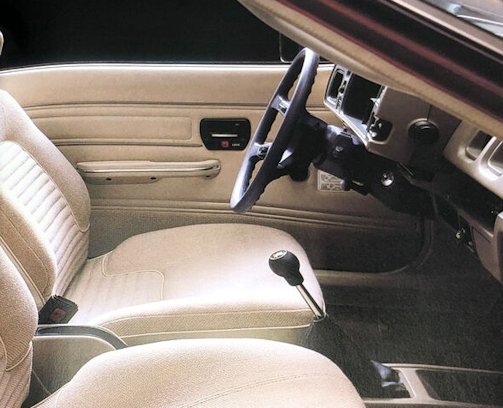
In the Prelude the CVCC engines of the Accord with 1.8-liter displacement for the Japanese and the North American market and 1.6-liter capacity for the other export markets were used. The smaller engine produced 59 kW (80 hp). As the first vehicle in its class, an electrically operated glass sunroof was offered. From the 1980 model year he was available with a Hondamatic called three-speed automatic.
Detail changes to Honda's sohc alloy-head engine include a slight capacity gain from 1599 to 1602cc and the adoption of electronic ignition. To reduce noise and vibration there are two torque' rods and a further special spring mount; the exhaust has a large pre-chamber silencer with flexible exhaust pipe. The compression ratio of 8.4:1 and the twin-choke carburettor remain as before, as does the maximum power of 80 bhp (DIN) at 5300 rpm, but the torque peak is altered from 92 1b ft at 3700 rpm to 93 1b ft at 3500 rpm. Its 0-60 mph time of 12.2 sec the Prelude retains a useful amount of acceleration, to the extent that fifth can be used around town.
Honda has re-designed the locating linkages of the MacPherson strut all-independent coil spring suspension, and an anti-roll bar is now fitted at the rear as well as the front. As a result, there is noticeably less under-steer and even sharper response to the accurate rack and pinion steering. The braking system, including the fitting of automatic adjusters to the rear drums, and new dirt and corrosion-proof front disc brake callipers are light, yet firm
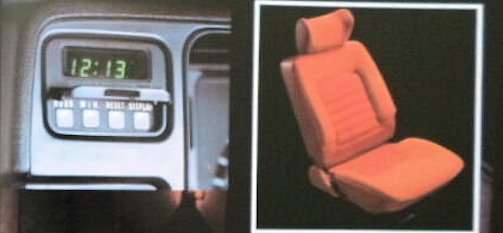
Honda does not claim the Prelude to be more than a 2+2 when it comes to accommodation; thus, the rear seats are for small children only, unless the front seats are set well forward in the front head-room is limited for taller than average drivers, but the front seats' range of adjustment provides plenty of legroom. Interior stowage space is fair, with a deep glove box, a tray in front of the gear-lever, a slot the size of a small cigar box on the facia, and a deep bin either side of the rear seat. A lever by the driver's seat can be used to open the boot lid, giving access to a compartment with 10.9 cu ft luggage capacity layout of controls is good. There are four horn-push buttons set in the spokes of the wheel with column stalks for, on the left, the wash/wipe system, and on the right for indicators and all lighting functions the remaining switches on the right. Two door mirrors are standard, and there is an intermittent as well as two constant wipe speeds.
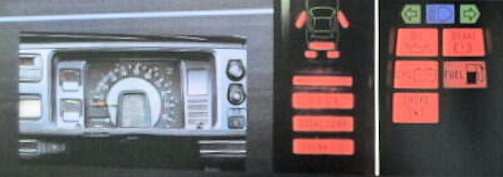
the tachometer inside, the concentric large speedometer, the clear, reflection-free calibrations, green for the tacho and white for the speedometer. Set to the left of these two gauges are the water temperature and fuel gauges, and in the top left corner of the instrument is an L.E.D. digital clock. There is also comprehensive bank of warning lights. For heating it is fitted with two slides for temperature and distribution, a rotary knob for the fan, control the Prelude's heating and ventilation system. Heated air can be directed through the footwell vents, or through two central face-level vents, or to the windscreen and side windows for demisting. Fresh air ventilation is provided through four face-level vents, two in the centre and one at each end of the facia. There are three modes of operation: with the heater in use, fresh air is obtainable on ram flow only through the outer face-level vents, but the flow cannot be regulated as the vents' individual controls are either on or off; with the slide control on "vents" and the temperature control on full cold, a good flow of fresh air can be fan boosted through all four vents. The sunroof made of smoked safety glass, is electrically operated, and incorporates a sliding blind to shut out the light if so desired; and it is standard as are the alloy road wheels, digital clock, rotary-dial radio, head restraints, remote boot opening lever, five-speed gearbox, door-open warning lamps, and indicators that warn the driver when to change the engine oil, oil filter, and to rotate the tyres.
PERFORMANCE:
- 1602 cc
Max power 80 bhp (DIN) at 5300 rpm
Max torque 93 1b ft (DIN) at 3500 rpm
Max Speed 95 Mph 153 kmh
Fuel consumption: 30.3 mpg - 1,750 cc
max power (JIS): 90 hp at 5,300 rpm
max torque (JIS): 98 1b ft, 13.5 kg m at 3,000 rpm
max engine rpm: 5,700; 51.4 hp/l
max speeds: (I) 27 mph, 43 km/h; (II) 45 mph, 73 km/h; (III) 63 mph, 102 km/h; (IV) 93 mph, 150 km/h; (V) 106 mph, 170 km/h
power-weight ratio: 21.8 lb/hp, 9.9 kg/hp
consumption: 29.7 m/imp gal, 24.8 m/US gal