

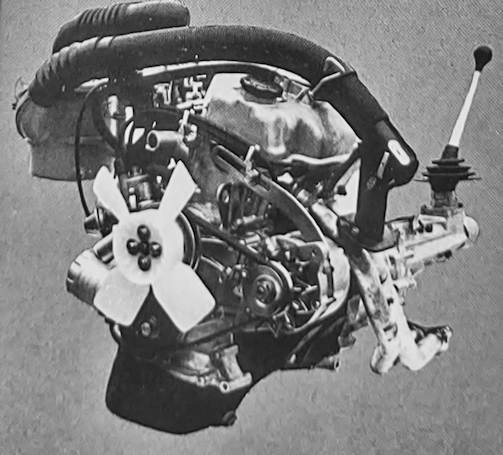
Mitsubishi 2G2 359cc series engine
 |
|
|
Make |
Mitsubishi Motors Corporation |
|
manufacturing period |
1972 to 1976 |
|
type |
In-line 2-cylinder SOHC |
|
Displacement |
0.36L |
|
Cooling |
Water |
The Mitsubishi 2G2 series engine is a series of water- cooled in -line 2-cylinder gasoline engines for the company's light vehicles manufactured by Mitsubishi Motors and Mazda Porter Cab (550cc model) . It is a 4-stroke version of the company's 2G1 series engine for mini vehicles .
History
Commonly known as " Vulcan Engine" . The valve drive system uses SOHC , and the number of valves is 2 valves per cylinder with 1 intake and 1 exhaust. Except for the early model of 2G21 (Mujirushi Vulcan), all are equipped with a silent shaft . Initially, a timing chain was used to drive the camshaft, but a timing belt was used in the later model G23B, which will be described later . At the end of the series, the class's first turbo specification and the class's first air-cooled intercooler turbo specification were also added.
The successor is the 3G8 series , which was produced from 1987 to 2013 .
Variations
2G21 (Mujirushi Vulcan)
The first engine to appear, without a silent shaft. The MCA (Mitsubishi Clean Air) system is adopted to clear exhaust gas regulations . There was also a sports series engine equipped with a twin carburetor, which was installed in the Minica GS / GSL and Minica Skipper IV in place of the previous 2G10 engine.
- Production period : 1972-1974
- Displacement: 0.36L (359cc)
- Number of cylinders: 2
- Bore x Stroke: 62.0mm x 59.6mm
- Maximum output: 24 kW (32 PS) at 8,000 rpm (single carb) / 26 kW (36 PS) at 8,500 rpm (twin carb)
- Maximum torque: 3.0 kg m (29.4 N m) at 5,500 rpm (single carb) / 3.2 kg m (31.4 N m) at 6,500 rpm (twin carb)
Installed vehicles
Minica F4 (A103A, early model, 1972-1976)
Mitsubishi Minica Skipper IV (1972-1974)
2G21 (Vulcan S)
Appeared at the end of 1974. The silent shaft is adopted for the first time and the MCA-II system is adopted.
- Production period : 1974-1976
- Displacement: 0.36L (359cc)
- Number of cylinders: 2
- Bore x Stroke: 62.0mm x 59.6mm
- Maximum output: 22 kW (30 PS) at 6,000 rpm
- max power (DIN): 32 hp at 8,000 rpm
- max torque (DIN): 22 1b ft, 3 kg m at 5,500 rpm
- max engine rpm: 8,700; 88.9 hp/l
- max speeds: (I) 20 mph, 32 km/h; (II) 32 mph, 51 km/h; (III) 48 mph, 78 km/h; (IV) 71 mph, 115 km/h
- power-weight ratio: 34.8 lb/hp, 15.8 kg/hp
Installed vehicles:
Minica F4 (A103A, late model)

