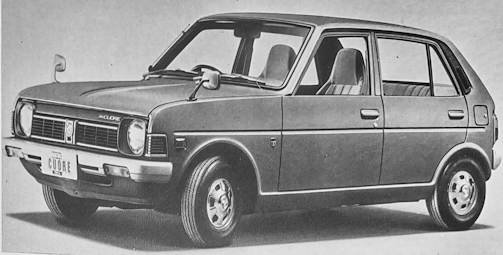
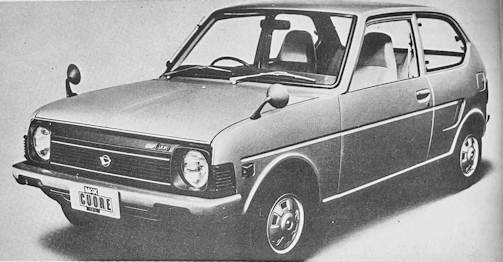
Daihatsu MAX Cuore First generation L40S series
 |
|
|
Manufacturing company |
Daihatsu Motor |
|
country of manufacture |
Japan |
|
Sales period |
1977 to 1980 |
|
Class |
Motor car |
|
Body type |
2-door/4-door fastback sedan |
|
Drive system |
FF |
|
Engine |
AB type 0.55L 4 cycle direct 2 |
|
Maximum output |
31PS/6,000rpm |
|
Maximum torque |
4.2kgf m/3,500rpm |
|
Transmission |
4-speed MT |
|
Suspension |
Front: MacPherson strut coil springs |
|
Wheelbase |
82.28 in, 209 cm |
|
full length |
124.40 in. 316 cm |
|
Width |
54.72 in, 139 cm |
|
Height |
51.97 in, 132 cm |
|
vehicle weight |
2-dr. 1,191 1b, 540 kg 4-dr. 1,235 1b, 560 kg |
The Max Cuore was first released in 1977 in Japan.
History
The Max Cuore was a minor change version of the previous Fellow MAX launched in 1970 with an enlarged body to meet the new mini vehicle standards (enforced in January 1976).
In May 1976, the engine was changed and expanded from a 2-stroke 360cc to a 4-stroke 550cc, but the body remained the same as the 360cc standard (only the bumper was enlarged and strengthened). The body width of the MAX Cuore has been expanded by 100mm, which has enabled both the body and the engine to comply with the new standards. On the chassis side, the wheelbase and suspension type have not changed, except for the wider tread due to the wider width. The engine has also taken over the one that appeared in the previous year.
The line-up includes three types: a 2-door sedan (STD/EX/custom), a 4-door sedan (EX/custom/high custom/Hi EX custom), and a 3-door van (STD/DX/Super DX). The engine is an AB type 2-cylinder 4 cycle.with cast iron block, alloy head 547cc, 28 horsepower with Aisan downdraught twin barrel carburettor. The sedan version as the C-L40 and the van is H-L40V.
By March 1979 some Minor changes. The sedan will be the E-L40, which complies with the 1953 emissions regulations, and the van will be the J-L40V, which complies with the 1954 emissions regulations control by Daihatsu lean-burn system with turbulence generating pot in each combustion chamber and catalytic converter. The maximum output is improved to 31 horsepower.
PERFORMANCE
- Max speeds:(IV) 68 mph, 110 km/h
- Max power (JIS): 28 hp at 6,000 rpm
- Max torque (JIS): 28 1b ft, 3.9 kg m at 3,500 rpm
- Max engine rpm: 7,800
- Power 51.2 hp/l
- Power-weight ratio: 2-dr. sedans 42.6 lb/hp, 19.3 kg/hp - 4-dr. sedans 44.1 lb/hp, 20 kg/hp
- Acceleration: standing 1/4 mile 21.8 sec
- Fuel consumption: 52.3 m/imp gal, 43.6 m/US gal at 37 mph, 60 km/h.
This first range was discontinued in July 1980. In total there was 144,241 MAX Cuore produced in all versions. The successor model as the " Cuore (2nd generation)" (Cuore) sedan and the " Miracuore " van the car name became " Cuore ", it was set only for passenger car models, and Mira (originally Mira Cuore) was set as a sister car of the commercial model. After that, the Mira, which was advantageous in terms of taxation at that time, sold more, and in Japan, it was integrated into the Mira in 1989, at the end of the third-generation model continued as an export vehicle for Europe. It was sold until the end of January 2013, when Daihatsu withdrew from sales in Europe with an 850cc or 1000cc engine mounted on a body almost identical to the Mira sedan for the Japanese market.