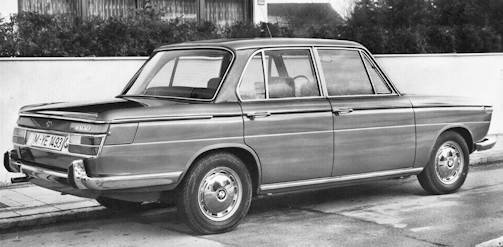
BMW 1800 New Class
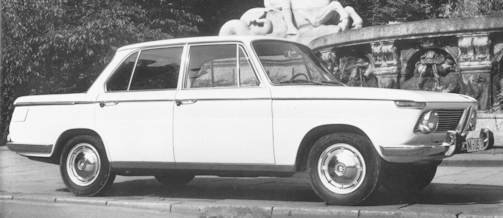 |
|
| Overview | |
|---|---|
| Production | 1964 to 1971 |
| Designer | Wilhelm Hofmeister Giovanni Michelotti, consultant |
| Class | Motor car |
| Body | Saloon |
| Powertrain | |
| Engine | 1,773 cc (1964–1968), 1,766 cc (1968–1971) |
| Transmission | 4-speed manual 5-speed manual on 1800 TI/SA 3-speed automatic optional on 1800/2000 |
| Dimensions | |
| Wheelbase | 100.39 in, 2,550 mm |
| Length | 177.16 in,4,500 mm |
| Width | 67.32 in, 1,710 mm |
| Height | 57.09 in, 1,450 mm |
| Dry weight | 2,293 1b, 1,040 kg |
The New Class (internal model designation 118 (1800) was a car from manufacturer BMW from the mid 1960s to the early 1970s.
History
Introduced in September 1963, the BMW 1800 was the second member of the New Class family. This model had an M10 engine with a 84 mm (3.3 in) bore and 80 mm (3.1 in) stroke, giving a displacement of 1,773 cc, a power output of 90 hp (67 kW) at 5,250 revolutions per minute, and a torque output of 96 lb·ft (130 N·m) at 3,000 revolutions per minute An 1800 TI (Turismo Internazionale) model featured components developed for the 1800 by the tuning company Alpina. The upgrades included dual Solex PHH side-draft carburetors and higher-compression pistons for 110 hp (82 kW) at 5,800 revolutions per minute and 100 lb·ft (136 N·m) at 4,000 revolutions per minute.
when the 1500 saloon appeared at Frankfurt in 1961. Five years later the same design in 1800 forms Briefly it is a spacious five-seater with 1,800 c.c. engine and particularly good roadholding. Although it feels quite big, the BMW is an easy car to drive as You sit quite high in a commanding position and can see all the corners; it weighs only 21.4 cwt. unladen, yet gives a feeling of tremendous solidity and seems particularly well insulated from the outside world with well damped road noise, little wind roar and engine noise which never rises above a distant hum.
Independent rear suspension by semi-trailing arms is a design trend which BMW were among the first to use. ,the BMW uses Macpherson struts at the front, but unlike the TI the 1800 does not have a front anti-roll bar and gives a more comfortable ride with some roll. Handling remains neutral until you corner very fast indeed for a saloon, when it is just possible to lift the inside rear wheel off the road, and the resultant momentary oversteer needs little correction.
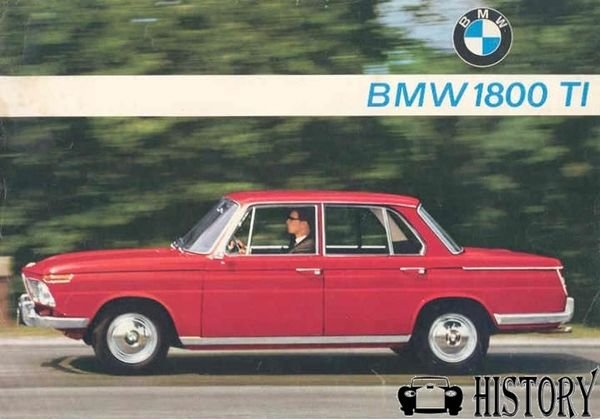
Inside the large flat-floored boot takes 13.1 cu.ft. of luggage. The toolkit shows good engineering sense too, with more items than usual and the jack is easy to operate.sliding positions of the front seats and 33 angles of the back rest all shapes and sizes were accommodated in comfort, particularly as the leatherette upholstery with attracdve mock woven wearing surfaces helps ventilation and increases the already good sideways hold of the contoured seats.The doors are trimmed in the same material as the mixture of mock-woven and plain leather clothand pocket takes maps and flat boxes. Britax inertia-lock safety belts, Other safety points are soft sun vizors senger's with mirror), a framed mirror and a soft steering-wheel boss.
All drivers will find the controls well balanced and in the right place; the pedals are particularly smooth in operation and heel-and-toe is a very natural action. A further advantage of the driving position, in which you sit on a chair with bent knees rather than sitting low down with straight legs, is that even the smallest people will be looking easily through the deep screen and gaining a good view over the bonnet; taller people still have plenty of headroom.Behind there is plenty of room for three abreast, even for six-footers behind other
six-footers in comfort if not sprawling luxury, with those on the outside being provided with substantial roof level grab handles. The simple heating system works well within the limitations imposed by only two controls—one lever for the temperature (by air mixing) and the other to direct air up or down—together with a two-speed fan, which is noisy at the faster speed necessary for rapid heating or defrosting in town. Whether or not you like imitation wood on the facia, it is prob-
ably cheaper than the real thing to replace if scratched. The identical knobs on it are few and suffciently far apart to avoid confusion; the two-speed wiper switch is on the left and the side/head/panel light switch on the right. A left hand steering column stalk flashes or dips the headlights; a pull on the right hand one gives a squirt from the washer followed by three wipes a useful feature; it also operates the indicators and acts as a switch for parking lights once the ignition key has been removed.
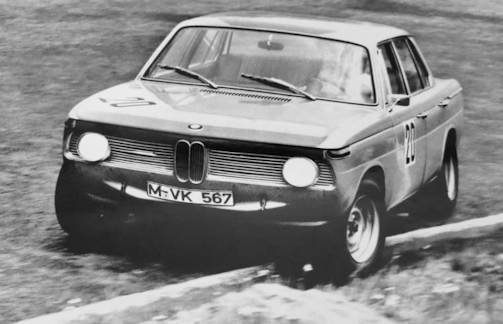
A homologation special, the 1800 TI/SA, was introduced in 1964. The TI/SA's engine had dual Weber DCOE-45 carburettors and a 10.5:1 compression ratio, with 130 hp (97 kW) at 6,100 revolutions per minute and 106 lb·ft (144 N·m) at 5,250 revolutions per minute. The TI/SA also had a Getrag five-speed gearbox and thicker anti-roll bars and larger-diameter brake discs than the TI,. 200 examples of the TI/SA were built. An oversquare four cylinder engine with a five bearing crankshaft is a currently accepted formula for good reliable performance at low production costs and BMW have added to it by using a single overhead camshaft which operates inclined valves through rocker arms to give the same valve positions as with twin overhead cam- shafts, staggering the valves to induce swirl. Together with a shaped piston crown. this allows An 8.6: 1 ratio The 1800 is as quick off the mark as the TI up to 40 m.p.h. and reaches 60 m.p.h. in 12.8 seconds compared with 11.3 for the TI
Transmission the excellence of the gearbox encourages frequent use of all ratios, including first gear when you want it, since the Porsche-type synchromesh on all four gears is quite unbeatable.An automatic transmission option was introduced in 1966 and in 1967 the 1800 was generally updated along with the 2000. The updates included interior changes (a modernized dashboard design and simpler door panels) as well as styling changes to the front grilles.
In 1968 the 1,773 cc engine used in the 1800 was replaced by an engine with the 89 mm (3.5 in) bore of the 2.0 L engine and the original 71 mm (2.8 in) stroke, yielding a displacement of 1,766 cc and a stroke/bore ratio of 0.798:1 instead of the previous 1800 engine's ratio of 0.952:1.
PERFORMANCE: 1800 1,766 cu cm
- Engine capacity: 107.76 cu in, 1,766 cu cm
- Fuel consumption: 26.9 m/imp gal, 22.4 m/US gal, 10.5 1 x 100 km
- Max speed:99.4 mph, 160 km/h
- max speeds: 26.7 mph, 43 km/h in 1st gear; 50.3 mph, 81 km/h in 2nd gear; 76.4 mph, 123 km/h in 3rd gear; 99.4 mph, 160 km/h in 4th gear
- power-weight ratio: 23.8 lb/hp, 10.8 kg/hp
- carrying capacity: 882 1b, 400 kg
- acceleration: standing 1/4 mile 19.3 sec, 0—50 mph (0 —80 km/h) 9.1 sec
- speed in direct drive at 1,000 rpm: 16.7 mph, 26.8 km/h.
PERFORMANCE: 1800 Ti 1,773 cu cm
- Engine capacity: 108.19 cu in, 1,773 cu cm
- Fuel consumption: 25.7 m/imp gal, 21.4 m/US gal, 11 1 X 100 km
- Max speed: 105.6 mph, 170 km/h
- Engine capacity: 108.19 cu in, 1,773 cu cm
- Fuel consumption: 25.7 m/imp gal, 21.4 m/US gal, 11 1 X 100 km
- Max speed: 105.6 mph, 170 km/h
- max speeds: 26.1 mph, 42 km/h in 1st gear; 46.6 mph, 75 km/h in 2nd gear; 74.5 mph, 120 km/h in 3rd gear; 105.6 mph, 170 km/h in 4th gear
- power-weight ratio: 18.5 lb/hp, 8.4 kg/hp
- carrying capacity: 882 1b, 400 kg
- acceleration: standing 1/4 mile 18.4 sec, 0—50 mph (0—80 km/h)7.8 sec
- speed in direct drive at 1,000 rpm: 17 mph, 27.4 km/h.