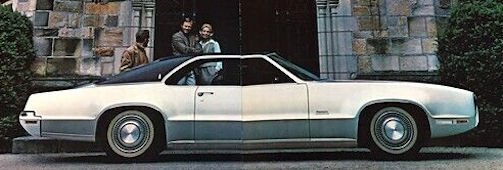
Oldsmobile Toronado First generation
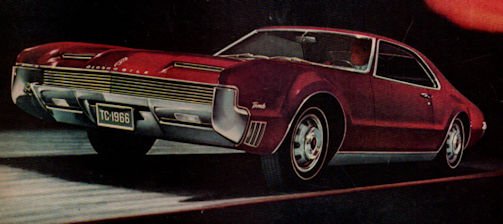 |
|
|
Model years |
1966 to 1970 |
|
Designer |
David North, Bill Mitchell |
|
Layout |
FF layout |
|
Engine |
425 cu in (7.0 L) 385 hp (287 kW) Rocket V8 |
|
Transmission |
3-speed TH-425 automatic |
|
Wheelbase |
119.0 in (3,023 mm) |
|
Length |
211 in (5,359 mm) (1966–67) |
|
Width |
78.5 in (1,994 mm) |
|
Height |
52.8 in (1,341 mm) |
|
Curb weight |
4,496 lb (2,039 kg) |
The Oldsmobile Toronado 1st Generation was built from 1966 to 1970.
History
The Oldsmobile Toronado was offered by the American car manufacturer General Motors under the brand Oldsmobile from autumn 1965 to mid-1992 front-wheel drive coupe of the upper class. The model was manufactured in four different series.
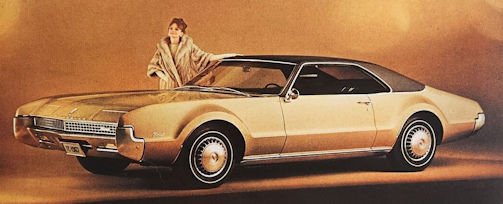
The model’s name is a term derived from the term tornado. When the Toronado was introduced in the fall of 1965, it differed in many ways from the then-usual offer in the US market. There was, on the one hand, the body shape of this large luxury coupé. In addition, the car was equipped with front-wheel drive. It was the largest front-wheel drive car ever built, and the first front-wheel drive car in America for almost 30 years Sharing the GM E platform introduced by the rear-wheel drive Buick Riviera in 1963 and adopted for the front-wheel drive.
A 7-litre, 385 b.h.p. Super Rocket V8 engine driving the front wheels? the Toronado is one of the biggest, fastest, quietest, most powerful and thirsty machines These things make it a very impressive car. With the 7.0-liter V8 reached a top speed of 217 km / h. Sceptics doubted whether the front-wheel drive made sense for such a big car, but the tests proved that the Toronado also had an above-average road holding compared to other American cars from that time. General Motors, like practically every other major manufacturer in the world, have been experimenting with front-wheel drive prototypes for many years. Everyone now recognizes the advantages of having the engine and transmission at the same end as the driving wheels whether they be front or back. Either way offers better traction, simplification in design The Tornado’s basic structure a three-quarter length perimeter sub-frame cloaked with an integral body customers want the Toronado, despite its radical engineering, it is still much like any other big American saloon to drive.
- PERFORMANCE 425 cu in
Max power (SAE): 385 hp at 4,800 rpm
max torque (SAE): 475 1b ft,65.5 kg m at 3,200 rpm
max engine rpm: 5,200
specific power: 55.3 hp/l
Engine capacity:425 cu in, 6,964.47 cu cm
Fuel consumption: 12 m/imp gal, 10 m/US gal, 23.5 1 x 100 km
Max speed: 133 mph, 214.1 km/h
max speeds: 55 mph, 88.5 km/h in 1st gear; 92 mph, 148.1 km/hin 2nd gear; 133 mph, 214.1 km/h in 3rd gear
power-weight ratio: 11.5 lblhp, 5.2kg/hp
acceleration: standing 1/4 mile 16.7 sec,
0—50 mph (0 —80 km/h) 6.3 sec - PERFORMANCE 455 cu in
Engine capacity: 455 cu in, 7,456.08 cu cm
Fuel consumption: 12.3 m/imp gal, 10.2 m/US gal, 23 1 x 100 km
Max speed: 131 mph, 210.9 km/h
power-weight ratio: 11.7 lb/hp, 5.3kg/hp
max power (SAE): 375 hp at 4,600 rpm
max torque (SAE): 510 1b ft,70.4 kg m at 3,000 rpm
max engine rpm: 5,200
specific power: 50.3 hp/l
Also, the technology of the big Olds was unusual, torque converter and gearbox were connected with a unique chain drive. However, the space in the rear and the overview to the rear were somewhat limited by the sloping coupe form. The front seats, the rear bench has been moulded for only two people but there is comfortable room for a third
without a prop shaft tunnel to get in the way of his feet. optional press-button air conditioning. capable of providing any amount of hot or cold air in any direction
There is a rectangular theme for the instruments which are clustered in front of the driver and viewed through a steering wheel with four
spokes in the middle are an unusual revolving speedometer—a calibrate drum which rolls its numbers past a fixed horizontal indicator It looks good but we did not consider it as easy to read. The steering column levers for the indicators, gears and steering ordinary dial. Adjustments are within finger-tip reach but the facia for lights, wash-and-wipe, fan speed, de-mister, air-condition the strongest safety point but there are also coil-up lap straps, easy to clip on and automatically tensioned supplied as standard fittings for all seats.There is also a dipping mirror and swivelling sun visors.
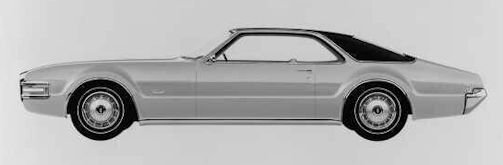
A special option code called W-34 was available on the 1968 to 1970 Toronado. This included a cold air induction system for the air cleaner, a special performance camshaft and a "GT" transmission calibrated for quick and firm up-shifts and better torque . Dual exhaust outlets similar to the 1966–67 model years with cutouts in the bumper, were included with W-34. The models also had dual exhaust systems, but single hidden outlet running from the muffler exiting rearward on the right side. For 1970 only, the W-34 option also included special "GT" badges on the exterior of the car.
The W-34 Toronado was capable of 0–60 mph in 7.5 seconds and the standing 1/4 mile in 15.7 seconds at 89.8 mph (144.5 km/h).
VARIATIONS AND OPTIONAL ACCESSORIES
separate front seats; cleaner air system; air conditioning system adjustable tilt of steering wheel; front disc brakes (diameter 11.30 in, 287 mm) 235R x 15 tyres; separate front seats, central selector lever; 55 Ah alternator
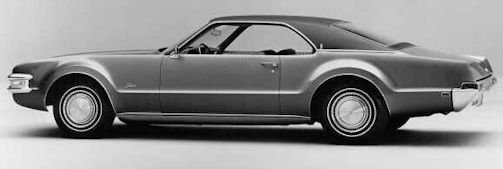
The car was popular with American car buyers. In 1966, more than 40,000 Tornados were sold. At the time it was technically one of the most impressive vehicles on the American market.
End of 1967 was a facelift, which approximated the shape of the Toronado with notchback and in the greatly enlarged grille integrated pop-up headlights the mainstream design in 1969, and the elimination of hidden headlights. The first-generation Toronado with the usual annual facelifts through 1970 The seven-Liter was replaced by a new 7.5-liter V8 with 375 or 400 hp. The deluxe model was renamed Toronado Custom.
In this form, the Toronado remained in production until the summer of 1970. Altogether 143.134 copies were made.
The Toronado shared drive technology with the Cadillac Fleetwood Eldorado, introduced in late summer 1966.