
Buick LeSabre 4th generation
|
Production period: |
1970 to 1976 |
|
Body versions : |
Saloon , Coupé , Cabriolet |
|
Engines: |
Gasoline: 3.8-7.5 liters (77-272 kW) |
|
Length: |
5593-5763 mm |
|
Width: |
2030 mm |
|
Height: |
1350-1370 mm |
|
Wheelbase : |
3150 mm |
|
Curb weight : |
1751-2011 kg |
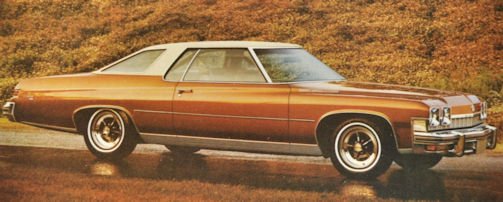
The Buick LeSabre was a series of passenger cars , which was manufactured by Buick from late 1958 to mid-2005 as the successor to the Buick Special in the United States. For many years, the LeSabre was the entry-level model at Buick with the lowest base price.
In the spring of 1970, there was only a small facelift, but the 5.7-liter V8 engine significantly increased power to 260 hp (191 kW). New came the 455 version , which included the large V8 with 7456 cc with 370 hp (272 kW). The standard and optional LeSabre engines include 2-barrel and 4-barrel 350's, the latter with or without dual exhausts, and a 4-barrel 455. teamed with either a 3-speed manual transmission or the Turbo Hydra-Matic. The automatics come in two sizes to handle the varying outputs.
LeSabres for 71 year come in plain, Custom and 455 form and each series consists of a hardtop coupe and a sedan plus a thin-pillar sedan. In addition, you could also get a LeSabre Custom convertible. The Custom featured a plusher vinyl and fabric, or all vinyl.Custom plaques were used beneath the LeSabre signature. The frame is of the perimeter box type with shaped members in front to absorb impacts, an all-new 124. inch wheelbase chassis with full coil suspension and with the "Accus drive" ride feature. "Accu-drive" is an evolution of the "Tru-Trac" principle developed by Buick for its previous 1969 models. It is designed when encountering gusty crosswinds or being passed by a large truck. The bodies, being all new, feature flush-mounted, ventless glass, thin windshield pillars and a new flow-through ventilation system that operates continuously whether or not optional air conditioning is specified. The fresh air emerges from outlets in the instrument panel, passes under the rear seat to the trunk and there passage through the double-panel trunk lid to the final exiting point from louvers under the rear window.
In 1971, completely revised, larger bodies were presented. Technically, however, remained with the offers of the previous year, with the 5.7 -liter V8 engine only 230 bhp (169 kW) delivered. Front disc brakes, three-speed automatic transmission and power steering have become standard on all LeSabre models.
In 1972, the performance data was changed to SAE-PS (nhp), which drastically reduced the nominal values, as the performances were now measured with all ancillary components and at the rear axle. So it brought the only available 5.7 -liter V8 engine now only 150 hp; the 7.5-liter V8 engine of the 455 fell out of the program. Stylistically, there were only minor changes.
The following year, the 7.5 -liter V8 engine was offered again and offered 225 nhp; the performance of the 5.7-liter V8 engine rose to 175 hp. The convertible was not offered this year. Otherwise there were hardly any changes.
1974 there was again a significant facelift. The round double headlights in their rectangular frames were now arranged laterally from the radiator grille, whose upper halves consisted of panels in body color. Also, there was again a convertible, but only as LeSabre luxury (the luxury replaced the custom ).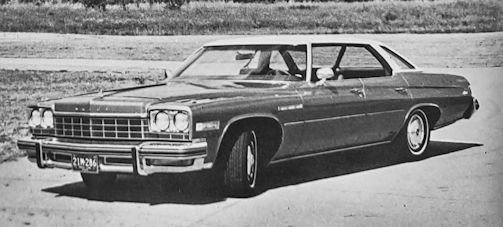
In 1975, the engine output dropped to 165 nhp or 205 nhp due to the use of catalysts. Also, for the first time unleaded gasoline was used. The luxury was again called Custom . Besides there was only a slight facelift.
In 1976, the Cabriolet fell because of its sustained failure from the program. The other models received small, rectangular twin headlamps with flashing and marker lights underneath. For the first time in the LeSabre and once in a US vehicle of the upper middle class, a V6 engine with 3785 cc displacement was offered as standard equipment. This was only available for the standard version and made 105 hp.
In total, 1,162,005 copies of the LeSabre were made by the summer of 1976.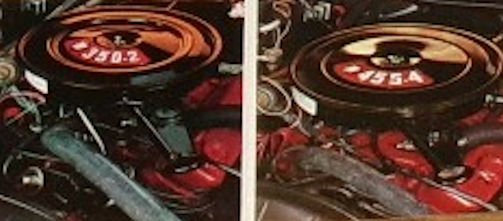
PERFORMANCE
- ENGINE: 350 cu in
max speed: about 104 mph, 167 km/h
power-weight ratio:18.3 lb/hp, 8.3 kg/hp
fuel consumption: 15.2 m/ imp gal, 12.6 m/ US gal, 18.6 1 x 100 km.
max power (SAE): 230 hp at 4,400 rpm
max torque (SAE): 350 1b ft. 48.3 kg m at 2,400 rpm
max engine rpm: 4,600
specific power: 40.1 hp/l - ENGINE 455 cu in, 7.456 cc
max power (DIN); 250 hp at 4,000 rpm
max torque (DIN): 375 1b ft, 51.7 kg m at 2,800 rpm
max engine rpm: 4.400 33.5 hp./l



