Rover 10 P1 (1933-1938)
 |
|
|
Manufacturer |
Rover |
|
Production |
1933 to 1938. |
|
Class |
Motor Car |
|
Produced |
9202 |
|
Body style |
saloon, coupé, open tourer |
|
Engine |
1.4 L straight 4 |
|
Transmission |
4-speed manual |
|
Wheelbase |
105 in (2,700 mm) |
|
Length |
152 in (3,900 mm) |
|
Width |
61 in (1,500 mm) |
|
Designers |
Maurice Wilks and Robert Boyle |
The Rover 10 P1 was a Motor car built in the 1930s by the Rover company in Great Britain. From 1933 to 1938 with the 4-Cylinder 1389 cc 1.4 litre engine .
History
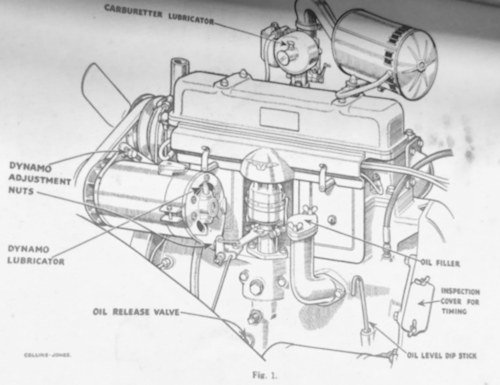
The new range for 1933 replacing the previous 10 and 10/25 model included a more upmarket Ten with also a new chassis that was also available to external coachbuilders and with now only Pressed Steel body built at the New Meteor Works, in Coventry England and fitted with a 1.4 litre engine. The Engine flexibly mounted, 66.5 mm. bore x 100 mm. stroke (with Treasury rating of 10.9 h.p.) this has overhead valves pump water circulation with automatic thermostat the lubrication by pressure from gear type pump.
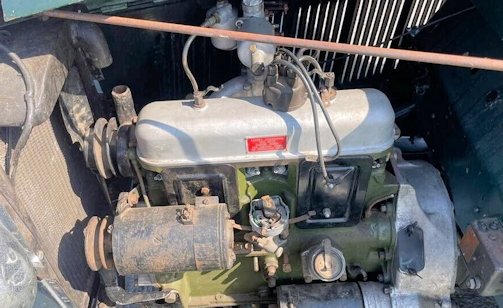
The new chassis automatically lubricated by Bijur system the underslung chassis has a wheelbase 8 ft. 9 in. and track 4 ft. 3.5 in the saloon body with flush-fitting sliding roof Triplex glass throughout; finished green, green wheels.
For the electrics coil and battery ignition; ventilated dynamo; Lucas electrical equipment chromium-plated head, side and tail lamps; electric dual windscreen wipers and electric horn.
The transmission 4 speed and reverse easy-change gearbox with silent engagement, freewheel controlled from dashboard incorporated with gearbox operates on all forward gears; central remote gear control; single-plate clutch and open propeller shaft with spiral bevel final drive
For the steering and brakes, wheels and suspension a worm and nut steering system and Girling balanced mechanical brakes on all 4 wheels; 18 x 4.75 Avon Duo-Tread tyres on
detachable wire wheels; half-elliptic springs front and rear with also hydraulic shock absorbers front and rear.
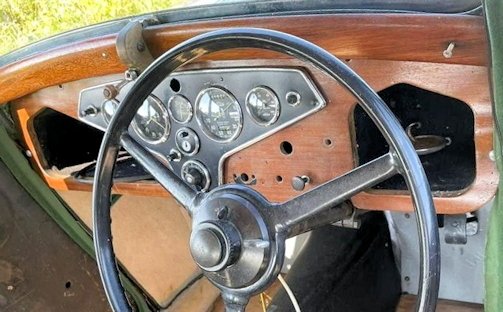
The saloon version features Inside green upholstery the equipment includes: centrally controlled windscreen, ventilating louvres at top of doors with built-in direction indicators with automatic return trip-speedometer The gauges include, clock; ammeter; combined electric petrol and oil gauge inside interior sun visors; mirror in near-side visor; interior light; driving mirror; roof parcel net; central folding and side arm rests to rear seat; body pulls; selected soft hide seating; specially improved seating springs; smokers' ash trays; driver-operated rear window blind; harmonic stabiliser; bumpers front and rear; folding luggage grid combined with rear bumper; spare wheel and tyre concealed by 1-piece cover; simplified jacking system; rear stop light and tool kit. Price, complete at £255
The "Ten" 4-Cylinder ROVER coupé came as a 4-seater coupé body with fixed head and flush-fitting sliding roof; finished maroon, maroon wheels and Upholstery soft hide seating; specially improved seating springs central folding and side arm rests to rear seat.
Equipment includes: chromium-plated head, side and tail lamps; electric dual windscreen wipers; centrally controlled windscreen; Triplex glass throughout; ventilating louvres at top of doors; built-in direction indicators with automatic return; electric horn; trip speedometer; clock; ammeter; combined electric petrol. and oil gauge;
interior sun visors; mirror in near-side visor; interior light; driving mirror; selected driver. operated rear window blind; smokers' ash trays; harmonic stabiliser; bumpers front and rear; built-in luggage compartment at rear; spare wheel and tyre; simplified jacking system; rear stop light; tool kit.
Price, complete, £280.
By 1935 the Rover programme comprised of the 10. 12 and 14 HP models. as well as Speed Fourteen and Speed Twenty Sports type cars. Prices ranged from £248 up to £495 .This model 10 was built up to 1938 .