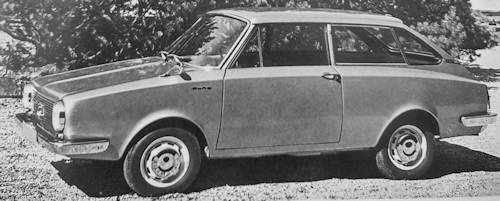
Glas 1004
 |
|
| Manufacturer | Hans Glas GmbH |
|---|---|
| Production | coupé May 1962 – October 1965 saloon January 1963 – December 1967 cabriolet January 1963 – July 1967 estate September 1966 – 1967/1968 40,703 units |
| Assembly | Dingolfing |
| Body style | coupé, saloon, cabriolet,estate |
| Layout | FR layout |
| Engine | 4-cylinder in-line 992 cc |
| Transmission | 4-speed manual all-synchromesh |
| Wheelbase | 82.68 in, 2,100 mm |
| Length | 150.98 in, 3,835 mm |
| Width | 59.05 in, 1,500 mm |
| Height | saloon & estate: 1,370 mm (54 in) coupe & cabriolet: 1,355 mm (53.3 in) |
The Glas 1004 is a small two-door, four-seater automobile produced by Hans Glas GmbH at Dingolfing. It was first exhibited in public, in coupé form, at the Frankfurt Motor Show in September 1961. Volume production of the 1004 coupé started in May 1962, and in January 1963 saloon/sedan and cabriolet versions joined the range along with the more powerful Glas 1204. September 1965 saw a yet more powerful variant, the Glas 1304. In September 1966, a fastback estate was added.
In 1960 the company’s research workshop came up with an engine that used an unconventional camshaft drive. Product developer Leonhard Ischinger, who had joined Glas from BMW, had produced a four-cylinder OHC engine with valve gear driven using a toothed rubber cam-belt, which at that time was a novel idea. The 992 cc engine provided a maximum output of 31 kW (42 PS) at 5,000 rpm. During 1961 the company added a modern coupé body using the chassis of the Glas Isar which for this application had been lengthened by 10 cm. The result was the 1004 prototype which appeared at the Motor Show in September of that year.
An updated entry level 1004 was introduced, horsepower on the 992 cc engine now reduced to 40 PS (29 kW). The car featured a slightly higher compression ratio than the original 1004 in 1963 and a different carburetor.
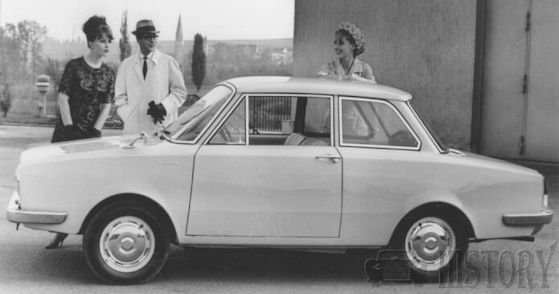
S 1004
Volume production began in May 1962 and the first cars were delivered in August. The car retained the water cooled 992 cc engine of the prototype which at this stage still delivered a claimed 31 kW (42 PS) of maximum power at 5,000 rpm. Drive was to the rear wheels via a four-speed manual transmission incorporating – still slightly unusually for this size of car synchromesh on all four forward speeds.
The S 1004 came with a steel monocoque steel body strengthened, from the start on this model, by reinforcing box sections under the floor. Commentators noted the contrast between the car’s relatively short 2,100 mm wheelbase and the overall 3,835 mm length of the car, which may, by later standards, have compromised the handling but did permit the use of a relatively short drive-shaft.
Front suspension used trailing arms and independent springs in combination, while at the back a rigid “swing” axle was supported by leaf springs. Both at the front and at the back the suspension was enhanced with “rubber air-filled hollow springs”.The hydraulically controlled drum brakes operated on all four wheels while the hand brake operated via a cable linkage to the rear wheels. Steering was of the then common worm and roller type.
The 2+2 coupé, commended in the manufacturer’s publicity for its “convincingly simple lines” in November 1963. From January 1963 the cabriolet was also offered. The Glas 1004 had the smallest engine in the range, and this was offered in combination with the full four seater sedan/saloon only from September 1965. A still unusual optional extra from August 1963 was disc brakes on the front wheels.
Press comment in a country where technical innovation generates enthusiasm was very positive in respect of the car’s status as the world’s first production car to be fitted with a belt driven camshaft, but criticised the unresponsiveness of the standard drum brakes and the heavy clutch. The car’s tendency to pitch under acceleration or sharp braking which was attributed to its short wheel base also drew criticism as did the “back to front” gear box which, as on the existing Isar, had originally been intended for a (never produced except as a prototype) front-wheel-drive small car and accordingly positioned first and third gears nearest to the driver, with second and fourth gears nearest the front of the car.
- PERFORMANCE: S 1004
- Engine capacity: 60.53 cu in, 992 cu cm
- Fuel consumption: 41.5 m/imp gal. 34.6 mlUS gal, 6.81 x 100 km
- Max speed: 80.8 mph, 130 km/h
- Max power (DIN): 42 hp at 5,000 rpm
- Max torque (DIN): 51 '1b ft, 7 kg m at 2,500 rpm
- Max number of engine rpm: 5,500
- Specific power: 42.3 hp/l
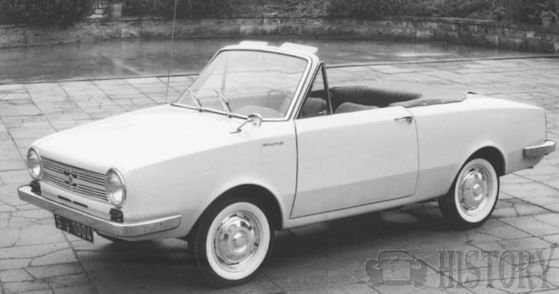
1004 TS
In November 1963 Glas added twin carburettor version were branded as the Glas 1004 TS. Claimed maximum horsepower output on these twin carburettor powered cars were 46 kW (63 PS) at 6,000 rpm. The TS powered versions of the car came with front disc brakes included in the price which provided, according to a contemporary report, “good stopping power with little effort”.
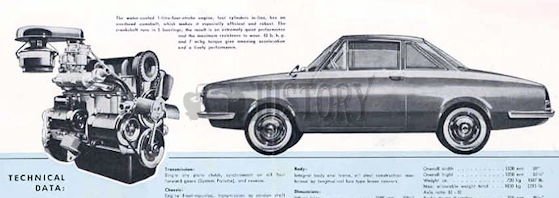
1004 CL
A fastback bodied kombi-limousines (estate cars) arrived in August 1966. Estate cars of this size were still relatively uncommon. The kombi-limousines could be purchased as 1004 CL with the "CL" standing for Combi Limousine. The Glas estate cars met with little success in the market place. Despite the rear tailgate, luggage space and rear leg room was severely limited thanks to the car’s short wheelbase.