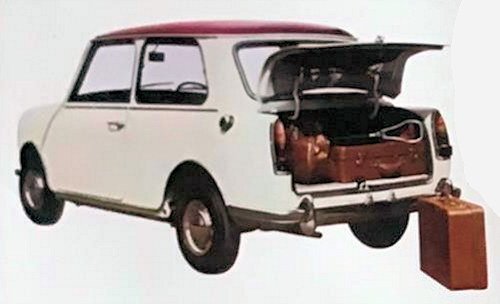
Wolseley Hornet Mark III
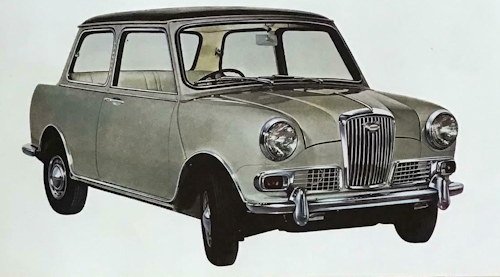 |
|
|
Production period: |
1966 to 1970 |
|
Class: |
Motor car |
|
Engines: |
1.0 litre |
|
Length: |
130.30 in, 3,310 mm |
|
Width: |
55.50 in, 1,410 mm |
|
Height: |
53 in, 1,346 mm |
|
wheelbase: |
80.15 in, 2,036 mm |
|
Dry weight: |
1,412 1b, 640 kg |
|
Price new: |
From £535 |
In 1966 the new Wolseley Hornet Mark III appeared and was built untill 1970.
History
The Wolseley Hornet Mark III came with front wheel drive and independent suspension. They had the same mechanics as their predecessors, but Hydromantic suspensions (rubber springs and hydraulic anti-tilt). This model was the same as the Riley Elf Mark III. The Riley Elf was discontinued in 1969, and the Riley name disappeared from the circle of automakers. The Wolseley Hornet was built until 1970.
The name "Wolseley Hornet" was first used on 1930s saloon, coupé, sports and racing cars, The Mark III facelift of 1966 The mono-construction body incorporates the body shell, floor, bulkhead, and wing valances. Full-width bumpers with over-riders front and rear. Deep, well-sprung leather upholstery with leathercloth on non-wearing parts. Large luggage compartment. The updates to the Mark III Wolseley were more substantial: Wind-down windows to each door. hidden door hinges, an improved ventilation fresh-air fascia vents system the fresh-air type heater and windscreen-demisting equipment (optional for Export markets). Adjustable fresh-air vents. option for reclining backrests heated rear window, an improved manual transmission and the availability, on request, of a 4-speed automatic gearbox with hydraulic torque convertor with 2 conic bevel gears (twin concentric differential-like gear clusters).with 4 ratios (1st 3.628, 2nd 2.172, 3rd 1.412, 4th 1, rev 3.628), operated by 3 brake bands and 2 multi-disc clutches. The gear selecting mechanism was updated to the "Cooper" type, (which also gave an increase in engine location due to the remote housing extension being directly bolted onto the back of the differential housing as seen on Mini 1000 cars of the time. Full-four synchromesh gearing was eventually introduced during 1968.
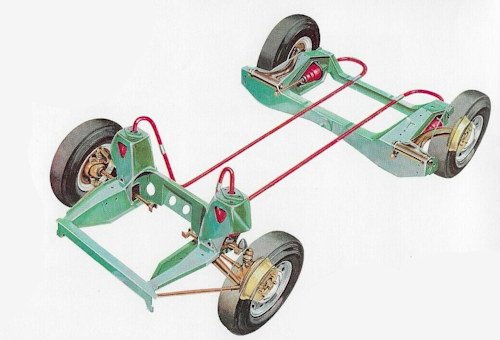
The A series 998 cu cm engine with Three-bearing crankshaft, came fitted with a single SU type HS 2 semi-downdraught carburettor with compression ratio of 8:3. Remote control gear change. Combined transmission casing and oil sump below engine crankcase. Transversely mounted power unit with main-shaft in constant mesh with differential assembly mounted on side of transmission casing.
PERFORMANCE :Wolseley Hornet 998 cc
- Engine capacity: 60.90 cu in, 998 cu cm
- Fuel consumption: 40.3 m/imp gal, 33.6 m/US gal, 7 1 x 100 km
- Max speed: 76 mph, 122.4 km/h
- Max power (SAE) 41hp at 5,7250 rpm
- Specific power: 41.1 hp/l
- Power- weight ratio: 34.4 lb/hp, 15.6 kg/hp
- Acceleration: standing 1/4 mile 22.5 sec, 0—50 mph (0—80 km/h) 14.7 sec
ELECTRICAL EQUIPMENT: double dipping headlamps with prefocused bulbs: foot dipping switch; side lamps; twin stop and tail lamps; rear reflectors, rear number-plate lamps ; instrument lighting; roof lamp with courtesy switches operated by doors ; dual-arm windscreen wipers ; Windtone horn flashing direction indicators with automatic cancelling. control: ignition, oil filter, headlamp main-beam, and flashing signal warning lights.
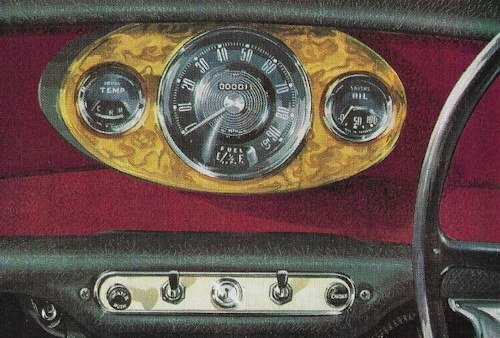
INSTRUMENTS: Speedometer with total mileage recorder; fuel gauge: oil pressure gauge; water temperature gauge.
CONTROLS: Heater switch; windscreen wiper switch;combined ignition and Starter switch on fascia; lighting switch ; mixture control ; windscreen washer control ; panel light switch.
BASIC EQUIPMENT: Safety glass all round; large curved windscreen and rear window ; safety driving-mirror ; windscreen washer; pile carpet floor covering with extra-heavy underfelt; separate front seats; large parcel trays in front compartment and behind rear squab; large pockets in each door; companion box at each side f rear seat with ashtray; washable headlining; hinged quarter-lights; road wheel trims; bright sill finishers; 2 crushable sun visors; ashtray with lid above fascia ; extensive sound insulation to body, including bonnet insulation provision for fitting radio and BMC seat belts.
30,912 Riley Elf’s and 28,455 Wolseley Hornets were built. Production of both models ceased in late 1969.The Riley Elf was discontinued in 1969, and the Riley name disappeared from the circle of automakers. The Wolseley Hornet was built until 1970. A luxury version of the mini also modified aesthetically capable of taking the place of the discontinued Hornet and Elf was introduced for 1970.
Front-end which incorporated each marque's traditional upright grille design the Hornet's grille with a lit "Wolseley" badge and additional chrome accents, bumper overriders and wood-veneer dashboards The full-width dashboard was a differentiator between the Elf and Hornet. Wolseley Hornet's bodies were built at Fisher & Ludlow under their "Fisholow" brand name. Plates in the engine compartment on the right-side fitch plate bear evidence of this speciality.
Vehicle identification serial number code:
- First prefix letter – W-Wolseley
- Second prefix letter – engine type: A
- Third prefix letter – body type: 2S – 2-door Saloon
- Fourth prefix – series of model: 3 – 3rd series
- Fifth prefix (used to denote cars different from standard right-hand drive): L – left hand drive