

Simca Jangada
 |
|
|
Production |
1962 to 1966 |
|
Manufacturer |
Simca Brazil |
|
Class |
Motor car |
|
Bodywork |
station wagon |
|
Engine |
2351cc |
|
wheel base |
105.90 in, 2,690 mm |
|
Length |
185.83 in, 4.720 mm |
|
Width |
69.68 in, 1,770 mm |
|
Height |
57.09 in, 1,450 mm |
|
Weight |
3,131 1b, 1,420 kg |
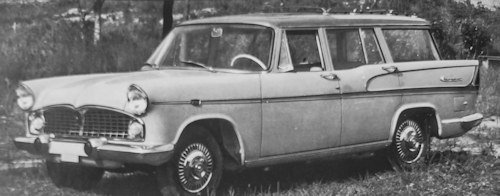
The Simca Jangada was the first large station wagon manufactured in Brazil in the 1960s, starting in 1962.
History
The combination rear wheel drive station wagon from the Chambord was called Jangada. It was a "tropicalized" version of the French Simca Vedette Marly estate wagon, but with its structure reinforced to withstand the adverse conditions of Brazilian roads. It could comfortably accommodate six adults and two children on folding seats.
The Jangada was a vehicle of a more luxury type and followed very closely the French edition of Chambord based on the Simca Vedette . The engine was that of Ford acquired Ford Flathead V8 engine with 2.4 litre displacement and first 62 kW (84 hp) at 4800 / min and 155 Nm at 2750 / min. Fitted with a single-disc dry clutch, a partially synchronized three-speed gearbox and a one-piece propeller shaft with rear wheel drive. At thefront there was MacPherson type suspension and a castor steering the rear suspension: rigid axle, semi-elliptic leafsprings, telescopic dampers. All wheels had hydraulically operated drum brakes, front duplex, called "Twinplex".
First, it was made from imported parts from France.Like the other models derived from the Simca Vedette, the Jangada had a serious power problem (the original V8 engine had only 92 hp, which made it difficult to transport the 1800 kg of cargo that the station wagon could theoretically carry). .
PERFORMANCE
- engine capacity: 147.30 cu in, 2,414 cu cm
- fuel consumption: 18.8 ml imp gal 15.7 US gal
- max speed:87 mph. 140 km/h
- max power (SAE): 100 hp at 4.800 rpm
- max torque (SAE): 120 lb ft.at 2,750 rpm
- max engine rpm: 5,400
- power-weight ratio: 31.3 lb/hp, 14.2 kg/hp
Only 2705 vehicles were produced at the Simca do Brazil factory from 1962 to 1966, in São Bernardo do Campo, of which few are still in circulation.

