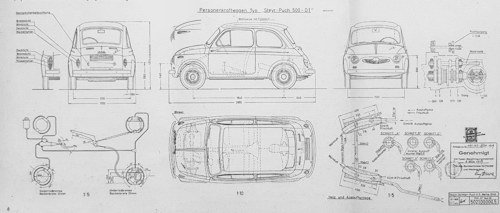
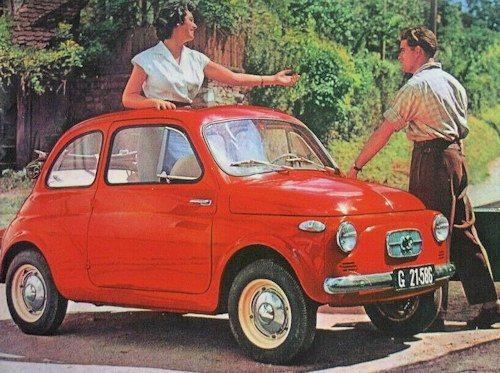
Steyr-Puch 500,650,700
 |
|
|
Make: |
Steyr-Puch |
|
Production period: |
1957 to 1973 |
|
Class: |
Motor Car |
|
Body versions: |
Saloon, Estate |
|
Engines: |
0.5–0.66 litres |
|
Length: |
2970-3054mm |
|
Width: |
1320-1374mm |
|
Height: |
1302-1325mm |
|
wheelbase: |
1840mm |
|
curb weight: |
470-580kg |
The Steyr-Puch 500 was a small car based on the Fiat 500 from the Puch works also as just Steyr 500 (Group of Steyr-Daimler-Puch AG in Graz).
History
In 1957 the Steyr-Puch 500 model Fiat was introduced. A 2 door, 4 seat rear-engine, rear-wheel drive car. For cost reasons, in-house body production was dispensed with and the body shell of the Fiat Nuova 500 was taken over. The air-cooled boxer engine for this vehicle with around 16 hp enabled good performance for the time, especially when driving uphill. The Steyr-Puch was clearly superior to the Fiat 500 with an in line engine, with the same fuel consumption and smoother running.
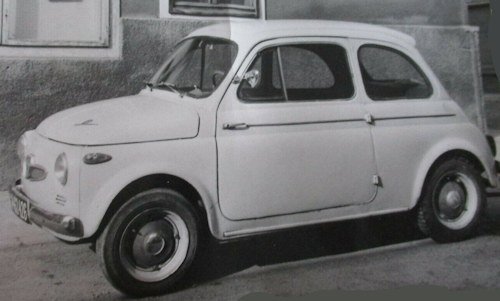
The gearbox, which was fully synchronized from the start, was also progressive and advantageous on mountainous roads. In the total braking surface of the drum brakes (total 66.98 sq in, 432 sq cm). However, the Fiat outperformed the Steyr-Puch by 18%.The chassis type was integral with the front suspension independent,wishbones, transverse leaf-spring lower arms and telescopic dampers, The rear suspension also independent, swinging trailing radius arms, coil springs and telescopic dampers.
The following models were made: The 493cc models 500,500d, 500DL.The 493cc model continued untill 1973
PERFORMANCE:493cc (1957-1973)
- engine capacity: 30.08 cu in, 493 cu cm
- fuel consumption:56.5 m/imp gal, 47 m/US gal, 5 1 x 100 km
- max speed: 65.2 mph, 105
- max power (DIN): 19.8 hp at 4,600 rpm
- max torque (DIN): 25 1b ft, 3.4 kg m at 2,800 rpm
- max engine rpm: 5,000
- specific power: 40.2 hp/l
- power-weight ratio: 57.8 lb/hp, 26.2 kg/hp
Built along with larger 643cc models 500 d and 700 E C (estates) in the 1960s
PERFORMANCE: 643cc (1961-1968)
- engine capacity: 39.24 cu in, 643 cu cm
- fuel consumption: 45.5 m/imp gal, 37.9 m/US gal, 6.2 1 x 100 km
- max speed: 67.7 mph, 109 km/h
- max power (DIN): 25 hp at 4,800 rpm
- max torque (DIN): 30 1b ft. 42 kg m at 3.000 rpm
- max number of engine rpm: 5,600
- specific power: 38.9 hp/l
- power- weight ratio: 51.2 lb/hp. 23.2 kg/hp
followed later in the 1960s with the 660cc models 650 TR and TR II and with the last version in the 1970s the 126 version. From 1959, Fiat took over the entire body including the roof (Puch 500 D). For rationalization reasons, from 1969 all the technology, including the transmission, came from Fiat and only the engine from Puch. From 1973, for a short time instead of the Fiat Nuova 500, the successor Fiat 126 was equipped with boxer engines.
PERFORMANCE: 650 TR 660cc (1964-1969)
- engine capacity: 40.27 cu in, 660 cu cm
- fuel consumption: 51.3 m/imp gal, 42.8 m/US gal, 5.5 1 x 100 km
- max speed: 79.5 mph, 128 km/h
- max power (DIN): 30 hp at 5,500 rpm
- max torque (DIN): 33 1b ft, 4.5 kg m at 3,500 rpm
- max engine rpm: 6,200
- specific power: 45.5 hp/l
- power-weight ratio: 36.8 lb/hp, 16.7 kg/hp