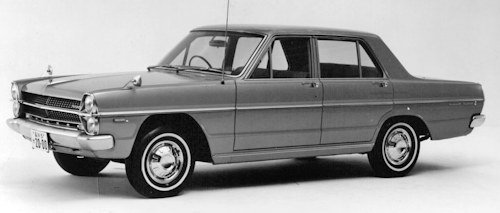
Nissan Gloria 3rd generation (A30 type)
 |
|
|
Production |
April 1967 to February 1971 |
|
Class |
Motor Car |
|
Bsody type |
4 door sedan and station wagon van |
|
Drive system |
FR |
|
Engine |
2.0L straight 6 and 2.0L straight 4 |
|
Transmission |
3-speed AT / 4-speed MT / 3-speed MT |
|
Wheelbase |
105.90 in, 2,690 mm |
|
Length |
184.65 in, 4,690 mm |
|
Width |
66.75 in, 1,695 mm |
|
Height |
56.90 in, 1,445 mm |
|
Weight |
2,690 1b, 1,220 kg |
|
maximum speed |
99.4 mph 160km/h |
The 3rd generation Nissan Gloria A30 type series was built from 1967 to 1961 in Japan by now Nissan.
History
In April 1967, the still developed by Prince Gloria type A30 appeared as Nissan. The new angular body was now much more modern.
The elaborate DeDion rear axle gave way to a simple rigid axle, The drive took over initially the prince two-litre six-cylinder, which was replaced in 1969 by a Nissan six-cylinder same displacement. There were also offered a four-door sedan (Gloria, Gloria Super 6 and Gloria Super Deluxe) and a five-door station wagon (Gloria Van and Van Deluxe). The car name given was the " Nissan Gloria ". However, the car name on the inspection certificate was still "Prince" (originally Prince was developing it as "S6 series").
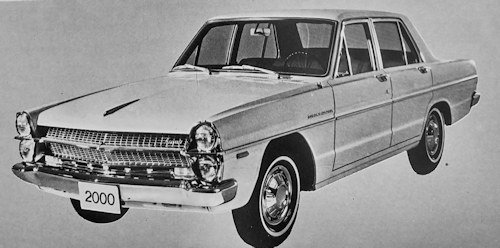
The 4-light headlamps with both sides of the front lined up vertically are similar to the Nissan Prince Royal, which was developed by Prince like Gloria and announced after the merger with Nissan (however, there was no sharing of body parts), so it was called "Royal" at that time.
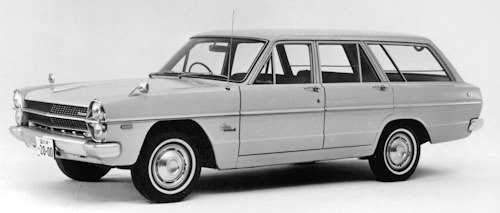
It is also called by nicknames such as "Vertical Gloria" and "Tategro" due to its distinctive front headlight design. This design was influenced by American cars around in the 1960s. The grade levels at the time of release are the super deluxe, super 6 (6 cylinders or more) fitted with a single Nippon-Kikaki downdraught twin barrel carburettor, standard (4-cylinder gasoline / LPG), van deluxe (6 cylinders), van standard (4 cylinders). Later an GL, which is a luxurious version of Super Deluxe, was added. Auto cars were also set for 6-cylinder cars, and they were often used in private taxis. Since development even during the merger drama, the sharing of parts with Cedric range was used. The traditional de Dion axle used for the rear suspension has given way to a simple more traditional leaf type the distribution of weight was 54.5% to the front axle and 45.5% rear axle. Also, from this model, following the second-generation Skyline, the Prince system shifted to a complete monocoque type body. The 6-cylinder engine was the G7 unit, a direct descendant of the prince (PA30), and the 4-cylinder was the Nissan H20 from the beginning (A30).
PERFORMANCE: Super Six
- Engine Capacity 121.31 cu in, 1,988 cu cm
- Fuel Consumption 23.5 m/imp gal, 19.6 m/US gal, 12 1 X 100 km
- Max Speed 99.4 mph, 160 km/h
- Max power (SAE): 106 hp at 5,400 rpm
- Max torque (SAE): 116 1b ft, 16 kg m at 3,800 rpm
- Max engine rpm: 6,200
- Specific power: 53.3 hp/l
- Power-weight ratio. 25.4 lb/hp, 11.5 kg/hp
- Acceleration: standing 1/4 mile 19.9 sec
The standard specification price in the Tokyo area is 1,015,000 yen for Super 6. The standard was 755,000 yen. The production volume of the third generation is about 50,000
- April 1967 - Released.
- October 1968 - Minor change. Changes such as a facelift to front.
- November 1969 - Minor change. The 6-cylinder engine is changed to Nissan's L20 type (HA30).
- October 1970 -Added GL equipped with power steering etc.