Hillman Imp MK II
 |
|
| Overview | |
|---|---|
| Manufacturer | Rootes Group |
| Class | Motor Car |
| Production | 1965 to 1968 |
| Assembly | Linwood, Scotland Australia Petone, New Zealand |
| Body style | 2-door coupe 2-door saloon 3-door estate |
| Layout | RR layout |
| Engine | 875 cc Straight-4 Overhead camshaft |
| Transmission | 4-speed manual all-synchromesh. |
| Wheelbase | 2,082 mm (82.0 in) |
| Length | 3,581 mm (141.0 in) |
| Width | 1,524 mm (60.0 in) |
| Height | 1,385 mm (54.5 in) Saloon 1,330 mm (52.4 in)Coupe 1,475 mm (58.1 in)Hillman Husky |
| Kerb weight | 725 kg (1,598 lb) |
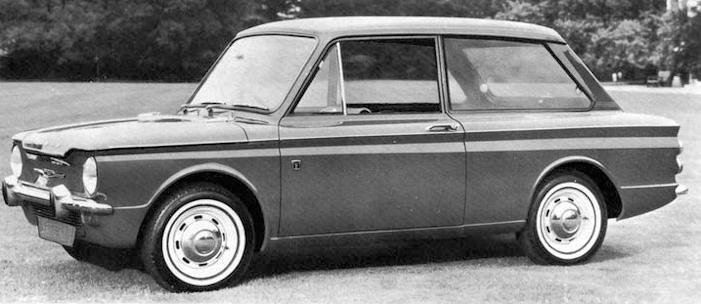
The Hillman Imp Mk II was a compact, rear-engined saloon car, manufactured under the Hillman marque by the Rootes Group in the 1960s.
History
At the end of 1965 a major revision to the Imp was introduced, effectively splitting the marque into Mk I and Mk II cars.The next generation of the Hillman Imp came along with the small van, the Commer Imp, was introduced in November 1965 and an estate version, using most of the same panels but with side windows behind the b-pillar, known as the Hillman Husky was produced from 1967.The Mk I Imps had a pneumatic throttle linkage and an automatic choke, both of which were replaced by more conventional items on the Mk II. The Mk II also had improved front suspension geometry and several trim and detail changes. Although the car was constantly improved over its production life, there was no single change as significant as that in 1965.
The Imp is that it is fun to drive. with integral chassis the front suspension is independent, U-shaped with swinging semi-axles, coil springs, telescopic dampers. It has a semi-trailing arm independent rear suspension system the distribution of weight was 38% to the front axle, and 62% rear axle. accurate rack-and-pinion steering with turns of steering wheel lock to lock of 2.63. coupled with excellent handling mean that the car goes where it is pointed, a superb gearbox allows changes rapidity, and an engine mounted behind the rear wheels, slanted over at 45° to fit. This was done to keep the center of gravity low and to minimise its effects on the roadholding of the car. with output of 39 b.h.p from a single Solex B 30 PlH-5 semi-downdraught single barrel carburettor and from 875 c.c light-alloy engine. With a maximum speed of 75.5 m.p.h. and a 0-50 m.p.h. acceleration time of 16.0 sec. The engine can be revved to 6,000 r.p.m. without any protest. Despite a compression ratio of 10: l, there was no pinking with 98 octane premium grade fuel, with an overall consumption of 31.3 m.p.g.
The ride is firm and comfortable and is certainly as good as that o fmost small cars from the time. the layout of the controls: the lights switch, wiper switch, indicator stalk, horn and flasher. Immediately in front of the left-hand side of the steering wheel is the lights switch with the dip/flash stalk just above other side is thc wiper switch and the indicator/horn stalk. The combined temperature gauge, speedo mounted in the binnacle and easy to read. The three additional, optional extra instruments such as clock, oil pressure gauge and ammeter along with three ashtrays.While room in the facia parcel shelf, two rear side pockets and two door pockets, The rear luggage compartment behind the
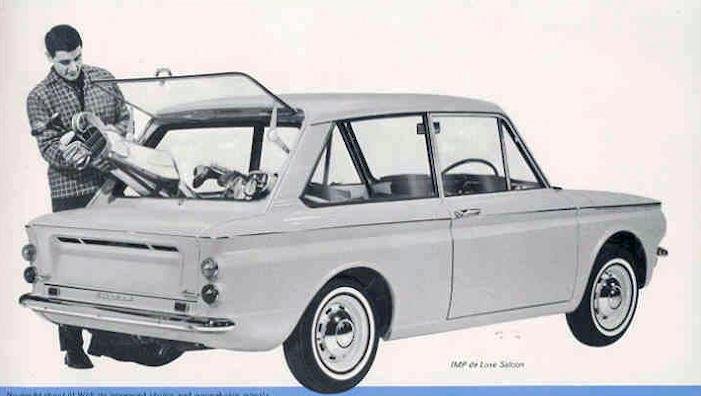
seats holds more than the front boot, and can be increased in capacity by folding the rear seats forward, so that in conjunction with the opening rear window.The opening rear window was intended to make it easier to load the small luggage area behind the fold-down rear seat. The fold-down nature of the rear seat was itself unusual in small car design at the time, being more often associated with larger upmarket estate cars.
PERFORMANCE
- Engine Capacity 53.39 cu in, 875 cu cm
- Fuel Consumption 43.7 mlimp gal, 36.2 mlUS gal, 6.5 1 x 100 km
- Max Speed 83 mph, 133.6 km/h
- max power (SAE): 42 hp at 5,000 rpm
- max torque (DIN): 52 1b ft, 7.2 kg m at 2,800 rpm
- max number of engine rpm: 6,000
- specific power: 48 hp/l
- power weight ratio: 35.5 lb/hp, 16.1 kg/hp
- acceleration standing 1/4 mile 21.8 sec, 0—50 mph (0—80 km/h) 14.7 sec
Imp Mk II variants
- Hillman Imp de Luxe Mark I & Mark II (1965-1968)
- Hillman Super Imp (1965-1968)
- Hillman Imp (1968-1968)
- Hillman GT (1967-1968) Developed by Chrysler Australia from the Singer Chamois Sport, it was never badged nor officially referred to as the Hillman Imp GT
- Hillman Imp Californian (1967-1968) Coupé / fastback saloon version
- Hillman Husky (1967-1968) Estate version of the Imp
- Commer Imp Van (1965-1968)