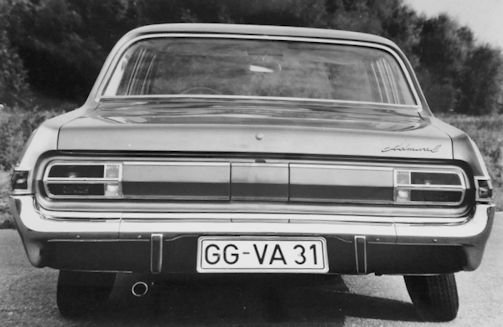
Opel Admiral A
 |
|
|
Production period: |
1964 to 1968 |
|
Class : |
Luxury Car |
|
Body versions : |
Sedan |
|
Engines: |
Petrol :2.6–5.4 litres |
|
Length: |
4948mm |
|
Width: |
1902mm |
|
Height: |
1494-1510mm |
|
Wheelbase : |
2845mm |
|
Curb weight : |
1350-1610kg |
The Opel Admiral A was built from 1964 to 1968 in Germany.
History
Only in April 1964, after the captain had been the Opel top model for more than 15 years, was offered with the Opel Admiral again as the model of this name. It had the same rectilinear body as the Opel Kapitan A and also newly built top models Opel Diplomat A with V8 engine .The Admiral was a more upper-class models that were built from spring 1964 to autumn 1968 by Adam Opel AG in Rüsselsheim , which at the time belonged to the US automobile group General Motors (GM) as can be seen by the style . The A indicates that this is the first version of the model series. The cheapest model was the Captain, the Admiral model as the successor to the Captain P 2.6 had better equipment and the top was the Diplomat with reinforced chassis, standard V8 engines and further improved equipment. The KAD A series was replaced in the spring of 1969 by the KAD B series, whose bodies were somewhat smaller and smoother
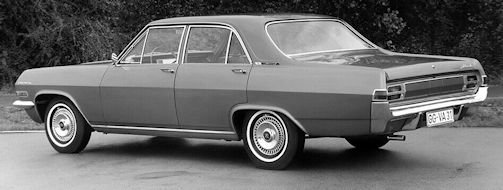
The Admiral A was a version of the Captain A that had been upgraded in various details, essentially the “L” model like the Captain P “L” before it. The name was adopted from the pre-war Admiral model, which was built from spring 1937 to autumn 1939.The Admiral A had a grid-shaped radiator grille. While the Captain A only had chrome-decorated door sills, the Admiral A had chrome-lined wheel cutouts. From September 1967 there was also a chrome-plated side protection strip.With the start of the 1966 model year, the Opel lettering on the front fenders was eliminated in September 1965, and at the same time the Opel name appeared in the radiator grille. In September 1967, the Admiral lettering was moved from the rear roof posts to the front fenders. The Admiral A was produced in 55,876 units from April 1964 to November 1968, of which 31,318 units were the 2.6 Liter engine offered until August 1965, the best-selling model in the KAD A series.
The new self-supporting body was essentially identical and its design was based on the Chevrolet Nova . The striking rectangular headlights with prismatically edged lenses and the wide-beam fog lights under the bumper, which are available as optional accessories, gave the KAD-A series an independent, harmonious appearance. Overall, however, the design of the KAD-A series in Germany was often perceived as too American.The new body was connected to a conventional chassis, consisting of a rear rigid axle with long, longitudinal two-leaf springs and independent front wheel suspension with coil springs , wishbones and internal shock absorbers . All KAD models had a dual-circuit brake system with front disc brakes and a brake booster .
The range of engines corresponded to that of the captain A. From March 1965, the Admiral V8 was also offered with the 140 kW (190 hp) 4.6 Liter Chevrolet V8 engine, which powered the car, which weighed over 1.5 tons, in just under 10 Accelerated from 0 to 100 km/h in seconds and reached 200 km/h. However, only 623 copies of this model were delivered, which was much more expensive than the Admiral with a six-cylinder engine.
The new litre six-cylinder engine developing 140 HP at 5200 r.p.m. With its extremely short stroke, precise timing of the slanted-position valves in the wedge type combustion chamber, crankshaft with 7 main bearings, and twin barrel carburetor (with automatic choke) the new power plant shows all design features of an elastic high performance engine. The car comes with standard front disc brakes, dual circuit power brake system, and accelerates from 0—100 km/h (0—62 MPH) in 13,9 seconds, top speed is about 170 km/h
(106 MPH). The 2.6 Liter six-cylinder in-line engine with a four-bearing crankshaft and side camshaft from the previous captain was improved and now achieved 73.5 kW (100 hp) at 4600 rpm and 181 Nm at 2400 rpm. For the first time, Opel used maintenance-free hydraulic lifters , which made checking and adjusting the valve clearance unnecessary. However, this engine soon no longer met the rapidly increasing demands in the luxury class, so in September 1965 the newly designed Opel CIH six-cylinder in-line engine was launched as the “2.8 S” with a seven-bearing crankshaft, overhead camshaft and register carburettor , 2.8 Liter displacement and 92 kW (125 hp) followed. From 1967 it was equipped as the “2.8 HL” (“high-performance engine”) with two Zenith register carburettors and thus achieved 103 kW (140 hp).
- PERFORMANCE: 2,605 cu cm
max power (SAE): 117 hp at 4,700 rpm
max torque (SAE): 145 1b ft, 20 kg m at 3,000 rpm
max number of engine rpm: 5,000
specific power: 44.9 hp/l
Engine capacity: 158.96 cu in, 2,605 cu cm
Fuel consumption: 23.9 ml imp gal, 19.9 ml US gal, 11.8 1 x 100 km
Max speed: 100 mph, 161 km/h
power-weight ratio: 25.8 lb/hp, 11.7 kg/hp
acceleration: 0—50 mph (0 —80 km/h) 9.2 sec
max speeds: 31.1 mph, 50 km/h in 1st gear; 49.7 mph, 80 km/h in 2nd gear; 78.3 mph, 126 km/h in 3rd gear; 100 mph, 161 km/h in 4th gear - PERFORMANCE: 2,784 cu cm
Engine capacity: 169.88 cu in, 2,784 cu cm
Fuel consumption: 22.9 m/imp gal, 19.1 m/US gal, 12.3 1 x 100 km
Max speed: 105.6 mph, 170 km/h
max power (SAE): 140 hp at 5,200 rpm
max torque (SAE): 161 1b ft, 22.2 kg m at 3,000-3,900 rpm
max engine rpm: 5,600
specific power: 50.3 hp/l
power-weight ratio: 20.1 lb/hp, 9.1 kg/hp
acceleration: 0—50 mph (0—80 km/h) 9.2 sec
max speeds: 32.3 mph, 52 km/h In 1st gear; 51.6 mph, 83 km/h in 2nd gear; 81.4 mph, 131 km/h in 3rd gear; 105.6 mph, 170 km/h in 4th gear
Now as before the Admiral is also built with 4,6 litre V 8-engine and automatic transmission (acceleration from 0—100 km/h, (0—62 MPH) in 11 seconds, top speed about 200 km/h (124 MPH).
After the Opel Regent with an eight-cylinder in - line engine , which was briefly offered at the end of the 1920s, Opel now once again had an engine with eight cylinders in its range: The V8 engine came from the Chevrolet division of the parent company General Motors (engine designation 283V). This produced 140 kW (190 hp) at 4600 rpm, produced approx. 347 Nm at 3000 rpm and was initially only available in the Diplomat.V8 engines were also installed to a small extent in the Captain and Admiral from 1965 onwards.
The engines were initially combined with a standard 4-speed steering wheel gearshift . Centre shift lever or two-speed Powerglide automatic from General Motors (already with kickdown function) with shift lever on the steering wheel could be delivered for an additional charge. The V8 engines were generally delivered in combination with an automatic transmission with a centre selector lever.
The production of this series was finished in November 1968.
Production figures KAD Between 1964 and 1968
|
Year |
1964 |
1965 |
1966 |
1967 |
1968 |
total |
|
2.6 Admiral |
19,904 |
11,414 |
|
|
|
31,318 |
|
2.5 Admiral Austria |
|
|
326 |
51 |
|
377 |
|
2.8 Admiral |
|
5,776 |
11,688 |
3,366 |
2,728 |
23,558 |
|
4.6 Admiral |
1 |
236 |
221 |
104 |
61 |
623 |