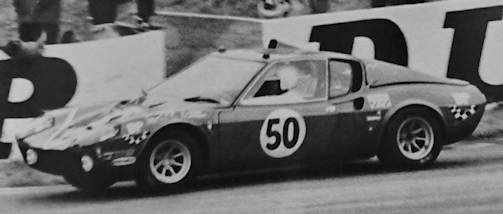
Ligier JS1 Racing sports car
 |
|
|
Production period: |
1969 to 1970 |
|
Class: |
Race Car |
|
Body versions: |
Coupe |
|
Engines: |
Ford various |
|
Length: |
155.51 in, 3,950 mm |
|
Width: |
66.14 in, 1,680 mm |
|
Wheelbase: |
90.55 in. 2.300 mm |
|
Dry weight: |
1,323 lb. 600 kg |
The Ligier JS1 was a racing sports car, built in 1969 by Ligier and 1969 and 1970.
History
The JS1 was presented in September 1969 at the Paris Motor Show. The car was a mid-engine racing car with a tubular frame. The racing prototype built by the French driver Guy Lgier as the basis of a limited production of high-performance touring cars gears the initials JS in memory of his close friend, the racing driver Jo Schlesser, who died tragically.
The body made of fiberglass-reinforced plastic had been developed by Pietro Frua. The Chassis a tubular frame with sheet reinforcements and independent front and rear suspension Guy Ligier himself raced in 1969 with the 1.6-liter variant a first race, but fell out at the national event with bearing damage.
The commercial version for sale has a Ford engine with larger V6 capacity of 2,500 cc but the race version a four-cylinder highly tuned Ford Cosworth for racing Originally a 1.6-liter Cosworth engine was installed, which was replaced in 1970 by a Cosworth FVC. This increased the engine output from 220 to 240 hp (164 to 184 kW).
Ligier won in 1970 with the JS1 sports car race in Albi and Montlhéry, before the team came for the first time to the 24-hour race at Le Mans. The 1970 race marks Ligier's entry into international motorsport. As a partner, Jean-Claude Andruet was obliged, who already had some success in racing. The duo qualified the car in 13th place and was among the top ten in the overall standings when the race had to be abandoned after eight hours due to persistent problems with the ignition distributor.
At the Tour de France for automobiles in 1970 Ligier sat two factory cars. Both cars received new engines. A vehicle received a 2.6-liter V6 engine from a Ford Capri, the second car was equipped with a 2.4-liter Weslake. Both cars failed, however.
Ligier built only three JS1, since 1970 was already working on the successor model, the JS2. A car has been exemplary restored and is since 2004 repeatedly seen at events for historic racing cars. The JS1 was the first race car built at Ligier. Already in 1968, Guy Ligier had the idea to develop a sports car based on the Porsche 911. But only the former Renault technician Michel Tetu, who came to Ligier in 1969, brought the project to work