

VW Polo II
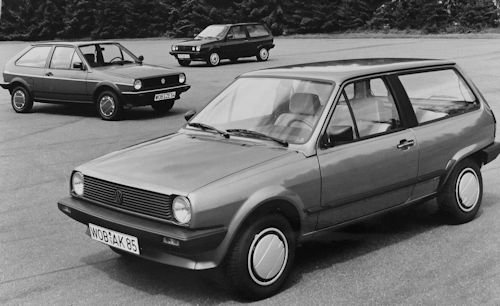 |
|
|
Production period: |
1981 to 1994 |
|
Class : |
Motor car |
|
Body versions : |
sedan , combo coupe |
|
Engines: |
|
|
Length: |
3655 or 3725 mm |
|
Width: |
1570 mm |
|
Height: |
1325-1350 mm |
|
Wheelbase : |
2335 mm |
|
Curb weight : |
725-830 kg |
The Polo II is a vehicle model from Volkswagen , which was manufactured from September 1981 to July 1994.
Bult in the factories Wolfsburg , Moselle and Pamplona (Spain) in total about 1.7 million made. It was only three-door with steep or hatchback (coupe), with four- or five-speed manual, front-wheel drive and front transverse engine installed. There was a choice of gasoline engines from 29 kW (40 hp) to 85 kW (115 hp) or diesel engines with 33 kW (45 hp) and 35 kW (48 hp). Characteristic of the Polo II are especially the front triangle windows, which did not fall away (as after a revision of the Golf II in the summer of 1987).
The second-generation Polo models have made a name for themselves as cheap and robust small cars, especially for novice drivers and minimalists. The safety equipment was at the end of construction no longer up to date and the comfort equipment was usually kept economical.
History
The Polo 86C was built for a total of 13 years - almost as long as the predecessor 86 and the successor 6N together. The Polo went through in addition to the large facelift in October 1990, several small "lifts".
The first Polos had partly thin partially chrome-plated plastic strips - if they had any - relatively high above the entire length of the vehicle. Later, there were only plastic bumpers between the wheel arches at the height of the bumper. The first polos also include the large steering wheels with bony thin steering wheel rim. Over time, all polos got smaller, thick foam wheels. The reversing lights were also changed: The first models had only a small illuminated area with red frame, while later a completely white diffuser was introduced.
In October 1981, VW introduced the successor to the first Polo generation, which was initially available only with hatchback . With a generous trunk for this class, which can be increased by flipping the back seat, can even transport goods the size of a washing machine. The first vehicle left on 17 September 1981, the Wolfsburg factory.
At the beginning there was the Polo in the equipment versions C , CL and GL with the following engines:1.05 l - 29 kW (40 hp)1.1 l - 37 kW (50 hp)1.3 l - 44 kW (60 hp) Formula E with higher compression , rear tread edge and economy indicator based on the 50 hp engine
In February 1982, followed by the new edition of the notchback variant Derby . The third body variant, the Polo Coupé followed in August 1982. It differs from the hatchback by a shallow sloping rear window and was designed from the outset rather on sportiness. Therefore, the newly developed 1.3-l 55 kW engine (75 hp) for the time being was only available for the coupe in the new trim variant GT , also there was the coupe as CL and GL . Even today, the coupe is the most popular body variant of all polos.
In August 1983 replaced a new 1.3-liter engine ( VW EA111 ) with 40 kW (54 hp), the previous engines with 50 and 60 hp.
In March 1984, the production of the Polo began in Seat -Werk Pamplona (Spain), which was later acquired by Volkswagen AG. In August 1984, the upscale GL version disappeared. In return, the CL equipment was upgraded. From now on, the Polo Coupé was also available with the 29-kW engine and the GT equipment was now also available with the 40-kW engine. At the same time, Volkswagen introduced the new car radio generations alpha , beta and gamma .
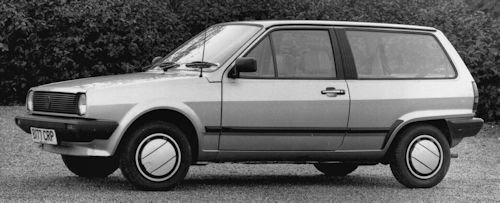
In January 1985, the derby was renamed Polo notchback . At the same time this got round headlights.
From August 1985, one could order the city delivery van with truck registration. For this one got a hatchback without back seat, but with unglazed side walls, luggage compartment linings and divider behind the front seats. Especially small craft shops or retailers should be addressed. In addition, you could now order the coupe in the C equipment.
In the same month, the 1.05-liter 29 kW (40 hp) engine was replaced by a new 1.05-l-33 kW (45 hp) engine. In addition, the coupe was presented as a top model GT G40 .
In July 1986, VW introduced a 1.3-liter diesel engine with 33 kW (45 hp) for the Polo. A month later, in August 1986, accounted for the equipment variant C .
From August 1987, limited to the Polo on three trim levels - Fox , CL and GT . The CL variant was slimmed down a bit, the GT was upgraded slightly. The Fox was created as a new base model out of a former special edition. The 1.3-l 55 kW engine (75 hp) was now also available for the hatchback .
In August 1989, VW upgraded all model variants.
As the last modification of the model program before the big facelift was from April 1990, an electric folding sunroof available as an optional extra. From May 21, 1990, the Polo was also assembled in Mosel : First of the IFA.
1990-1994: Polo 86C "2F"
In October 1990, a comprehensive facelift of the Polo. In the interior, a new dashboard with more shelves, raised radio shaft, knobs for heating and ventilation and redesigned instruments space. In addition, with the facelift new steering wheels, fully panelled doors and rear side walls, new pitman arm and for the first time two front speaker shafts were installed.
Outside, the Polo was also revised. The bumpers have been designed larger area to make them less sensitive for small damage. The front end and the rear end were redesigned, which caused a change of the side parts in the connection area to the car's rear. Larger square headlights provide up to 50% higher road illumination and larger rear lights for more active safety. The front turn signals were mounted with the 86C "2F" next to the headlights, so that they were also recognizable from the side. The c w value of the Polo 86C improved by 10% in 1990. This was the rear window at the hatchback and coupe glued flush and the front end was rounded. Therefore, it is often referred to as Polo 2F ( Facelift).
The introduction of the Polo 86C successor, the Polo 6N (or the real Polo 3) was planned by VW earlier than in 1994, but due to the enormous success of the Polo 2F, the plans were postponed several times. Particularly diverse special models such as the Polo "Genesis" with a particularly sporty special equipment ex works and special colours in the interior ensured high sales figures. Other attractive special models included Polo Boulevard, Universal, Style, Scot and GT Extra.
On September 12, 1991, the installation of the Polo was reinstated in Mosel. Since May 1990, a total of 17,978 polos has been produced in Moselle.
In August 1991, the equipment variants Fox , CL , GT & G40 were upgraded. All Polo's got stiffeners in the doors to protect them from side impact, as well as automatic three-point belts on the outer rear seats and side flashing lights.
Further equipment enhancements were: Fixed luggage compartment cover and passenger sun visors with make-up mirror for the Fox interior adjustable exterior mirrors for Fox and CL, side luggage compartment trim and three-spoke steering wheel for CL. From CL equipment there is a holder for first aid box and warning triangle; in the GT the driver's seat is height adjustable. In the Polo G40 fog lights, white flashing lights front and partially darkened rear lights are installed as standard, also received the model a leather cover on the steering wheel and shifter. The electric folding sunroof was taken from the model program with model year 1992 (from August 1991).
In July 1994, the last Polo 86C rolled off the line . Successor was the Polo 6N .
G40
The most powerful variant of the Polo Coupé was presented in August 1985, the 'G40' with 85 kW (115 hp) at 6000 / min and with a torque of 148 Nm at 3600 / min based on the 1.3-l engine. The extra power is built up by a scroll compressor , which acts as a compressor . The intake air is compressed by the belt-driven G-charger, allowing more fuel to be injected without greasing the mixture. The G-charger is contrary to the statements of the manufacturer not maintenance free. Depending on engine speed and mileage, various components may wear due to their design, which can lead to limited function or destruction of the G-charger. However, the function of the G-charger can be backed up regularly by regular moderate revisions with suitable spare parts to several hundred thousand kilometres.
During development, an upper limit was set. In order not to exceed the load capacity of the standard 5-speed gearbox, the engine was not allowed to deliver more than 150 Nm of torque, because the redevelopment of a more powerful gearbox would have been too expensive. To get the performance on the road, the intercooled GT G40 has a custom chassis with a 30/20 mm (VA / HA) lowered body, ventilated front disc brakes and 175/60 R 13 tires on aluminium wheels. Furthermore, the front axle has been improved by UniBall bearings on the control arms and tie rods.
In May 1987 left for the first time a special series of 500 black Polo Coupe GT G40 based on the "old" Polo 86C factory. He received a speedometer to 240 km / h with a trip meter. The vehicle key number was 719. One year later, due to the high demand, 1500 vehicles were produced, of which 500 were delivered to France. The Coupé was now also available in the colours white, tornado red, traffic purple, blue (Helios blue metallic) and black. Only in January 1991, the Polo G40 , as he has since been called only, based on the Polo 2F included in the regular model program. The car initially cost 25,690 DM . The performance shrank due to the catalyst from 85 kW (115 hp) to 83 kW (113 hp). Identification marks of the G40 were BBS aluminium wheels in the size 5½ J × 13, and fenders, a roof antenna, red trim strips in the bumpers, G40 emblems in the grille and on the tailgate, sports seats with checkered Le Mans covers and a speedometer up 240 km / h. From August 1991, additional fog lights and white turn signals, partially darkened taillights, and leather steering wheel and leather gear knob were standard. The vehicle key number was 844.
Eco-Polo
Also was the experimental vehicle called Eco-Polo . Of the series production series of the 86C created in 1988 of 70 planned copies exactly 50 pieces that have been tested by public institutions (public order, charities) in everyday life. This variant was always delivered in the colour alpine white with rainbow stripes on the sides; The eco-Polo was aerodynamically optimized only by a small front spoiler. Inside, except for the missing clutch pedal and the boost pressure display everything is the same as in the production version, only some special instruments indicate the special technique. The model was designed for maximum economy and had a diesel engine with 860 cc displacement. The two-cylinder direct injection was calmed with a balance shaft and counterweights on the crankshaft in the barrel. The G-Charger from the G40 switched on when needed electrically and raised the power from 27 hp to 40 hp. So, the Polo reached a top speed of 138 km / h. With semi-automatic 5-speed gearbox from the Spar Golf The eco-Polo could reach a standard consumption of 3.6 Liters. On a test drive of the car magazine Auto Motor and Sport , the slow pace (about 60 km / h on average) from Wolfsburg the vehicle consumed only 1.7 Liters per 100 kilometres. This was also achieved by the first use of an electronic start-stop system, which shut down the engine in coasting and at traffic lights. Furthermore, VW tested in the eco-Polo a soot particulate filter, which was self-cleaning with additives in the fuel, as well as an exhaust gas recirculation to reduce NOx emissions. The additive was needed because the small engine did not develop enough heat in city and short-haul operation to dissipate the particulates in the exhaust filter itself. Despite successful tests, the car was never built in series, since the economy was not given by the then low fuel price. However, some knowledge for the later following 3L-Lupo , and the Golf III Ecomatic used.

