Volkswagen Polo I (first generation)
 |
|
|
Production period: |
1975 to 1981 |
|
Class: |
Motor Car |
|
Body versions: |
hatchback |
|
Engines: |
Gasoline: 0.8-1.3 litres |
|
Length: |
3512 mm |
|
Width: |
1560 mm |
|
Height: |
1344 mm |
|
Wheelbase: |
2335 mm |
|
Curb weight: |
685-700 kg |
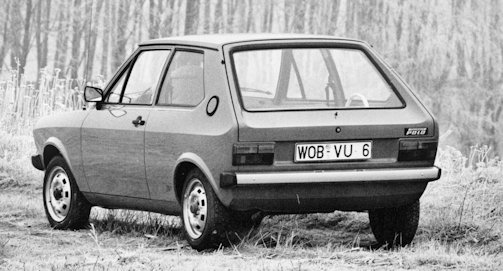
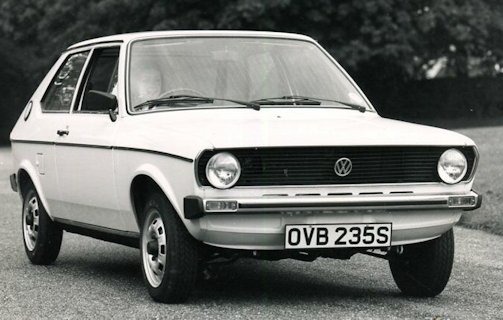
The first VW Polo I was from the spring of 1975 produced until mid-1981 three-door compact car with hatchback from Volkswagen.
History
The name Polo was borrowed from the sport of the same name and was supposed to make a reference to the VW Golf. On September 10, 1974, the name Polo was decided in a board meeting for the new model. Other suggested names at that time were Bonito, Euros, Mini-Golf and Pony. Under the name Bonito had since 1969 been the Fiberfab FT Bonito, and 1975 brought the Hyundai Motor Company to Hyundai Pony on the market.
In March 1975 series production began in the Wolfsburg plant, on March 13, 1975, the Polo was first shown to the public at the Geneva Motor Show. In May 1975, the first vehicles were delivered to customers.
The first model bears the in-house designation Type 86. The Polo was only available as a three-door hatchback in the features Basis, L, S, LS, LX, CLS, GLS, GT and Formula E. In addition, a notchback variant was offered from February 1977 under the name VW Derby.
The basic version was initially very sparse. The door panels were made of cardboard, on the passenger side missing the locking cylinder of the door lock, the door contact of the interior lighting, the sun visor and the upper handle. From the beginning there was a trim level Polo L, which was almost identical in appearance to the Audi 50. When it became clear that Audi should stop operating the small car segment, the Polo was gradually upgraded. The better-equipped Polo GLS appeared in August 1978. Equipment: all models are 2-door Saloons with wide, up- swinging tailgate; combined ventilation/heating system with infinitely variable fresh and warm air mixture; blower (2-speed on L model) makes the system independent of engine; heat taken from cooling system; through-flow ventilation extractor vents in left and right side panels of luggage compartment.
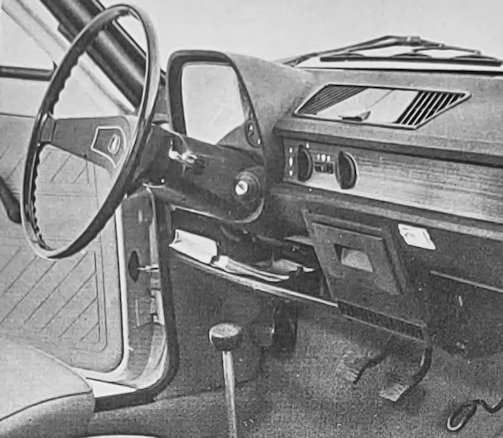
Early interior trim and features:front seat back rests adjustable, folding rear seat, luggage compartment cover, rubber floor matting, footwell side panels; impact absorbing instrument panel with leather grain surface, centre lined with imitation wood grain; instrument cluster with large anti-dazzle cowl; instrumentation: speedometer, fuel gauge, indicator lamps for turn signals, high beam, alternator, oil pressure, water temperature, choke; hazard warning lights; safety steering wheel; 2 padded sun visors; 2 coat hooks; safety armrest door pulls; cloth upholstery; driver's door mirror; dashboard ashtray/radio aperture/speaker grille; driver's door contact courtesy light; single speed windscreen wipe system with flick wipe;electric windscreen washers.
895 cc weights and trailer loads: unladen weight 1510 1b. (685 kg.); axle load, front/rear 1213/1323 lb.(550/600 kg.); permissible trailer load, braked/unbraked 1323/ 838 lb. (600/380 kg.); permissible total weight 2426 lb. (1100 kg.); maximum payload 915 lb. (415 kg.).
The drive and transmission: front wheel drive via dry single plate clutch, fully synchronised 4-speed gearbox, differential and double-jointed drive shafts all combined in a 4,compact transversely mounted front drive unit. chassis: springing front/rear: coil springs with progressive buffer springs and telescopic shock absorbers, all combined in suspension struts; suspension: front, suspension struts and lower wishbones, rear, suspension struts with torsion beam trailing arm axle.Steering is maintenance-free, self-adjusting rack and pinion steering, safety steering column the brakes: diagonal dual circuit brake system with discs front, drums rear; wheels: styled perforated discs (without hub caps) with drop centre rims 4Wx13; tyres: 145x13 crossply.

In February 1979 there was a facelift, which included the grille and the bumpers (now made of plastic). The dashboard has also been redesigned, provided with a wooden imitation strip and received a filing box. In addition, the 60 hp Polo GT was brought to market.
By the early 1980s in January 1981, the fuel-efficient version of Formula E with 3 + E transmission came on the market, but already in June 1981, the Polo I was discontinued.
- PERFORMANCE: 895 cc
max power (DIN): 40 hp (29.4 kW) at 5,900 rpm
max torque (DIN): 45 1b ft. 6.2 kg m (60.8 Nm) at 3.500 rpm
max engine rpm; 6,000: 44.7 hp/l (32.8 kW/l)
power-weight ratio: 37.7 lb/hp (51.4 lb/kW), 17.1 kg/hp (23.3 kg/kW)
acceleration: 0-50 mph (0-80 km/h) 12.7 sec
fuel consumption: 38.7 m/imp gal, 32.2 m/US gal
max speeds: (l) 27 mph, 43 km/h; (Il) 46 mph, 74 km/h; (Ill) 62 mph. 110 km/h; (IV) 82 mph, 132
km/h - PERFORMANCE: 1,093 cc
max power (DIN): 50 hp (36.8 kW) at 5,900 rpm
max torque (DIN}: 56 1b ft, 7.7 kg m (75.5 Nm) at 3,500 rpm
47.5 hp/l (33.7 kW/l)
max speed: 88 mph, 142 km/h
power. weight ratio: 30.2 lb/hp (41 lb/kW), 13.7 kg/hp (18.6 kg/kW)
acceleration: 0-50 mph (0-80 km/h) 9.6 sec
fuel consumption: 37.2 m/imp gal, 30.9 m/US gal, 7.6 1 x 100 km. - PERFORMANCE: 1,272 cc
max power (DIN): 60 hp (44.2 kW) at 5,600 rpm
max torque (DIN): 70 1b ft, 9.7 kg m (95.1 Nm) at 3,400 rpm
47.2 hp/l (34.7 kW/l)
max speed: 94 mph. 152 km/h
power-weight ratio: 25.2 lb/hp (34.2 lb/kW), 11.4 kg/hp (15.5 kg/kW)
acceleration: 0-50 mph (0-80 km/h) 8.3 sec
fuel consumption: 34 m/imp gal, 28.3 m/US gal