
VW Type 4 (411) car history
 |
|
|
Manufacturer: |
Volkswagen |
|
Production: |
1968 to 1972 |
|
Class: |
motor car |
|
Body styles: |
sedan-station wagon |
|
Doors: |
2,4 |
|
Chassis/body: |
steel |
|
Drive: |
rear |
|
Engine Type: |
flat boxer |
|
Engine Displacement: |
1.7 litres |
|
Engine location: |
rear |
|
Engine power: |
50-59 kW |
|
Wheelbase: |
2500 mm |
|
Length: |
4525-4553 mm |
|
Width: |
1635-1650 mm |
|
Height: |
1485 mm |
|
Weight: |
1020-1120 kg |
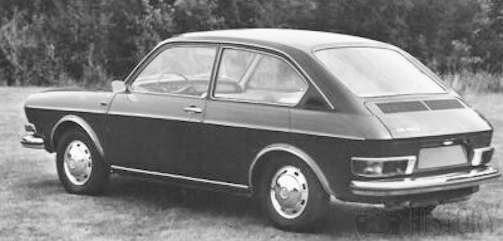
The VW Type 4 was built between 1968 and 1974 from the Volkswagen brand with air cooled four-cylinder boxer engine and rear wheel drive . Initially, the sales name was VW 411 , after the facelift in 1972, in which the front end was designed similar to the Brazilian VW 1600 , then VW 412 .
History
The air-cooled VW model series were chronologically numbered at Volkswagen. Since the beginning of the production of the first transporter / bus (type 2 / T1 ) at the Wolfsburg plant in 1950, the VW Beetle named later became the Type 1 sedan and the 1961 VW 1500 then the Type 3.An important innovation for the makers is the fitting of four doors. The 411 is a very comfortable and roomy car which can easily accommodate five people even on long journeys, and leg-room in front is more than adequate. The seats are particularly interesting for they not only allow lore-and-aft adjustment but can also be tilted up and down and even raised or lowered. The backrests, too, are adjustable. The heating system is efficient even when the engine is switched off. There are many innovations in the field of safety. Besides the dual braking circuit, the new semi-trailing link independent rear suspension, the collapsible steering column and a rear mirror that comes off on impact, the facia and door-pillars are well-padded. Radial ply tyres are fitted which naturally improve the car's roadholding. The Volkswagen 411 L is also available with an automatic gearbox on request.
The VW 411 was the first four-door passenger car of the Volkswagen factory . The 411 L 4-door saloon, though remaining faithful to the traditions of the Wolfsburg makers, presents several important innovations. An integral chassis has been preferred to the separate platform and the bodywork is entirely in steel, although the front and rear ends are collapsible in the event of an accident so as to absorb much of the shock on impact: The mudguards all bolt-on on and can thus be removed easily and swiftly they have to be replaced. In the summer of 1969 followed the three-door station wagon , which wore the name "Variant" as in the smaller type 3 and reached a share of about 50 percent of the total sales. There was no five-door station wagon. The VW 411/412 were based on the concept of the VW Type 1 (Beetle ) with air-cooled boxer engine in the rear and rear-wheel drive, However, chassis and structure of the type 4 were not similar, as with the smaller type 3 , the VW Beetle, because the 411/412 had no central tube frame , but a self-supporting body . The Type 4 was also the first VW model with MacPherson struts forward; a rear semi - trailing arm axle (there torsion bar sprung) was already used from 1967 in the VW transporter and the 1500/1600 beetles with automatic transmission.
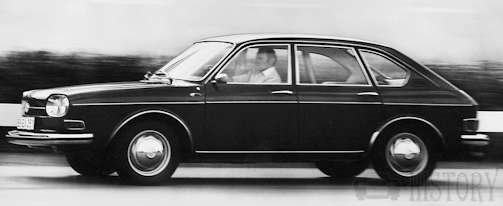
In order to create a competitive space while maintaining the rear engine concept, a large trunk in the front area had to be accommodated. The 411/412's long front end required it to make optical compromises that inspired the nickname "coati". Because of the already outdated concept at the time of the concept, the model was named after Heinrich Nordhoff , who died in April 1968 VW CEO, as "Nordhoff's legacy" or "Nordhoff's farewell gift". Others suggested the model’s name as "4 doors, 11 years too late", after all VW Beetle and the Type 3 were available exclusively as a two-door.
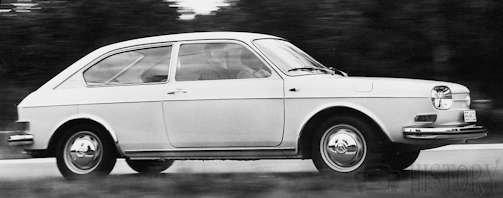
- August 1968: Start of production of the 411 in the Volkswagen Wolfsburg plant . Characteristics of the first series are headlamps in oval shape with two-filament lamps for high and low beam .
- August 1969: The Variant combination is offered additionally. Better engine insulation. In place of the oval single headlamps, all models get round twin headlamps with H1 halogen bulbs . The front VW character is offset from the trunk lid on the front panel. The 80-hp injector replaces the 68-hp carburettor, which is still available on request or in conjunction with the automatic transmission. For the engine block, instead of the expensive magnesium alloy electron , an aluminium alloy is now used.
- August 1970: Mouldings on the dashboard in the wood design in the L models omitted. Automatic transmission now also available for the injector.
- August 1971: New four-spoke safety steering wheel. Reinforced door locks. Wiper switch now on the steering column instead of a knob. New Tach design, scale now up to 190 instead of 170 km / h. new extras: brake booster , windscreen wiper interval circuit.
Model overview and equipment
The standard equipment of the 411/412 was compared to the other contemporary VW models rather extensive and should underline the higher status of the car. So had the type 4 front disc brakes , a hydraulically actuated clutch, three-phase alternator , reversing lights, H1 halogen headlights (from 1969), radial tires and fabric seats. In the L model, there were in addition z. As a clock, a dimming interior mirror, make-up mirror, velour carpets and reclining seats front and more...
Popular optional extras included front headrests, heated rear windows, imitation leather seat covers, seat belts , a sunroof and a programmable 24-hour timer for the auxiliary heater. During the construction period, the list of extras has been extended, e.g. For example, to interval switching for the windshield wipers, air conditioning (especially the US export models), brake booster or steel wheels with wide tires.
The following model variants were available:
- 411 / L (1968-1973): 1.7 litres, carburettor (68 hp / 50 kW)
- 411/412 (L) E (1969-1973): 1.7 Liter, injector (80 hp / 59 kW)
(L referred to each of the luxury equipment, which was the more popular version of the Type 4 than the less popular in this class standard version)
VARIATIONS AND OPTIONAL ACCESSORIES
sunshine roof
automatic gearbox hydraulic torque convertor and planetary gears with 3 ratios (I 2.650,II 1.590, II 1, rev 1.800), max ratio of convertor at stall 2.5, possible manual selection,central selector lever
In the six years of production, only 367,728 units of Type 4 were built - a low number for VW. That was certainly one of the reasons that the production in June 1974 prematurely abandoned and was discontinued (the Passat was formally successor to the smaller type 3 in 1973: VW 1500/1600 ). Together with the VW K 70 is the VW 411/412 emblematic of the model-politically turbulent time early 1970s, when VW was the conversion to completely different constructed vehicles with water-cooled front engines in preparation.
The four-cylinder, air-cooled engine, though it has been entirely redesigned, retains the traditional Volkswagen layout. Mounted at the rear, it is over-square with a very short piston stroke which allows a low piston speed which in its turn contributes to long engine life and the maintenance of high regimes over long journeys. Practically speaking, the top speed is nearly 90 mph (145 km/h), and there is no trouble in maintaining this as a cruising speed. The relatively low compression ratio (17.8) also contributes to make this a long-lasting engine and at the same time allows normal grades of fuel to be used. There is a vertical carburettor for each pair of cylinders: the short inlet pipes make for a prompt response to pressure on the accelerator and excellent pick-up from low speeds. From a standing start the411 gets up to 50 miles per hour in 11.5 seconds. The engine is very flexible, too, and maximum torque at low revs allows a speed of about 19 mph(30 km/h) to be maintained with the engine turning over at 1,000 revs a minute.
The engines ("flat boxer") with 1.7 or 1.8 litres displacement were completely redesigned and achieved with two carburettors or a port injection for those times respectable performance of 50-63 kW (68-85 hp). The available from 1969 80 PS version had an electronic D-Jetronic Bosch, the (previously in type 3 one-year VW 1600 LE / TLE ) had been offered for the first time and later also in the VW-Porsche 914/4 to Use came. The gearbox was a manual four-speed gearbox or a three-speed automatic transmission available.
Since the production of hot air about how lying at the VW Beetle in the exhaust system heat exchanger was not sufficient for the larger interior of the Type 4, this model had standard a gasoline-electric auxiliary heater from Eberspächer (BA type 4 with timer). Likewise, a two-stage fresh air blower was standard.