

SEAT 800
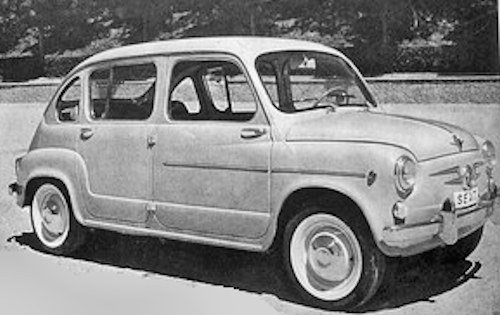 |
|
|
Maker |
SEAT and Bodyworks Costa |
|
Period |
1964 to 1967 |
|
Built |
18,200 units |
|
Factories |
Barcelona and Tarrasa , Spain |
|
Type |
Motor car |
|
Bodyworks |
Berlina four doors |
|
Drive |
Longitudinal rear engine and rear wheel drive |
|
Dimensions |
3475/1380/1350/2180 mm |
|
Designer |
Dante Giacosa / Franco Ambrosini |
The SEAT 800 is the four-door body version of the SEAT 600 , a car produced by the Spanish manufacturer SEAT under a Fiat license .
History
The SEAT 800 had no Italian counterpart, since there was no Fiat 600 with this type of bodywork. Its body is 180 mm longer than that of the normal 600 and the engines are the same as those of the 600. The SEAT 800 was a attempt by SEAT to compete with the Citroën 2CV and the Renault 4 , both cars equipped with four practical doors and therefore more versatile than the small utility SEAT 600 . The Carrocerías Costa de Tarrasa factory ( Barcelona ) was responsible for carrying out the new car project and in 1962 it presented a prototype that was nothing more than an elongated SEAT 600 and equipped with rear doors.
Performance
- Engine Capacity 46.80 cu in, 767 cu cm
- Fuel Consumption 43.4 m/imp gal, 36.2 m/US gal, 6.5 1 x 100 km
- Max Speed 68.3 mph, 110 km/h
- Max power (SAE): 32 hp at 4,800 rpm
- Max torque (SAE): 381b ft, 5.2 kg m at2,700 rpm
- Max engine rpm: 5,000
- Specific power: 41.7 hp/l
- Acceleration: standing 1/4 mile 26.9 sec, 0—50 mph (0—80 km/h) 24.2 sec
- Speed in top at 1,000 rpm: 13.8 mph, 22.2 km/h.
The presented prototype liked and the official presentation of the new model was made in June 1963 , at the XXI International Trade Fair of Barcelona, using a second prototype built during the same year, already incorporating the aesthetic and mechanical features of the new SEAT 600 D that would also be presented at the event. The factory price of 800 was 75,000 pesetas in 1964.
The mass production of the SEAT 800 lasted from January 1964 to June 1967 , with 18,200 units being produced at a fairly slow pace, mainly due to the almost artisanal way in which they were prepared. Said process consisting in cutting the naked bodies of SEAT 600 that were delivered from the factory SEAT the free zone of Barcelona, lengthen them by 18 cm, mount a new roof made in the press and manually adapt the sides of the body to accommodate the new rear doors, also made in the press, and the front doors, which were the originals of the SEAT 600 shortened at the back . Once the bodywork was mounted, it was painted and delivered finished to the SEAT, where it was incorporated into the assembly line of the SEAT 600 to receive the mechanics, glass and trim and finally the vehicle to be finished.
Due to the small number of copies built, it was not an easy car to see on Spanish roads, except in the microtaxi service , where they were relatively successful in cities such as Madrid , Bilbao or Valladolid .

