

Lancia Theta
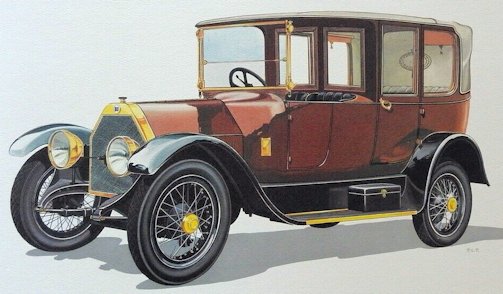 |
|
|
Production period: |
1913 to 1919 |
|
Class: |
Motor Car |
|
Body versions: |
Touring car, Phaeton, Limousine |
|
Engines: |
Gasoline 4.9 litres (51 kW) |
|
Length: |
4650 mm |
|
Width: |
1615 mm |
|
Wheelbase: |
3100-3378 mm |
|
Curb weight: |
1060 kg |
The Lancia Theta is an automobile of the manufacturer Lancia and was produced from 1913 to 1918. It is a revision of the Lancia Epsilon.
History
The designation followed the nomenclature of the manufacturer to name the car after the Greek alphabet. The chassis was available with two wheelbases, the most popular body shape, the Lancia Theta Torpedo Coloniale, in the then-customary torpedo shape. The Lancia Theta, also known as Lancia 25/35 HP or Lancia Tipo 61, is a car produced from 1913 to 1918 by the car manufacturer Lancia. It was the first production car to feature a complete electrical system and the first Lancia model to exceed a thousand units produced, with 1,696 examples. The Theta was the first car in Europe to have a 6-volt electric system from Charles Kettering and was also the first car with a starter and a lighted cockpit. the installation of the starter was initiated by Vincenzo Lancia, who wanted to do away with the hassle of cranking before driving. Other patents that were applied for the first time were a three-way adjustable steering column, a chain-operated transmission brake and a novel drum brake.
Less innovative was the drive, a four-cylinder engine, which was taken over by the commercial vehicle Lancia IZ and made possible with 70 hp a top speed of 120 km / h.
It was exhibited at the London Motor Show in autumn 1913 and put on the market at the end of the same year. The car was destined to have a rather long existence for the time: in fact, it survived the First World War, remaining in production for around 5 years, until 1918 (for a total, not insignificant for those times, of 1696 units). It was replaced by the Lancia Kappa when industrial production resumed after the conflict.
The first Lancia product of irrefutable international success, powerful and fast, the Theta was destined to go down in history as the first European car marketed with a complete electrical system offered as standard equipment. The system, made in America (Rushmore), worked with a voltage of 6 volts and included, among other things, the starter motor (with pedal control), a generator, two 50- candle headlights, two additional lights, a rear light and even dashboard lighting and a horn button. included dynamo lighting Lancia also shares with Hispano-Suiza the distinction of introducing electric starters to Europe, and the pedal-operated Rushmore unit was standard equipment on all Thetas. Equally advanced was the layout of the switches: not only the ignition, but also the lamps, the electric klaxon, and the panel light were controlled from the steering-wheel, while the steering-column was adjustable for rake. Lancia's prosperity was reflected in sales to Argentina, Australia, Ceylon, Cuba, France, the Netherlands, India, Malaya, Morocco, New Zealand, Rumania, Russia, South Africa, Switzerland, and the U.S.A.
The Theta's specification embraced full-pressure lubrication, a four-speed unit gearbox, and a dry multi-disc clutch, and output was 70 b.h.p. at 2,200 r.p.m., which gave it a brisk performance on a 3•26: 1 axle ratio. Vincenzo Lanciahe was so convinced of the goodness of the new system that he opted to eliminate the front starter crank (which survived only as an accessory and was supplied with the tools).
Engine performance
Power : maximum HP 70 at 2,200 rpm
Speed : (max speed in the various gears: 26 in 1st, 52 in 2nd, 77 in 3rd, over 120 in 4th) approximately 120 km/h
Braking was also improved: the braking system was always made up of the usual two-system scheme (the lever that acted on the rear wheels and the pedal that acted on the transmission) but the effectiveness was increased thanks to a Lancia patent on the basis of which the gearbox, modified for this purpose, was equipped with a chain to push the lining against the drum with uniform pressure over the entire braking surface.
The engine mounted on the Theta, although not innovative (it was essentially the 4- cylinder of almost 5 litres of displacement already adopted on the 1Z truck in 1912) was nevertheless reliable and powerful (it delivered around seventy horsepower) and, despite a very heavy chassis significant, he managed to push the car up to reach and sometimes exceed 120 km/h.
The robust Theta chassis could be chosen between two wheelbase sizes (310 or 337 cm) while the inclination of the steering column (thanks to one of the many mechanisms patented by Lancia) could be varied on three different values (34°, 37°, 40°).
Altogether 1696 vehicles of this type were created. Chassis numbering: from n° 1800 to n° 5154 (the numbering includes, in addition to the Theta, the Jota and Djota trucks; a total of 1696 Theta examples were built)

