

Lancia Dilambda
 |
|
|
Builder |
Lancia |
|
Class |
Luxury Car |
|
versions |
Various |
|
Production |
from 1928 to 1935 |
|
Examples produced |
1,685 |
|
Length |
4950 mm lwb |
|
Mass |
bare frame 1250 k g |
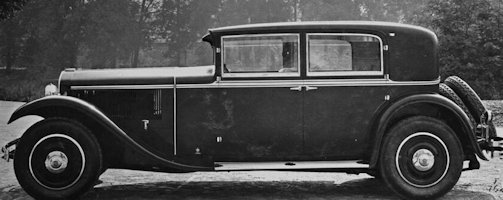
The Lancia Dilambda was a vehicle model of the Italian Turin manufacturer Lancia, which was produced from 1928 to 1935.
History
It was officially presented at the Paris Motor Show in 1929. The top speed was 120 km / h and the power 74 kW (101 hp). The Epsilon was developed for a production in the USA, but it was then produced in Europe.
The Dilambda didn't arrive on the European scene until 1929, two years after an abortive appearance at the New York Show. Plans to manufacture it in that country were
shelved, but as an enduring momento of that project, all Dilambdas carried indents in their frame pressings to allow for left- or right-hand mounting of the steering box. Dilambdas had a non-metric bore dimension (31/8ins) and, on the first series, a Detroit-style art instrument panel. Those who imagine that the first lhd Lancia’s were Aurelias in the fifties would be surprised to find a left-handed Dilambda in the Harrah Collection in Reno. Since Dilambdas were to be platforms for the top specialist coachbuilders, a monocoque skeleton was 'out'. Instead, to secure the torsional stiffness essential to Lancia's suspension principles, a fully boxed and electrically welded frame was evolved, reinforced amidships by a robust cruciform and at the rear by a stressed petrol tank. At the front a tubular cross-frame incorporating the spring pillars was dowelled and bolted to the main structure. Dilambdas didn't have was a rubber roller race to support the steering column where it passed through the steel dashboard! The caged rollers of hard rubber absorb shock as well as reducing friction. Dilambda equipment included centralised chassis lubrication from an oil reservoir also supplying an automatic system for maintaining the engine sump level. Final drive was by hypoid bevels one of the very first such and a Yale lock in the gear lever knob to hinder thieves.
The Dilambda project began in 1926 when Vincenzo Lancia, who was certainly not the type to live on his laurels, decided to propose to the public a successor to the Trikappa, always equipped with a large 8-cylinder engine. Initially, the planned model (with factory designation 220), clearly inspired by Lambda, should have contained a displacement of around 3-3 and a half litres. In that period, fate would have it that an American, Lancia, who didn't take long to convince Vincenzo of the broad horizons that could be opened up for the Turin company by entering the enormous US automotive market. Without even notifying his closest collaborators, Vincenzo immediately had the ongoing project abandoned to divert his studies towards a larger car.
Convinced (with good reason) that the load-bearing structure is not suitable for a large and heavy model, Monsù Lancia entrusts the technical office with the task of designing a chassis that is as robust and rigid as possible, to which the front suspension can still be applied. independent wheels according to the scheme of the younger sister Lambda. The first frame built, made up of boxed spars and patented in June 1927, was subsequently modified and in January 1928 a further patent described what would eventually correspond to the Dilambda chassis: boxed spars frame, with "X" cross (also It is made of boxed sheet metal and with holes suitable for the passage of transmission shaft) and with rear fuel tank acting as a stiffening cross member.
Meanwhile, in Turin, work is underway on a dozen luxurious "pre-series" examples, destined to be shipped to New York to be exhibited at the Commodore Hall. The salient technical characteristics of the Dilambda were: the engine is a 24° V- 8 whose displacement is somewhat reduced compared to that of its Trikappa progenitor: 4 litres (versus 4.6). Continuing the comparison, we note how the maximum power is practically unchanged (around 100 HP which are now delivered at a speed of 3800/4000 rpm). According to what specialized magazines of the time wrote, the Dilambda's greatest qualities were its driving flexibility (it is said that the car could even start from a standstill in fourth gear) and, despite its size, its easy handling. As for the maximum speed, it is between 120 and 130 kilometres per hour and varies depending on the version (axle ratio, wheelbase size and therefore weight, are the factors that influence it).
Among the many peculiarities of the Dilambda we must mention the application of particular bearings (called "silent bloc") to the joints, a particular engine lubrication pump, the thermostat for regulating the temperature of the cooling water, the "centralized" lubrication of the frame. As standard, the Dilambda is produced in sedan and torpedo versions, but in a certain sense it is the chassis that plays the lion's share: in fact, there are countless creations by the major coachbuilders (Italian and foreign) on the mechanical basis of the Dilambda. An interesting curiosity: it's Pininfarina– which has not yet opened its body shop – to suggest to Vincenzo Lancia the adoption, in harmony with the emblem on the radiator, of the singular and original shield-shaped headlights.
The initial model - built with a 347.5 cm frame - was defined as "type 227" and was produced, in two series, from 1929 to 1931, in 986 pieces (879 of the first series and 107 of the second series) while of the "type 229” with short wheelbase, which joined the “227” in '31, 418 were built (225 first series and 193 second series). Then, in 1933 the last Dilambda was launched, defined as "type 232", which returned to the long wheelbase and which was produced until 1935 in 281 units.
The production numbers above, although probably substantially correct as a whole (even if they do not appear to include the 12 "pre-series" examples) must however be considered with caution when referring to the data of the individual versions (for example, it seems that some cars from the first series were subsequently modified in the second series and so on). Between 1929 and 1935, therefore, almost 1,700 Dilambdas were built: the number may seem modest, but it must be considered that the release of the car coincided with the difficult economic period following the collapse of Wall Street and that its selling price is almost prohibitive: in 1931, a Dilambda loom costs 58,000 lire, while, to make a comparison, the Artena costs less than half (24,500 lire) and a complete Fiat 514 spyder can be bought for 14,900 lire. The car was in service with the Regia Aeronautica.
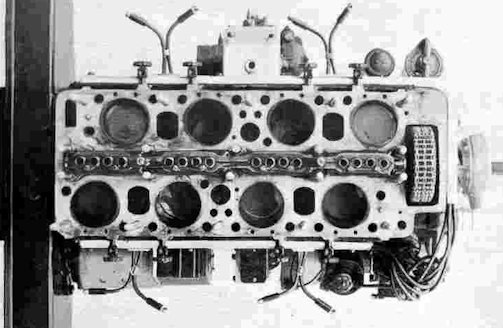
The Dilambda engine was dimensioned 79.37mmx100mm and claimed to give off 100bhp at 3000rpm. included cast iron cylinder blocks with five-bearing crankshafts having offset individual throws to provide equal firing intervals, and cast-iron heads with a line of vertical valves above each bank. But the Dilambda's head casting was shaped like an elongated O, in effect two independent heads linked at each end by an integral bridge; the hollow centre enclosed a separate housing for camshaft and tappets that remained
undisturbed when the head was removed. Very short pushrods made contact between tappets and rockers. An American twin-choke updraught Zenith, cast in zinc-based metal brewed an extravagant mixture that passed through an exhaust-heated manifold and into the cylinder block, thence upwards through tracts cast into each side of the head.
In a beautifully engineered chassis, unexcelled in its day for robustness and rigidity.
The Dilambda was considered very fast in its day and had some technical innovations. A special feature of the engine was the close 24 ° V position and the use of silent blocks at the anchoring points. There was a device for refilling the engine oil by pump, as well as a central lubrication of the chassis via a small pedal on the dashboard. The cooler was thermostatically controlled. Leading the way was the independent suspension. The tank had a supporting function.
There was a total of three model maintenance, which mostly entailed technical changes. The last series was only available with a long wheelbase, while the first two were produced in two other wheelbases.
- First series (1928-1931) in 1104 copies
- Second series (1931-1933) in 300 copies with modified gears and brakes
- Third series (1933-1935) in 281 copies with modified aerodynamics
Erich Maria Remarque fled in his Dilambda together with Marlene Dietrich and her daughter from Germany to France and dedicated the car even a story. The Dilambda was driven by many stars of the 1930s, including Max Schmeling, Ernest Hemingway and Greta Garbo. Until the postwar period Konstantin Prinz of Bavaria drove a Lancia Dilambda Cabriolet, which he described as a car of my life.
First series Production period: from 1929 to the first months of 1931
Prototypes and pre-series aside, the Dilambda chassis was officially presented at the Paris Motor Show in autumn 1929. In 1930 production continued quietly and successfully (847 examples), then, in 1931, the normal Dilambda of the 227 types was joined by the type 229, i.e., the short wheelbase version (329 cm instead of 347.5). In that same 1931, both models (the normal 227 and the "short wheelbase" 229) received some modifications which made them define them as "second series".
Second series Production period: from 1931 to the end of 1932
The second Dilambda series (always in two models, the 227 with long wheelbase and the 229 with short wheelbase) began during 1931 and continued in practice for almost two years, until the end of 1932.
The changes that give rise to the second series (which differs externally from the "first series" by the front grille , which here is similar to that of the latest Lambdas, with vertical shutters) can be summarized as follows: improvements to the braking system (adoption of Albert servo brakes Dewandre and smaller but wider brake drums), changes to the gearbox (now with direct drive for the 3rd and 4th gear) and to the differential , changes to the instrumentation, new gearbox and transmission ratios, adoption of 16 x 45 tires .
Third series 232 Production period: from 1933 to 1935
What can be considered as the last Dilambda series (also defined as model 232) has a life of approximately three years (1933/35): it is essentially a chassis - whose wheelbase measurement corresponds to that of the previous model 227 (therefore 347.5 cm) – modified to be able to more easily fit the lower and semi-aerodynamic custom-made bodies typical of the period.
Compared to the second series, only the chassis data changes (which is also a little heavier)
produced
|
Year |
Total |
|
1928 |
6 |
|
1929 |
22 |
|
1930 |
847 |
|
1931 |
383 |
|
1932 |
136 |
|
1933 |
107 |
|
1934 |
95 |
|
1935 |
89 |
|
Total |
1,685 |
|
Model |
Built |
|
227, first series (1928/31) |
879 |
|
229, first series (1931) |
225 |
|
227, second series (1931) |
107 |
|
229, second series (1931/33) |
193 |
|
232 (1933/35) |
281 |
|
Total |
1,685 |

