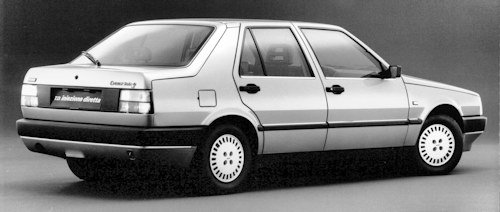
Fiat Croma
 |
|
|
Manufacturer |
FIAT |
|
Main type |
Sedan hatcback |
|
Doors |
5 |
|
Production |
from 1985 to 1996 |
|
Replaces the |
Fiat Argenta |
|
Produced |
438,000 |
|
Length |
4495 m m |
|
Width |
1760 mm |
|
Height |
1430 mm |
|
Step |
2660 mm |
|
Mass |
from 1095 to 1240 k g |
|
Style |
Fiat Style Centre with Italdesign |
The Fiat Croma code-named Type 154 is a Croma is a hatchback with saloon appearance produced by FIAT between 1985 and 1996.
History
In 1985 FIAT renewed its high-class model by replacing the Fiat Argenta, which remained in production for only four years and with rather disappointing sales results, with the new Croma. The debut resulted in the disappearance of previous rear-wheel drive in favour of front-wheel drive. The project is also known as "Type Four" and also includes other cars: the Lancia Thema, Saab 9000 and Alfa Romeo 164 greatly reducing development times and design costs. The extremely balanced and elegant line, the comfort of the passenger compartment, the versatility of the tailgate and the innovative "VSS" concept, guaranteed the Croma a great success: during the eleven years of commercial life of the model, about 438 000 were sold. Numerous specimens they were armoured versions, intended for the protected transport of public personalities or magistrates. Among these special cars, the most sadly known in the collective memory are the three Croma 2.0 turbos (white, blue and brown) that made up the escort procession to judge Giovanni Falcone, blown up in the Capaci massacre on May 23, 1992.
The design of the classic two and a half volume line was born within the Fiat Style Centre, which had entrusted its supervision to Tom Tjaarda, and Giorgetto Giugiaro of Italdesign, while the construction was almost entirely robotised. Technically the car shared with the other three cars the chassis, the suspensions, the skeleton of the sides, most of the systems (air conditioning, braking circuit) and with Thema and Saab also the doors.

It was initially sold in different engine versions, derived from the Fiat Argenta: two with the classic carburettors with displacements of 1585 and 1995 cc, two with 1995 cc injection, one at atmospheric pressure and one turbocharged; the powers supplied ranged from 83 to 155 hp; these engines were all evolutions of the " Lampredi bialbero ". A diesel (2.5 l) and a 75 and 100 hp turbodiesel (2.4 l) were also available on the list. A petrol version called "CHT" was also marketed, with a 1995 cm³ and 90 hp engine and Yamaha system CHT (Controlled High Turbulence), which allowed for variable geometry suction for greater regularity of operation at low speeds and lower consumption in the urban cycle. This was possible thanks to a splitting of the suction ducts: a small one (for low speeds) and a larger one, which came into operation with the opening of the additional throttles, suitable for medium and high speeds.
Croma Turbo ie 2-litre injection turbo performance
Maximum speed 131 mph (211 km/h)
Top gear speed at 1000 rpm: 26.2 mph (42.1 km/h).
0 to 60 mph (100 km/h) 8.2 sec
Fuel consumption at constant 75 mph (120 km/h) 34.0 mpg
The range was expanded in 1988 with the first 2,000cc turbodiesel engine with direct injection mounted on a large series car. In 1991 the model underwent a restyling that rounded the lines, following the fashion of the time and the new family feeling of the house, which refined its front; over the years also the engines were modernized, with the elimination of the smaller displacement. In the last years of production, a model of the Croma with airbags (starting from 1994) and ABS; 2492 cc and 160 hp V engine, coming from the V6 Busso fitted at that time by the Alfa Romeo 155. Top models are extremely well-equipped, with electrically adjustable seats. and antilockbrakes, plus usual luxury items. Fuel tank: 15.4 Imp, gall (70 litres). Unladen weight: 2601 1b (1180 kg),
Production ceased, after a long career, in December 1996, without the car being replaced by any model of similar class.