
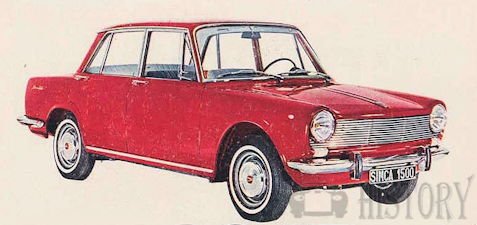
Simca 1300 1301
 |
|
|
Production period: |
1963 to 1976 |
|
Body versions: |
Sedan, station wagon |
|
Engines: |
Petrol: 1.3 Liters (45kW) |
|
Length: |
4242-4547 mm |
|
Width: |
1575-1580 mm |
|
Height: |
1397-1422 mm |
|
Wheelbase: |
2520 mm |
|
Curb weight: |
902-1080 kg |
The Simca 1300 and 1301 series were passenger cars of the motor vehicle manufacturer Simca, which were manufactured between the spring of 1963 and the spring of 1976.
In March 1963, the Simca 1300 and Simca 1500 were presented to the public as successors to the Simca Aronde. From spring 1964 the Kombi 1500 Break was delivered. In the summer of 1964, the 1500 GL automatic was presented. In 1966.
The model series in October 1966 there was a facelift, the models were now 1301 and 1501. They were extended at the bow and stern, front by 7 cm, rear 13.5 cm, which was reflected in a larger trunk. The hood was pulled further forward and changed the grille, there were flat, rectangular rather than round rear lights. Inside, the vehicles received another instrument carrier. The circular central instrument that Simca had adopted from the Aronde models, gave way to a rectangular display unit with tacho, now surrounded by wood imitation according to the taste of the time. Furthermore, the heating and ventilation system has been improved. Simca offered the 1301/1501 series in the equipment variants Luxe Super, Grand Luxe and Grand Luxe Super, plus the combi versions Break LS and GLS. Radial tires as standard equipment.
In early 1970, the 1301/1501 Special and the 1301/1501 Break were introduced. All models of the series received another new dashboard with three or four round instruments, a new grill and the monogram of Chrysler. The Chrysler 160, Chrysler 160 GT and Chrysler 180 were introduced at the Paris Salon in October 1970 as the successor to the Simca 1501.From mid-1971, the 1501 were further built for export and only the 1301/1301 break remain in the program. On 31 August 1971 Simca became "Chrysler France".
In early 1972, the 1301 and the 1301 Break received the radiator grille of the 1501. One year later, the models were equipped with a new gearbox and new brakes. Already in the spring of 1974, the 1501 and the 1501 Break due to the poor sale of the Chrysler 160/180 were available again.

PERFORMANCE: 1300
- Engine capacity: 78.72 cu in, 1,290 cu cm
- Fuel consumption: 31.4 ml imp gal, 26.1 ml US gal
- Max speed: 80.8 mph, 130 km/h
- power-weight ratio: 34.2 lb/hp, 15.5 kg/hp
- acceleration: standing 1/4, mile 21.2 sec, 0—50 mph (O— 80 km/h) 16.2 sec
- max power (SAE): 62 hp at 5,400 rpm
- max torque (SAE): 74 1b ft. 10.2 kg m at 2,600 rpm
- max number of engine rpm: 5,300
- specific power: 48.1 hp/l
In the fall of 1975 Chrysler presented at the Paris Salon Chrysler Simca 1307 and 1308 before. In the spring of 1976, the production of 1301 and 1501 ended.
The Simca 1500, has been equipped with an automatic gearbox. The makers have made this innovation not only on this larger model but also on the 1000 saloon.
It is not therefore a question of a passing fashion but it is clearly a new conception of the use of a car that is American in derivation and only today is beginning to gain a place for itself in Europe.
An automatic gearbox makes driving in heavy town traffic much simpler and greatly reduces fatigue; this, apart from any other consideration, is the principal motive for the change and is itself enough to justify its adoption. In the case of the Simca. a Borg-Warner unit specially designed for medium-powered cars has been adopted. It is composed of a hydraulic torque convertor that ensures the multiplication of the torque in a range of ratios that vary continuously from 2: 1 to 1: Combined with the torque convertor there is a speed change controlled automatically by means of a hydraulic system. The control works on the basis of the torque provided by the engine and the speed of the car, and the gears are obtained by means of a three-speed epicyclic train.
The gear lever is on the steering wheel and has five different position parking (P). reverse (R), neutral (N), normal driving (D), and climbing (L). that is to say. in the last of these positions only the two lowest ratios can be engaged.
The system of control also allows the driver to move down to a ratio below by means of simply pushing the so-called kick-down that engaged accelerator down to the floorboards and then letting it come back again. The Borg-Warner unit uses very little power and the acceleration. when the gearbox is used with the two forward positions, is equally as fast as anything a good driver can achieve through the gears.


