


Autobianchi Bianchina
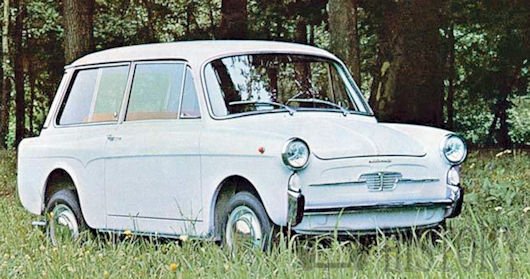 |
|
|
Class |
Motor car |
|
Body style |
Berlina (saloon) |
|
Layout |
RR layout |
|
Engine |
|
|
Transmission |
4-speed manual |
|
Wheelbase |
1,840 mm (72 in) (All) |
|
Length |
3,020 mm (119 in) (Berlina, Cabriolet) |
|
Width |
1,340 mm (53 in) (All) |
|
Height |
1,320 mm (52 in) (All) |
|
Curb weight |
530 kg (1,170 lb) (Berlina) |
The Autobianchi Bianchina is a small car produced by the Italian automaker Autobianchi, based on the Fiat 500.
History
It was available in various configurations: Berlina (saloon), Cabriolet (roadster), Trasformabile (convertible), Panoramica (station wagon), and Furgoncino (van).
The car was presented to the public on 16 September 1957 at the Museum of Science and Technology in Milan.
Initially it was proposed in the only 3-box bodywork, defined as " Transformable ", equipped with rear fins, abundant chrome and a canvas sunroof. Given the good success, Autobianchi decided to expand the range and improve its characteristics. In 1959 the engine power increased to 17 hp, while in 1960 the convertible and Panoramica versions were launched.
The first was a real open car with a canvas top (the Trasformabile had a simple but large canvas sunroof and fixed side pillars) was also made available in the Special version with two-tone paintwork and an engine boosted to 21 HP. (499 cm³ and 21 HP compared to 479.5 cm³ and 17 HP); compared to the Trasformabile, the hinging of the doors brought to the front also changed, while the second is a station wagon with a 499 cm³ (22 HP) sole engine and extended wheelbase, derived from the New 500 Giardiniera from Fiat.
Initially, the car was equipped with the smallest Fiat engine, air-cooled 479 cc producing 15 PS (11 kW). In 1959, the engine power was increased to 17 PS (13 kW) and in 1960, the cabriolet version was launched.

In the same year, the Trasformabile, whose engine cylinder capacity was increased to 499 cc (18 hp), was made available in a Special version with bi color paint and an engine enhanced to 21 PS (15 kW). Transformabile featured fixed B-pillar and partial roof, as the rest of the opening was covered with foldable fabric hood. Cabriolet version had no B-pillar. Also, this was the only version to feature suicide doors.
In 1962 the Trasformabile was replaced by the sedan version with a closed roof and 4 seats. The engine and chassis (short wheelbase) were the same as the Transformable. Unlike the other versions in the price list (Panoramica and Cabriolet), the 4-seater could be chosen in the basic version (with 18 HP engine) or Special. The latter, better finished and equipped, was recognizable by the two-tone paintwork (with the roof in a contrasting color), the chromed door window frames and the 21 HP engine. In the same year, all versions adopted a platform with the passenger foot area, to improve space
In 1965, a minor facelift was made. In France, the models were sold under different names: the Berlina became the Lutèce, the Familiare the Texane, and the Trasformabile was marketed as the Eden Roc., in addition to a very slight restyling (front frieze, redesigned dashboard with faux wood insert and some other revised interior details), which involved all versions, the 4-seater and Cabriolet variants adopted the F -type engine, optimized in various components.
In 1969 the Bianchina went out of production, replaced by the " Giardiniera”. At the same time as the production activity of the Bianchina Panoramica, Fiat, shortly before becoming the full owner of the Desio company, transferred the production of the Fiat 500 Giardiniera to Autobianchi in 1966. The Giardiniera, later sold under the name of " Autobianchi Giardiniera " was produced in Desio until 1977. Despite the adoption of the "Autobianchi" brand, it was substantially identical to the original Fiat model from which it derived.
PERFORMANCE: Late Models
PERFORMANCE: 499cc
engine capacity: 30.48 cu in. 499.50 cu em
fuel consumption: 54.3 m/imp gal, 45.2 m/US gal, S.2 1 x 100 km
max speed: 60.9 mph. 98 km/h
max power (SAE): 22 hp at 4,600 rpm
max torque (SAE): 25 1b ft, 3.5 kg m at rpm
max engine rpm: 4.600
specific power: 44 hp/l
power-weight ratio: 53.1 lb/hp, 24.1 kg/hp
Bianchina Special Berlina
max power (SAE) 25 hp at 4,600 rpm
max torque (SAE) 27 1b ft, 3.7 kg m at 3,500 rpm
power-weight ratio 47.2 lb/hp, 21.4 kg/hp
acceleration (max load) O—50 mph (O—80 km/h) 23 sec, 92 oct
fuel consumption 49.5 m/imp gal, 41.3 m/US gal, 5.7 1 x 100 km
max engine rpm 5,100
specific power,50 hp/l

The variants of the Bianchina
Convertible (Trasformabile): it was the first version to debut in 1957 and the only one to be produced in the early years (i.e., until the arrival of the Panoramica and Cabriolet in 1960). Characterized by the doors hinged behind, the Trasformabile was a small three-volume 2-seater equipped with a large canvas sunroof that also incorporated the rear window (in Plexiglas). Aesthetically, this version was recognizable by the rounded C-pillar and the three chrome strips behind the door. It was produced until 1962.
4 seats Berlina (saloon): it was the last version to be introduced in the range in 1962. The logic of the 4 seats must be seen in the context of the thought of the Italian motorist of the sixties, who considered the family cars (now station wagons) as "work" cars. In the wake of these considerations, Autobianchi, alongside the Panoramica (favored by the long wheelbase), included the 4-seater in the range. Made as a closed version of the Cabriolet (therefore with a short wheelbase), to which a metal roof with rather squared shapes was added (to ensure a certain rear roominess), this version was the most appreciated by the public thanks to the characteristic shape of the rear window, practically vertical, and inserted in a protective "pagodina", which guaranteed a greater habitability than that of the contemporary "500". It was produced until 1969.
Panoramica (station wagon): based on the mechanics of the Fiat 500 Giardiniera, it was undoubtedly the version that required the most technical effort: wheelbase lengthened by 10 cm, sole motor rotated by 90 °. Practical (thanks to the tailgate and the good luggage compartment), habitable and not without a certain elegance, the Panoramica was produced until 1969.
Cabriolet (roadster): it was undoubtedly the more "frivolous" version of the little Autobianchi and, as such, was enriched by a greater number of chrome and shiny profiles. Currently it is the rarest version (about 3150 copies produced) and most sought after by enthusiasts. The mechanics were identical to that of the Transformable and the Sedan. From 1960, in addition to the canvas top, a more protective hard top could be fitted in winter. Production ceased in 1969.
Van (Furgoncino): based on the Panoramica, a van version was created, available in 2 variants: low roof and high roof. These two versions were substantially different from each other: the first retained the body of the Panoramica (with the appropriate modifications, such as the elimination of the rear windows and the rear seats), the second shared only the front part of the body with the original model., while the rear part, "van", had a specific design (a solution that Fiat would have re-proposed in the seventies with the Fiorino).
The complete list of variants produced from 1957 to 1969 is:
- 1st series convertible (1957-59): 479.5 cm³ - 15.0 HP
- 2nd series convertible (1959-60): 479.5 cm³ - 16.5 HP
- 3rd series convertible (1960-62): 499.5 cm³ - 17.5 HP
- 3rd Special series convertible (1960-62): 499 cm³ - 21.0 HP
- Cabriolet D (1960-65): 499.5 cm³ - 21 HP
- Cabriolet F (1965-69): 499.5 cm³ - 21 HP
- Panoramic (1960-69): 499.5 cm³ - 18.7 hp
- Convertible overview (1960-69): 499.5 cm³ - 22.0 hp
- 4 seats D (1962-65): 499.5 cm³ - 17.5 HP
- 4 seats F (1965-69): 499.5 cm³ - 18.0 HP
- 4 seats D Special (1962-64): 499.5 cm³ - 21.0 HP
- 4-seater F Special (1965-69): 499.5 cm³ - 21.0 HP
- Normal roof van (1960-69): 499.5 cm³ - 22.0 hp
- High roof van (1960-69): 499.5 cm³ - 22.0 hp


