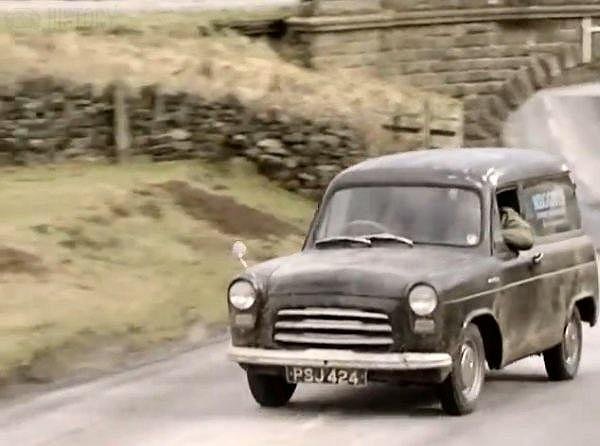
Ford Thames 300
 |
|
|
Manufacturer: |
Ford of Britain |
|
Class: |
Commercial vehicle |
|
Type: |
van |
|
Production period: |
1954 to 1961 |
|
Engine: |
Petrol engines |
|
Wheelbase: |
7ft. 3in. |
|
Length: |
11 ft 8 in |
|
Height: |
5ft. 3in |
|
weight: |
5 cwt: 1,563 lb.; 7 cwt: 1,640 1b. |
The Ford Thames 300E is a small car derived van produced by Ford of Britain from 1954 to 1961.
History
The Thames 300E produced by Ford of Britain from 1954 to 1961.The Thames and Thames Trader name was given to all available sizes produced by British Ford Commercial vehicles from the time following the dropping of the Fordson badge. The Thames 300E was introduced in July 1954 built on the Ford Anglia, this was also based on the the original Ford Squire that was a two-door estate design, related to the Ford Prefect 100E four-door saloon with an all-steel body along with the Ford Escort version that was a mechanically identical estate car with the lower trim level of the Ford Anglia, it was substantially shorter than both the Prefect and the closely related Ford Anglia 100E two-door saloon.It used the short front doors of the four-door model because the bodyshell was optimized for use as the Thames 300E panel van.Production of the Thames 300E panel van continued along with the original Escort until 1961.
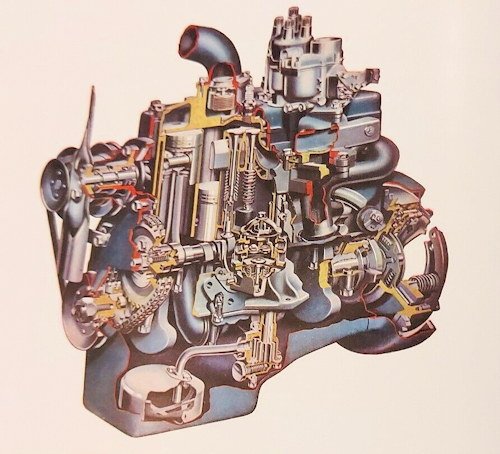
The Ford Thames 300E received the petrol 1172 cc four-cylinder in line, side valve engine this came with 36 bhp at 4,500 r.p.m. and Glide ride suspension independent Type front
and the rear Longitudinal semi-elliptic leaf. The bodyshell was optimized for use as a small delivery panel van rather than an estate with its two, short passenger doors and shorter overall length than the saloons.
The basic instruments around the steering column directly ahead of the driver. speedometer. odometer. fuel gauge. oil warning light and main beam indicator. Ignition warning light. ignition. lighting Controls Choke and starter knobs and instrument lighting switches windscreen wiper knob ; foot—operated headlamp dipper switch. in a small cluster,the gear change was floor-mounted. during production the dashboard was revised twice replaced by a central panel with twin dials by 1957 along with a new mesh radiator grille replacing the 3 slated version grill, new front lamp surrounds and larger taillights and from 1959 more changes .
Inside ,Sun visor,Ashtray,Bucket type driver's seat.parcel tray beneath facia panel, Vacuum-operated Windscreen wipers. Optional extras available : demister; passenger seat, with second visor, flashing indicators. rear quarter bumpers. twin windtone horns.
Colours Suede Grey primer. (at extra cost) Black, Dover White. Kenilworth Blue. Richmond Blue, Pembroke Coral. Newark Grey. Ludlow Green, Durham Beige.
Initially, there was only one model with 5 cwt with 21.5 cwt (250 kg) carrying capacity. Later standard and deluxe models with 7 cwt variant with 23.5 cwt 350 kg payload and stronger rear leaf springs with 6-ply tires. They all had the same 66-cubic-foot (1.9 m3) load volume. Inside plenty of leg and head room the passenger seat and heater was optional the extra spare wheel is positioned against body side when passenger seat is fitted, a well-designed facia with a full-width parcel shelf A low loading height of 23" for 5 cwt and 24" for 7 cwt increases the load space, and automatic retainers hold open the Wide rear doors.
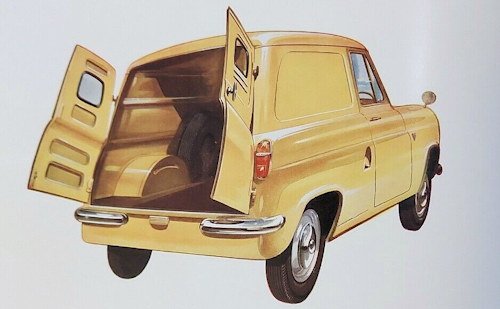
300E production ended in April 1961 and the van's replacement, the Anglia 105E based Thames 307E, was introduced in march of the same year. A Production totaled 196,885 examples comprising 139,267 5 cwt, 10,056 Standard 7 cwt and 47,562 Deluxe 7 cwt units. Were manufactured until the end of production 1961.