




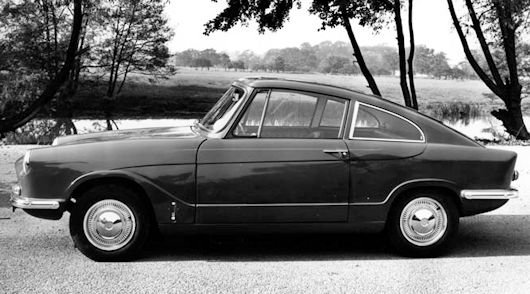
Bond Equipe
 |
|
| Manufacturer | Bond Cars Ltd |
|---|---|
| Production | 1963 to 1970 |
| Produced | 4,389 |
| Assembly | Preston, UK |
| Class | Sports car |
| Body style | 2-door saloon 2-door convertible |
| Engine | Triumph 1147, 1296 or 1998 cc |
| Transmission | 4-speed manual optional overdrive on 2 litre |
| Wheelbase | 93 in (2,362 mm) |
| Length | 160 in (4,064 mm) |
| Width | 60 in (1,524 mm) |
The Bond Equipe was an English 2+2 sports car, manufactured by Bond Cars Ltd. It was their first 4-wheeled car, and production started in April 1963.
History
The 2 + 2 Equipe first made in in May 1963,With two years of the original licensing agreement to run between Bond and Standard-Triumph, who supply
most of the components, a three-year extension has already been agreed.
The original Equipe, the GT, was based on the Triumph Herald chassis with a double backbone, channel section with outriggers and fastback fibreglass body and also utilised further Triumph parts including the windscreen / scuttle assembly, and doors. The more expensive and roomy GT4S has now completely super-seded the earlier 2+ 2 so that all Equipes now have two more inches of headroom at the back, an outside boot lid and rather heavy treatment for the four embedded headlights.
The well finished glass fibre body built round a (steel) Herald scuttle structure and doors. It looks from the outside like a fastback two-seater but in fact it will accommodate four small adults in greater comfort than many bigger GT cars.
Excellent front seats giving superb lateral support allow a keen driver to exploit the good handling and excellent brakes even more than in a Herald to which the Bond naturally has a strong family resemblance.
The ride from the all-independent suspension is firm but not uncomfortable except on really bad bumps. The cornering power is only moderate but the handling is good and allows a keen driver to throw the car about. the Equipe is very controllable on its Dunlop C41 tyres. With strong kick-back through the rack-and-pinion steering, the seats provide the sort of lateral support against cornering that is rarely found outside a competition car.
The heating is simple and normally effective enough with, as the Herald, two push/pull knobs on the facia controll. standard of finish set by the polished wood Herald facia.The black upholstery is particularly smart and luxurious and there is a wood-rimmed steering wheel and carpet on the floor. Excellent luggage qualifies the Bond for its GT label rear seat cushion can be removed to make another useful for suitcases, at the expense of passengers.with a carrying capacity of 353 1b, (160 kg). There is also locker on the facia. From a safety the adjustable steering is collapsible and there is padding on the dash
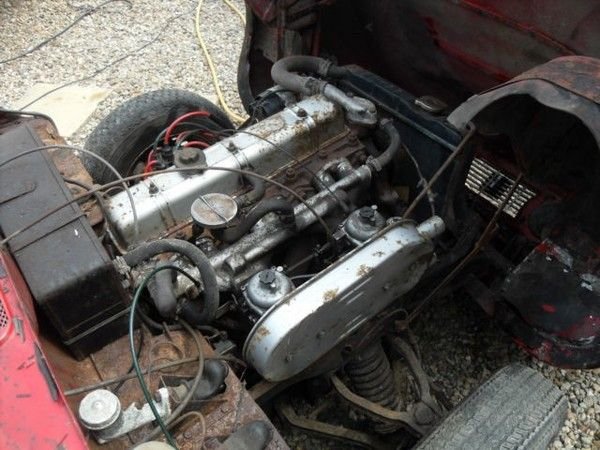
The backbone chassis and all-independent suspension coil and wishbone at the front, swinging axles behind are still basic Triumph Herald but the engine now comes from the Mk Il Spitfire; with 67 b.h.p.The top speed of 85.7 m.p.h.the 10-gallon petrol tank, which has a reserve tap, gives an excellent range of up to 360 miles.
The September 1964 GT4S model saw revisions to the body with twin headlights and an opening rear boot. It was powered by the same, mildly tuned up (63 bhp, later increased to 67 bhp), Herald-based 1147 cc engine used in the Triumph Spitfire. The engine was switched to the 75 bhp (56 kW) 1296 cc Triumph Spitfire engine in April 1967, just one month after the Spitfire itself had undergone the same upgrade,the revised model being identified as the GT4S 1300. An increase in claimed output of 12% resulted. the distribution of weight: 54% to front axle, and 46% to the rear axle At the same time the front disc brakes were enlarged and the design of the rear suspension (one component not carried over unmodified from the Triumph Spitfire) received "attention" with independent, swinging semi-axles, transverse leafspring upper arms, swinging longitudinal trailing arms, telescopic dampers.
PERFORMANCE 1300cc
max power (DIN): 70 hp at 6,000 rpm
max torque (DIN): 75 1b ft, 10.3 kg m at 4,000 rpm
max engine rpm: 6,700
specific power: 54 hp/l
power- weight ratio: 23.1 lb/hp, 10.5 kg/hp
carrying capacity: 706 1b, 320 kg
speed in direct drive at 1,000 rpm: 15.7 mph, 25.3 km/h.

The GT4S was joined by the 2-litre GT with a larger smoother body directly before the London Motor Show in October 1967. This model was based on the similar Triumph Vitesse chassis and used its 1998 cc 95 bhp (71 kW) six-cylinder engine. The 2-litre GT was available as a closed coupé and, later, as a convertible. The car was capable of 100 mph (161 km/h) with respectable acceleration. Horsepower and suspension improvements were made in line with Triumph's Mark 2 upgrade of the Vitesse in Autumn 1968, and a convertible was introduced at the same time.
PERFORMANCE 2.0cc
Engine Capacity 121.92 cu in, 1,998 cu cm
Fuel Consumption 23.7 ml imp ga
max power (DIN): 95 hp at 5,000 rpm
max torque (DIN): 117 1b ft, 16.1 kg m at 3,000 rpm
max engine rpm: 6,000
specific power: 47.5 hp/l
power-weight ratio: 201.1 lb/hp, 9.1 kglhp
acceleration: standing 1/4 mile 18 sec, 0—50 mph (0—80 km/h) 11.5 sec
speed in direct drive at 1,000 rpm: 17.3 mph, 27.8 km/h
Production
- Bond GT 2+2: April 1963 - October 1964; 451 (including 7 known pre-production cars)
- Bond GT 4S: September 1964 - January 1967; 1934
- Bond GT 4S 1300: February 1967 - August 1970; 571
- Bond Equipe 2-Litre Saloon: January 1967 - January 1970; 591
- Bond Equipe 2-Litre Convertible: January 1968 - January 1970; 841
Total Equipe Production = 4389 (including one known Mk.3 prototype made at Tamworth)
Production ended in August 1970 when Reliant, which had acquired Bond in 1969, closed the factory.
In Film and Television
Bond Equipe GT4 in Monty Python Flying Circus TV series


