

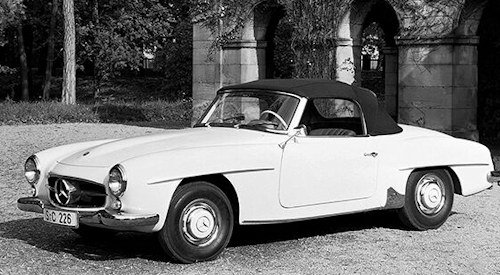
Mercedes-Benz W 121 SL 190
 |
|
|
Manufacturer |
Mercedes-Benz |
|
Production |
1955 to 1963 |
|
Built |
25,881 |
|
Assembly |
Stuttgart Untertürkheim, Germany |
|
Successor |
Mercedes-Benz W113 (230SL) |
|
Class |
Sports car |
|
Body style |
2-door roadster |
|
Layout |
FR layout |
|
Platform |
Mercedes-Benz W121 |
|
Engine |
1,897 cc M121 SOHC I4 |
|
Transmission |
4-speed manual, fully synchronized |
|
Wheelbase |
2,400 mm (94.5 in) |
|
Length |
4,290 mm (168.9 in) |
|
Width |
1,740 mm (68.5 in) |
|
Height |
1,320 mm (52.0 in) |
|
Curb weight |
2,552 lb (1,158 kg) |
The Mercedes-Benz 190SL is a two-door grand touring convertible that was produced by Mercedes-Benz between May 1955 and February 1963.
History
The Mercedes-Benz 190 SL (W 121 B II) was offered from 1955 to 1963 as a roadster (also available with a coupé roof) the ideal basis for the conception of a real sports touring car with high suitability for everyday use should also be offered. . The 190 SL is without a doubt known for the quality of its construction and workmanship. with comfort and space allocation, With its elegant shape and the flat bonnet with the new, low and wide radiator front. The number 190 in the sales designation stands for displacements, the additional designation SL is short for "Sport Light"
Despite the extremely short development time of just five months, prototypes of the 300 SL and 190 SL were made, the New York Auto Show and the trade press. The development of the 300 SL was already well advanced, so that production could begin in August 1954. In the course of 1954, Walther Häcker's body design team carried out several changes on the New York version of the 190 SL in order to bring the vehicle closer to the shape of the 300 SL designed by Friedrich Geiger (e.g., removing the air scoop the bonnet and retouching of turn signal lights, radiator grille, bumpers, rear fender and dashboard). The first revised 190 SL was shown at the Geneva Motor Show in March 1955. Series production began two months later, where the 300 SL was also produced.
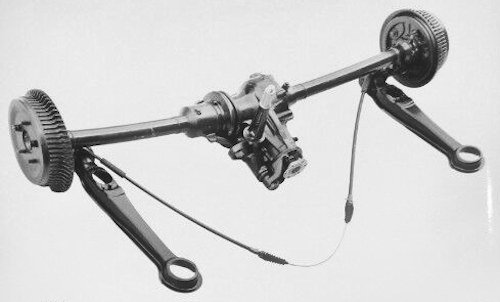
The 190SL was sold alongside the faster, more expensive Mercedes-Benz 300SL, which it closely resembled both in its styling, engineering, Technically, the 190SL did not use the 300SL's purpose-built tubular spaceframe W198 platform, but was built on a shortened and monocoque R121 platform that modified from the W121 small saloon. the Mercedes-Benz 190 SL is based on the W 121 series sedan “pontoon model”. To distinguish it from the pontoon model 190, the works code W 121 was supplemented by the suffix B II (for series II), Based on the later designation of the SL models with the abbreviation R (for roadster, from series 107), the 190 SL is sometimes also referred to as the R 121 detailing and fully independent suspension, having double wishbone suspensions at the front and swing axles at the rear.
The body of the 190 SL was aerodynamically shaped based on the model of the 300 SL gullwing. Many stylistic elements were adopted from the 300 SL, e.g., the front mask, the bumpers, the front headlights and parts of the hood. The rear lights and chassis components came from the pontoon vehicles. Bumper guards were mandatory in the USA because of the height required there, available at extra cost in Europe. The body of the 190 SL was made of sheet steel, the bonnet, trunk lid, door sill and door skin were made of aluminium. The 190 SL weighed 1180 kg (1200 kg with the hardtop on).
The co-existence of two different SL series was unique in the history of Daimler-Benz. Only since the introduction of the SLK series have there been two different roadster models, which is why the 190 SL is sometimes regarded as the predecessor of the SLK.
The 190 SL was offered in three variants:
from May 1955 Roadster with soft top -
by December 1955 came the coupé with hardtop attachment without soft top compartment or also coupé with hardtop attachment and soft top The majority of the models produced were soft top roadsters with the possibility of retrofitting a suitable hardtop. With the most expensive version, the "coupé with roadster top", The 190 SL coupe version was very seldom ordered because, after the hardtop had been removed, good weather was required for open-top driving.
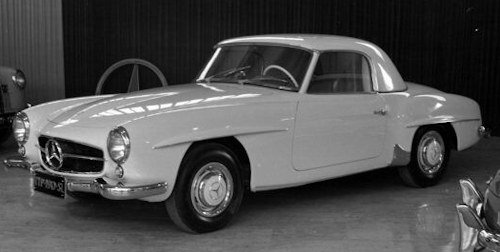
- from May 1955 Roadster with soft top - model code 121.042 -
- from December 1955 coupé with hardtop attachment (without soft top compartment) - model code M 121.040
- from December 1955 coupé with hardtop attachment and soft top - same model code as coupé
The majority of the models produced were roadsters. Here there was the possibility of retrofitting a suitable hardtop. With the most expensive version, the "coupé with roadster top", both roofs were available for year-round use. The 190 SL coupe version was very seldom ordered because, after the hardtop had been removed, good weather was required for open-top driving. A subsequent retrofitting of the soft top, including the locking mechanism and the top compartment, also resulted in high additional costs.
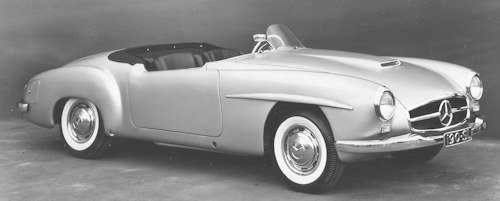
A sports version of the 190 SL was offered better driving performance should be achieved by reducing the vehicle weight. For this purpose, the bumpers and the hood could be removed. In addition, the windscreen could be replaced by a small, light plexiglass pane in the driver's seat and the doors could be exchanged for special light-metal specimens without windows. However, only 17 vehicles of this "Sport roadster" were produced (source: Motor-Klassik 2/1986), the model variant was discontinued in March 1956.
PERFORMANCE:
- max speed in 1st gear: 31.1 mph, 50 km/h
- max speed in 2nd gear: 47.2 mph, 76 km/h
- max speed in 3rd gear: 74.6 mph, 120 km/h
- max speed in 4th gear: 108.7 mph, 175 km/h
power-weight ratio: 20.1 lb/hp, 9.1 kg/hp useful 'load: 761 1b, 345 kg, max gradient in 1st gear: 50 %, speed in direct drive at 1000 rpm: 18.3 mph, 29.5 km/h
The interior of the 190 SL was luxuriously equipped. The Roadster was available with MB-Tex upholstery (artificial leather) in four colours to match the paintwork. Initially, the roadster had "bucket seats" related to those of the 300 SL, from 1956 the thicker upholstered seats of the 190 SL coupe were installed. Leather seat covers were standard in the coupé versions.
To take a third person with you, a separate transverse seat could be installed in the rear and removed again in just a few simple steps. If you didn't take a third person in the back, two full suitcases could be accommodated there. Tailor-made luggage sets for the rear and trunk were available as an extra. When the fabric top was closed, some utensils could be stored in the top compartment, and map pockets were attached to the doors. The interior floor was covered with rubber mats, later there was also an interior carpet.
Very advanced at the time was the heating control, which could be set separately for the driver and front passenger, with additional ventilation for defrosting the windows.
The dashboard is related to the 300 SL gullwing: rev counter on the left, speedometer on the right. Below that were three more instruments: oil pressure, coolant temperature and fuel gauges. Later, a hand-wound Kienzle timer was added to the lockable glove box lid. The dashboard was upholstered with artificial or genuine leather. A radio could be installed. The dimmable interior mirror and an ashtray were located on the dashboard.
The steering wheel with a diameter of 43 cm limits the field of vision for small drivers; there was no power steering. The first sun visor versions were made of metal and celluloid. In the late 1950s these were replaced by leather-covered panels; then on the passenger side with a make-up mirror.
The 190SL was powered by a new, slightly oversquare 1.9 L straight-four SOHC engine (Type M121 BII), that developed 105 PS (77 kW; 104 hp) (or 120 gross hp) that earned itself a reputation for not running that smoothly mostly due to the difficulty in properly synchronising the twin-choke dual Sole carburettors, and that, in detuned form, was later also used in the W120 180 and W121 190 models. The four-cylinder engine block of the 190SL was based on the six-cylinder engine of the 300 SL.
The 85 mm bore was transferred unchanged from the larger engine to the smaller, although the stroke for the 190 SL was reduced from 88.0 mm to 83.6 mm. The car was available either as a soft-top convertible or with removable hardtop. Optional was a third-passenger transverse seat that could even fit an adult. During its first years the 190SL was available as a sports-racing model with small Perspex windscreen and spartan one-piece leather covered bucket seats and aluminium doors, although any competition aspirations were modest. In 1959, the hardtop's rear window was enlarged.
Both the 190SL and the 300SL were replaced by the Mercedes-Benz 230SL in 1963.With 25,881 vehicles built, the touring sports car proved to be successful.

