BMW 8 Series E31
 |
|
| Manufacturer | BMW |
|---|---|
| Production | 1989 to 1999 |
| Built | 31,062 |
| Assembly | Germany |
| Designer | Klaus Kapitza |
| Class | Sports car |
| Body style | 2-door coupé Grand tourer |
| Layout | FR layout |
| Related | McLaren F1 |
| Engines | 4.0 L M60 V8 4.4 L M62 V8 5.0-5.6 L M70 V12 5.4 L M73 V12 |
| Transmission | 4-speed automatic 5-speed automatic 6-speed manual |
| Dimensions | |
| Wheelbase | 2,685 mm (105.7 in) |
| Length | 4,780 mm (188 in) |
| Width | 1,854 mm (73.0 in) |
| Height | 1,341 mm (52.8 in) |
| Curb weight | 1,830 kg (4,000 lb) (840) 1,975 kg (4,350 lb) (850) |
The BMW 8 Series (E31) is a V8 and V12-engined Grand Tourer built by BMW from 1989 to 1999.
History
BMW 8 Series is a luxury coupe of the 8 Series from BMW .The 8 Series was created under the direction of BMW chief designer Claus LutheAs The main models 840 and 850and was officially presented at the IAA in Frankfurt in the summer of 1989
it was was produced until mid-1999. The E31 was the most expensive model in the BMW range until it was discontinued in 1999 and had an electronically limited top speed of 155 mph (250 km/h).
Design of the 8 Series began in 1986, with construction starting in the same year. The 8 Series debuted at the Frankfurt Motor Show (IAA) in early September 1989. The 8 Series was designed to move beyond the market of the original 6 Series. The 8 Series however had substantially improved performance, as well as a far higher purchase price.BMW used CAD tools, still unusual at the time, to design the car's all-new body. Combined with wind tunnel testing, the resulting car had a drag coefficient of 0.29.While CAD modeling allowed the car's unibody to be 8 lb (3 kg) lighter than that of its predecessor, the car was significantly heavier when completed due to the large engine and added luxury items
The 8 Series supercar offered the first V-12 engine mated to a 6-speed manual gearbox on a road car. It was also one of the first vehicles to be fitted with an electronic "fly-by-wire" throttle. The 8 Series was one of BMW's first cars, together with the Z1, to use a multi-link rear axle.
Initially, the vehicle was only available as an 850i with the M70B50 twelve-cylinder engine with 220 kW (300 hp)
The power is transmitted via a 6-speed manual transmission or a four-speed automatic .By 1992, the series was expanded to include the 850CSi with a 280 kW (380 hp) M73B54 twelve-cylinder engine This was offered exclusively with a 6-speed manual transmission and a steering rear axle.
By 1993 the 840i equipped with a M60B40 210 kW (286 hp) V8 . This base model was BMW's first V8 coupe since the BMW 3200 CS in the 1960s.
By 1994,the 850Ci received a modernized M73B54 twelve-cylinder engine with 240 kW (326 hp)
From the end of 1996 only 840Ci and 850Ci were made, the 850CSi was discontinued.
840Ci
| Power | 286 bhp |
|---|---|
| Top Speed | 155 mph |
| 0-60 mph | 6.8 secs |
| Torque | 420 Nm, 310 ft-lb |
| CO2 Emissions | 319 g/km |
| Euro Emissions Standard | 2 |
| Miles Per Tank | 415 miles |
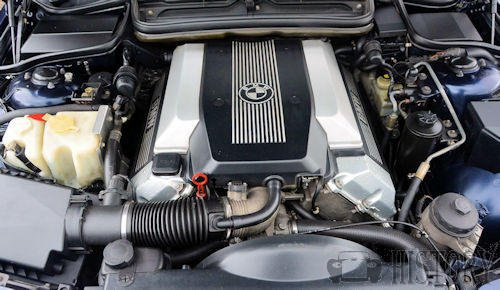
The 840Ci exists with two different engine packages. The first used the 4 liter M60B40 engine with 286 PS (210 kW) and was produced from mid-1993 to late 1995. From mid-1995, production phased in the newer 4.4 liter M62B44 engine, which had better fuel economy and more torque, though power output remained unchanged.
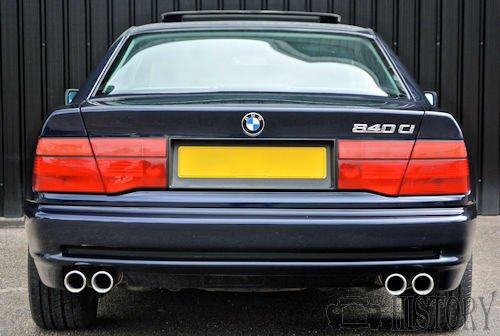
The 840Ci was available with a 5-speed automatic transmission, though European cars were given the option of a 6-speed manual transmission. The only external features distinguishing the V8 model from the V12 models were the quad round exhausts, which were square in the V12 models, The 840Ci stayed in production until May, 1999.850iThis was the first model launched in 1990 with the 5 litre M70B50 V12 engine producing 300 PS (221 kW; 296 hp). It was available with either a 4-speed automatic or a 6-speed manual gearbox.
850Ci As the capacity of the M73 increased to 5.4 liters and the compression ratio went up, the power output rose to 326 PS (240 kW; 322 hp).
The M8 project with a special 550 bhp (410 kW; 558 PS) version of the S70 engine, was eventually scrapped because BMW decided that there was no market for an M8. The only prototype ever produced (one that was reportedly not even road safe) was locked away by BMW in the company's Giftschrank (poison storage) The engine of the M8 would have been a 6-liter V12 engine with up to 441 kW (600 hp) based on the S70 , which ultimately found its place in the McLaren F1 super sports car in a modified form . The engine of the 850CSi (which is indicated as M8 in the vehicle registration document) is also based on the S70 engine, but with a displacement of 5.6 liters and only 280 kW (380 hp). The M8 prototype had no pop- up headlights : the low and high beams were integrated into the bumper instead of the narrow parking lights. The prototype was powered by the V12, which achieved an output of around 400 kW thanks to a single throttle system, among other things.
The 830i was a prototype which did not reach production. As the potential entry-level model, the 830i was to use the 3-liter V8 with 218 PS (160 kW; 215 hp) from the 530i and 730i, known internally as the M60B30. Eighteen cars were produced, 13 of which had an automatic gearbox fitted. The model was dropped in favour of the 840Ci and almost all of the 18 cars were dismantled; one car is in a BMW museum.
Only three prototypes of the convertible version of the E31 were produced. The vehicle is technically based on the 850i E31 with six-speed manual gearbox introduced in 1989, was manufactured in 1990 and extensively tested by BMW and bears some details of the previously built E34 5 Series Cabriolet , which also did not go into series production. The designation was adapted to the newer 8 series models from 1993 with the additional abbreviation Ci in 850Ci. "Too sluggish, too little stiff, too expensive" were the reasons for the declaration of waiver for the convertible version. Developing such an elaborate niche model afterwards did not promise sufficient quantities and returns.
850CSi
| Power | 380 bhp |
|---|---|
| Top Speed | 155 mph |
| 0-60 mph | 5.8 secs |
| Miles Per Tank | 435 miles |
As a top-of-the-range sports tourer, the 850CSi took over from the prototype M8. The 850CSi used the same engine as the 850i, which was tuned so significantly that BMW assigned it a new engine code: S70B56. The modifications included a capacity increase to 5.6 liters and power increase to 380 PS (279 kW; 375 hp).
The 850CSi's modified suspension included stiffer springs and dampers and reduced the car's ride height. The recirculating ball steering ratio was dropped 15% over the stock E31 setup. The model also sported wider wheels, with the option of forged alloys. The front and rear bumpers were reshaped for improved aerodynamic performance. Four round stainless steel exhaust tips replaced the square tips found on other models. The 6-speed manual gearbox was the only transmission option. In Europe all 850CSi's came with four-wheel steering (AHK - Aktive Hinterachs-Kinematik). The 840Ci (4.0/4.4l V8)These models were equipped with a 5-speed automatic transmission or a 6-speed manual transmission. The 850i/850Ci (V12) models each carry either a 4-speed automatic transmission or a 6-speed manual transmission,a 5-speed automatic transmission was fitted from mid-1994. The 850CSi model only came with a 6-speed manual transmission.
Production ended in late 1996 because the S70 engine could not be modified to comply with new emission regulations without substantial re-engineering.
Alpina B12
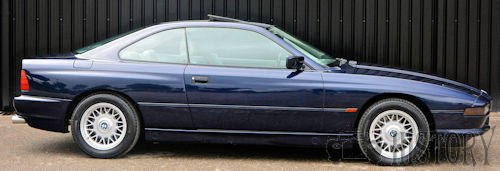
The Alpina company built the Alpina B12 based on the 8 Series .The B12 was built from 1990 to 1994 on the basis of the 850i
with a performance-enhanced V12 engine and automatic transmission. The M70 engine output was increased to 257 kW (350 hp), the maximum torque is 470 Nm.Compression increased from 8.8 to 9.5 the displacement of the engine remained unchanged.
The manual B12 5.7, based on the 850CSi, was also available from 1992.The S70 V12 engine was increased by 70 cm enlarged and the output increased by 26 kW to 306 kW (416 hp).The maximum torque of the engine is 570 Nm.
Both are not limited to the 250 km/h usual for BMW, top speed is 280 @ 300 km/h respectively.
97 of the B12 5.0 and 57 pieces of the B12 5.7 were produced.
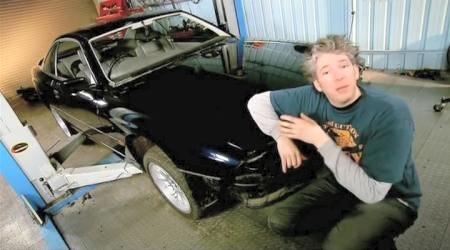
Wheeler Dealers Series 7 840 BMW