

Triumph Vitesse MKI 6 and 2-Litre
 |
|
| Manufacturer | Standard-Triumph |
|---|---|
| Production | 1962 to 1968 |
| Class | Sports car |
| Designer | Giovanni Michelotti |
| Body and chassis | |
| Body style | Two-door saloon Two-door convertible |
| Powertrain | |
| Engine | 1596 cc or 1998 cc Triumph I6 |
| Transmission | Four-speed manual, Optional overdrive |
| Drive | RWD |
| Dimensions | |
| Wheelbase | 91.5 in (2,324 mm) |
| Length | 153 in (3,886 mm) |
| Width | 60 in (1,524 mm) |
| Height | 52.5 in (1,334 mm) |
| Curb weight | 2,072 lb (940 kg) |
The Triumph Vitesse Mk1 is a sports car built by Standard-Triumph from May 1962 to July 1968.
History
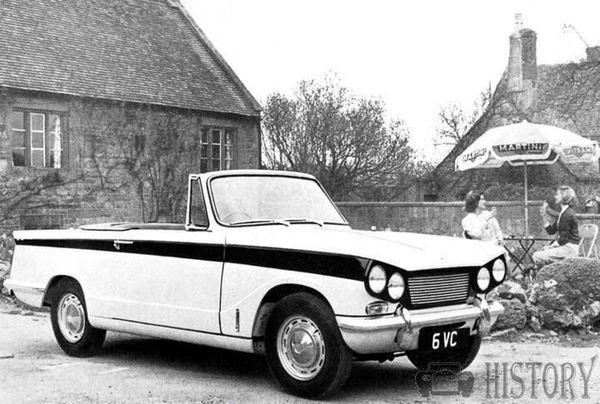
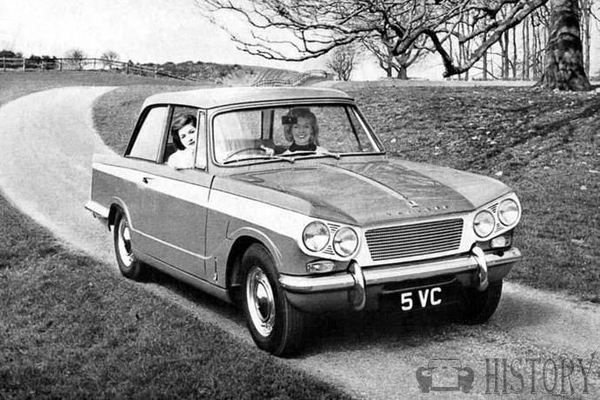
The Triumph Vitesse is a compact six-cylinder car built by Standard-Triumph. The car was styled by Giovanni Michelotti, and was available in saloon and convertible variants.
The Vitesse name was first used by Austin on their 1914–16 Austin 20 and 30 hp models, then first used by Triumph between 1936 and 1938. The name remained unused until 1982, when Rover used it on their SD1 until 1986, and later on the final Rover models for ten years from 1988 to 1998.
The Triumph Vitesse 6 was introduced on May 25, 1962. It was the high-performance variant of the Herald small two-door sedan. The Herald was introduced on April 22, 1959. Its shape also came from Michelotti. In the early 1960s, Triumph considered building a small six-cylinder sports sedan based on it. Michelotti was in turn tasked with the styling and presented a car that used almost all of the Herald's body panels and featured a new front end. The front of the vehicle with its offset twin 4-headlights was called "Chinese Eye".
Standard-Triumph incorporated the familiar 1,596 cc straight-six engine from the Standard Vanguard Six, but with a smaller bore of 66.75mm instead of the Vanguard's 74.7mm and twin Solex B32PIH downdraft carburettors. These carburettors were replaced with B321H carburettors soon after the car's introduction as the accelerator pump proved to be a problem. Close inspection reveals a seam on the cylinder block between the third and fourth cylinders, indicating the beginnings of this engine design as the 803-cc block of the 1953 Standard Eight. The manual gearbox was strengthened and with an overdrive offered by Laycock-de-Normanville, D-type. Disc brakes at the front and more powerful drum brakes at the rear were offered as standard, and the Herald's fuel tank was enlarged while retaining the spare cock of the smaller tank. Due to the higher weight of the six-cylinder engine, the front wheel suspension was equipped with stronger coil springs, on the rear axle the Herald system was equipped with a swing axle and transverse leaf spring, but soon proved to be unsuitable for the more powerful Vitesse. The chassis essentially corresponded to that of the Herald. A sedan and a convertible were available; a coup that was also designed never made it to series production. A handful of station wagons were also built on special customer request at Standard-Triumph's Park Royal service depot in west London.
The interior was upgraded from the Herald, wooden door panels matched the wooden dashboard; in addition, the car had better seats and door controls. A Webasto sunroof in vinyl or fabric finishes was available as an extra on the sedan. Externally, there were stainless steel mouldings on the car's sides and aluminium bumper mouldings (instead of the Herald's white rubber mouldings). The side trim strips run the entire length of the vehicle and are also routed around the radiator grille.
About a year after its launch, the Vitesse's styling was revised for the first time; the dashboard received several round instruments instead of the single one from the Herald and from September 1965, from chassis number HB27986, the Solex twin carburettors were replaced by Zenith-Stromberg CD 150. Previously, the engine had done 70 bhp (51 kW) at 5,000 rpm and 125 Nm of torque. Now the values increased enough to make the car more flexible and powerful than before. A 13-14 bhp (9.6-10.3 kW) increase in power was quoted, which was a little overoptimistic, but an engine magazine put the top speed at 146 km/h; the acceleration from 0 to 130 km/h was managed in 33.6 seconds instead of 46.6 seconds.
The Vitesse 6 sold extremely well and was the most popular Vitesse model. The car was very popular for its good driving performance and fuel economy, as well as for its elegant interior. The Vitesse had few competitors: its driving performance matched that of many sports cars (Triumph called it the "two-seater beater"), but it offered room for the whole family. The cabriolet in particular had no competitors on the market until the Stag from the same company appeared many years later.
The Vitesse 6 convertible was also exported to the United States in 1962–1964; the left-hand drive version was called Triumph Sports 6 and was marketed as a "Limited Edition" (special model). Because of its high price, only 679 units were sold.The Sports 6 was probably better suited to US highways than the Herald, but faced cutthroat price competition from cars like the Ford Mustang. The Vitesse sedan was not officially sold in the US, although some examples were imported privately, usually by American service personnel. The official retail price for the Sports 6 Cabriolet was US $2,499.
Vitesse 6 (1600): May 1962 – September 1966
- saloon: 22,814
- convertible: 8,447, includes 679 Sports 6 (USA)
Vitesse 2-Litre
In 1966 Triumph upgraded the engine to 1998 cc, also used it for the GT6 coupe and brought out the Triumph Vitesse 2-Litre. Power increased to 95 bhp (70 kW); the new car accelerated from 0–60 mph time of just over 11 seconds (0 to 100 km/h in 13 seconds). The power increase also revealed the shortcomings of the rear suspension, which were also came from the GT6 and the Spitfire and an improved stronger differential was fitted. There were some detail improvements for the 2-Litre like a stronger gearbox all synchromesh gearbox, better brakes and "VITESSE" lettering on the aluminium strip above the reversing light and badges on the side of the bonnet with 2 litre.. in line with the new Triumph GT6 coupé, and relaunched the car as the Vitesse 2-Litre.
PERFORMANCE: 2-litre
- engine capacity121.92 cu in, 1,998 cu cm
- fuel consumption 23.7 m/imp gal, 19.8 m/US gal, 11.91 x 100 km
- max speed 100 mph, 161 km/h
- max power (DIN): 95 hp at 5,000 rpm
- max torque (DIN): 117 1b ft, 16.1 kg m at 3000 rpm
- max engine rpm : 5,900
- specific power: 47.5 hp/l
- power-weight ratio; 20.3 lb/hp, 9.2 kg/hp
- acceleration: standing 1/4 mile 18.5 sec
Vitesse 2-Litre: September 1966 – September 1968
10,830 .Saloon: 7,328 ,Convertible: 3,502