




Triumph GT6 MKI
 |
|
| Overview | |
|---|---|
| Manufacturer | Standard-Triumph |
| Production | 1966 to 1968 |
| Class | Sports car |
| Body style | 2-door fastback |
| Layout | FR layout |
| Related | Triumph Spitfire Triumph Herald Triumph Vitesse |
| Engine | 1,998 cc (2.0 L) OHV I6 |
| Transmission | 4-speed synchromeshed manual with optional overdrive |
| Dimensions | |
| Wheelbase | 2,128 mm (83.8 in) |
| Length | 3,717 mm |
| Width | 1,450 mm (57 in) |
| Height | 1,193 mm (47.0 in) |
The GT6 MKI is a 6-cylinder sports car which was built by Triumph. Production ran from 1966 to 1968 .The GT6 fixed head coupe that was based on the Triumph Spitfire .
History
The GT6 is the result of a happy marriage between the little Spitfire andthe 2000 Saloon, but in some ways it is quite different from both. The new coupé has taken the body used by the official works team or the 1964 and 1965 Le Mans 24 Hours (the power bulge on the bonnet is one difference from the Spitfire) and also the chassis and suitably strengthened suspension. The 2000 engine has been taken over, but, with the compression ratio increased to 9.5, it now develops 95 hp DIN at 5,000 rpm. Since this car weighs only 1,793 pounds (913 kg) the power-weight ratio is extremely favourable for a car of this category and results in formidable acceleration powers (from O to 50 miles per hour in under 7.8 seconds), Both for this reason and because the maximum torque is very high (117 1b ft. 16.2 kgm at 3,000 rpm) there is no need. even in town traffic, to change gear
too frequently.The suspension is independent all round, with wishbones, coil springs,like the co-axial telescopic dampers and anti-roll bar on the front, and— swinging semi-axles with a transverse semi-elliptic leafspring and Spitfire longitudinal radius rods on the rear.
With the Spitfire, Triumph introduced an affordable sports car in 1962. At the time, the competitor MG had a coupe on offer from the MGB, which sold well. Triumph therefore commissioned the Italian designer Giovanni Michelotti to also design a coupé based on the Spitfire The new body was a sleek fastback with an opening rear hatch .It was a two-seater, but a little extra back seat could be obtained if needed, and it was big enough for small kids The basic price new was £ 985 inc in the UK and just over $ 2,000 in the US . Due to the higher weight, however, the performance of the Spitfire engine proved to be insufficient in this car, which is why the 2-litre six-cylinder engine from the Triumph Vitesse was installed in the new Spitfire coupe.
The Triumph GT6 was a new car that was released in 1966. With its rear hatchback. The GT6 was well equipped. Inside that as the spifire with addition to the wooden dashboard with four instruments, it had a two-speed windshield wiper, a two-speed heater fan, a padded steering wheel and bucket seats as standard. There is
also a collapsible safety device for the steering column in case of accidents. The polished wood facia includes trip arid total mileage recorder, rev counter, temperature gauge and fuel gauge. There is no oil gauge, but a warning light comes on when the pressure falls too tow. finger-tip stalks from the steering column control indicators, overdrive and lights. The courtesy light is operated by the rear door as well as the two side doors.
The chassis as of the Spifire was double backbone, channel section with outriggers. The swing-axle system adopted from the Spitfire and the Triumph Herald small saloon.The Mk.1 model was 3717 mm long and 1450 mm wide.Front suspension was independent, wishbones, coil springs, anti-roll bar, and telescopic dampers the
rear independent, swinging semi-axles, transverse leafspring upper arms,swinging longitudinal trailing arms,and telescopic dampers.

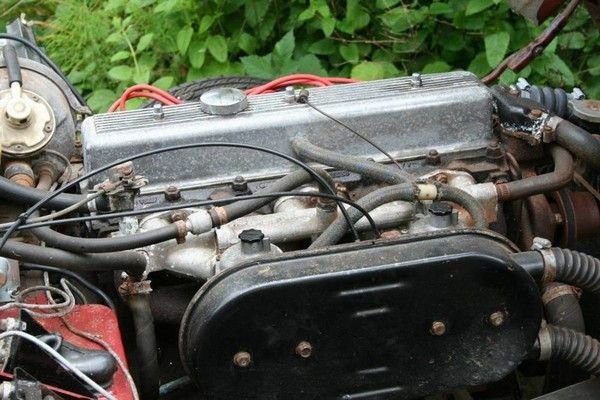
Powered by 2 Stromberg 1-50 CD horizontal carburettors , the old 6-cylinder delivered 95 hp , thanks to the weight of only 864 kg, to undermine the original set-up (identical to that of the Spitfire ). Due to the higher weight, however, the performance of the Spitfire engine proved to be insufficient in this car, which is why the 2-litre six-cylinder engine from the Triumph Vitesse was installed in the new coupe.The enlarged 6-cylinder engine demanded a redesigned bonnet top with a power bulge, and the doors were equipped with opening quarter light windows and squared-off glass in the top rear corner, and the family resemblance to the Spitfire Mk II was evident.The 6-cylinder engine was adjusted to produce 95 horsepower (71 kW) at 5000 rpm and 117 pound-feet of torque (159 Nm) at 3000 rpm.
PERFORMANCE
- engine capacity 121.92 cu in, 1,998 cu cm
- fuel consumption 25.7 mlimp gal, 21.4 ml US gal
- max speed 107 mph, 172.3 km/h
- max power (DIN): 95 hp at 5,000 rpm
- max torque (DIN): 117 1b ft, 16.1 kg m at 3,000 rpm
- max engine rpm: 6,000
- specific power: 47.5 hp/l
- power-weight ratio: 19 lb/hp, 8.6 kg/hp
- acceleration: standing 1/4 mile 17.7 sec, 0—50 mph (0— 80 km/h) 7.8 sec
The increased power necessitated certain changes to the Spitfire mechanics; the radiator was new and mounted further forward in the car and the gearbox was the stronger unit from the Vitesse, with optional overdrive. Front springs were uprated to cope with the extra weight from the new engine. The overall vehicle weight unladed was 1,904 lb (864 kg). The interior of the GT6 was well equipped; a wooden dashboard housed a full complement of instruments, with carpets and heater included as standard.
The new car had some very strong selling points. The new engine provided a 106 mph (171 km/h) top speed and 0–60 mph in 12 seconds, better than the MGB GTs rather harsh 4-cylinder engine B series engine. Fuel economy was very reasonable for the period at 20mpg, and the interior well up to the competition. The only major criticism was of its rear suspension; the GT6 inherited the swing-axle system from the Spitfire, which in turn was copied from the Herald small saloon. In the saloon it was tolerated, in the little Spitfire it was not liked and in the powerful GT6 it was heavily criticised. Triumph had done nothing to improve the system for the GT6 and the tendency to break away if the driver lifted off the power mid-corner was not helped at all by the increased weight at the front of the car. The handling was most bitterly criticised in the USA, an important export market for Triumph, where they were traditionally very strong. Similar criticism was being levelled at the Vitesse saloon, which shared the GT6's engine and its handling problems.


