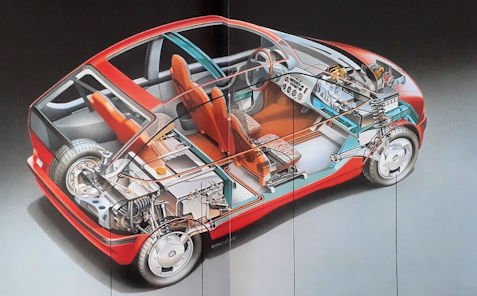
BMW E1 Prototype
 |
|
|
Presentation Year: |
1991 |
|
Vehicle Expo: |
IAA |
|
Class : |
prototype |
|
Body design : |
hatchback |
|
Engine: |
Electric motor : |
|
Length: |
3460 mm |
|
Width: |
1650 mm |
|
Height: |
1335-1393 mm |
|
Wheelbase: |
2320 mm |
|
Empty weight: |
900 kg |
BMW E1 is the name for two prototypes of an electric vehicle from BMW of 1991 and 1993
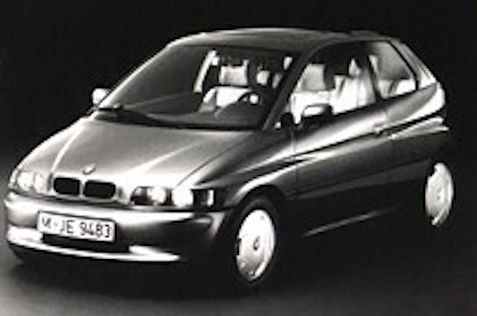
The original E1 was presented by BMW in 1991 at the IAA in Frankfurt. The BMW E1 (factory code Z11 ) was a 2 + 2-seater, which was only 3.46 m long, but with 1.65 m width . The design of the then BMW models was adopted, such as the double-glazed front headlights. The peculiarity of this model from the time was that it was a pure electric vehicle. The engine, which was mounted directly above the rear axle, provided 32 kW and gave its power, as usual with BMW, to the rear wheels.
The top speed was 120 km / h, the acceleration of 0-50 km / h at 6 seconds, the acceleration of 0-80 km / h at 18 seconds. The wheelbase was 232 centimetres, the turning circle less than nine meters. The 200-kilogram sodium-sulphur battery with 120 volts and 20 kWh provided under reasonable circumstances, energy for about 200 km range . The vehicle had a recuperation (Brake energy recovery ) with the aid of which the traction battery could be recharged by the braking energy. Outstanding for the time were the drum brakes integrated in the rims. Note : This first prototype fell victim to a fire. 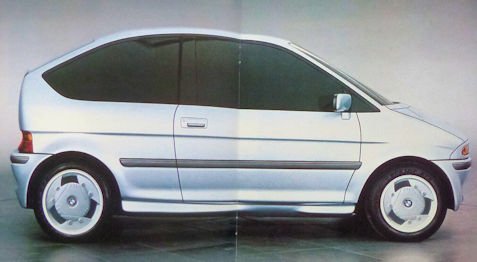
The second-generation new BMW E1 (factory code Z15 ) made its debut during the IAA in Frankfurt from 9-19 . September 1993. It was conceived to be completely exhaust-free in the city and extremely low-emission. The specifications provide fulfilled requirements for acceptable performance, acceptable range, an uncomplicated handling and a high degree of active and passive safety and low weight.
From the original E1 and the Z13 study, the employees of BMW Technik GmbH developed a two-door, four-seat, 3.70-meter-long and therefore manoeuvrable sedan that can be equipped with an electric drive, internal combustion engine or even both, depending on the application. The scope of all externally largely identical variants consists of a computer-calculated aluminium frame in so-called "space frame" technology, while the outer skin is largely made of recyclable plastic and some aluminium parts. The drive unit used here (as in the BMW Z13) is a 1.1-liter engine from the BMW K motorcycle series . The reduced to 60 kW (82 hp) for automotive operation, but torque-optimized inline four-cylinder is located in front of the vehicle and drives the front wheels. With a weight of only around 800 kg, the E1 with gasoline engine reaches the 100 km / h mark in 11.5 seconds. The maximum speed is 180 km / h, the average consumption is given with 5 to 6 litres per 100 km. 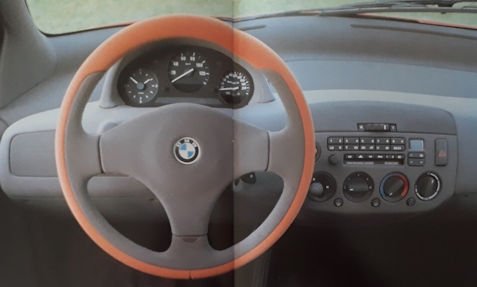
The electric E1 is about 100 kilograms heavier than the combustion engine variant. Under the back seat is the 200 kg high-temperature sodium nickel chloride battery from AEG with a capacity of 19 kWh. It supplies the ABB-Unique electric motor, which has 32 kW (45 hp) and has a maximum torque of 150 Nm, placed over the rear axle. The range is like all electric cars depending on the driving style but up to 265 kilometres. This E1 top speed is 125 km / h.
The hybrid variant has both drive sources, which depending on the application can be switched independently of each other. The smaller battery whereby the space gained occupies a 40 Liter fuel tank. The performance corresponds approximately to the above, but the hybrid E1 with 930 kg is again 30 kg heavier than the electric version. This gives the E1 user the choice: If the vehicle is used predominantly or exclusively in short-haul traffic, the pure electric E1 is the preferred choice (or even where emission-free traffic will be mandatory once). If it comes primarily to brisk forward driving at conventional range, the variant with internal combustion engine is an advantage. And for "mixed-use" offers the hybrid car. Incidentally, the two generations of the BMW E1 differ not only technically, but also optically from each other. The BMW E1 of the first generation (with the registration number M-DA 8375) differs from the BMW E1 of the second generation (license plate: M-JE 9483) or red paint (license plate: M-JE 9482)) in particular by a narrower circumferential bumper, other seats, another dashboard and the differently designed rear end. In addition, the C-pillar designed differently. The BMW E1 second-generation also has fender flares in the form of pronounced beads, which are indicated above the wheels, which the E1 of the first generation does not have.
Design study BMW E2
At the Greater Los Angeles Auto Show from 2.-12. January 1992, BMW presented the study BMW E2 based on the E1. The BMW E2 study was essentially different from the E1 developed for urban transport in Europe in that it was tailored in size and performance to US traffic conditions. The stylists of Design works should first use a model to show what such a vehicle could be. The result was a four-seater, the full equipment with 1000 kg curb weight, although about 100 kg heavier than the E1, but at an identical width of 3.82 meters by 36 inches longer and 1.45 meters five inches lower than the "Ur- Model "would be. As driving performance with the approximately 32 kW (45 hp) engine, the following values were provided for the E2: acceleration from 0 to 50 km / h in 6.5 s, from 0 to 80 km / h in 15.6 seconds, maximum speed 120 km / h. The maximum range should be 430 km, the range in practice at 260 km.