
About
Technical
-
Note: Full Specifications and Service Repair Manuals available for registered users
petrol enginesmodel
1.2
1.2
1.4
1.4 FSI
1.4
Construction period
11 / 2001-05 / 2005
04 / 2002-05 / 2005
01 / 2002-06 / 2002
07 / 2002-05 / 2005
Engine code
AWY, BMD
AZQ, BME
AUA, BBY, BKY
AXU
AUB
BBZ
Type and number of cylinders
R3 - gasoline engine with
multi-point injectionR4 gasoline engine with
multi-point injectionR4 gasoline engine with
direct injectionR4 gasoline engine with
multi-point injectionvalves
6
12
16
16
16
Displacement, cm³
1198
1390
1390
1390
Max. Power, kW (hp) at 1 / min
40 (54) / 4750
47 (64) / 5400
55 (75) / 5000
63 (86) / 5000
74 (101) / 6000
Max. Torque, Nm at 1 / min
106/3000
112/3000
126/3800
130/3750
126/4400
Gearbox, standard
5-speed manual transmission
Gear, optional
-
4- speed automatic transmission
-
-
Top speed, km / h (a)
152
162
172 (168)
178
188
Acceleration from 0-100 km / h, s (a)
17.5
14.9
12.9 (15.3)
12.1
10.9
Fuel consumption, l / 100 km
(according to EEC directive) (a)5.8-6.0
5.9-6.0
6.4-6.5 (7.4-7.6)
5.8-5.9
6.6-6.7
CO 2 emission, g / km (combined) (a)
139-144
142-144
154-156 (178-182)
139-142
158-161
Emission standard according to EU classification
Euro 4
comment
also, as notchback
not for E10 fuel suitable [16]
also, as notchback
(a) Figures in brackets are for vehicles with four-speed automatic transmission.
Diesel engines
model
1.9 SDI
1.4 TDI
1.9T DI
1.9 TDI
Construction period
11 / 2001-05 / 2005
10 / 2003-05 / 2005
Engine code
ASY
AMF, BAY
ATD, AXR
ASZ, BLT
Type and number of cylinders
R4 - Diesel engine with
distributor injection pumpR3 diesel engine with
pump-nozzle injection systemR4 diesel engine with
pump-nozzle injection systemengine charging
-
turbocharger
turbocharger
valves
8th
6
8th
Displacement, cm³
1896
1422
1896
Max. Power, kW (hp) at 1 / min
47 (64) / 4000
55 (75) / 4000
74 (101) / 4000
96 (130) / 4000
Max. Torque, Nm at 1 / min
125 / 1600-2800
195/2200
240 / 1800-2400
310/1900
Gearbox, standard
5-speed manual transmission
6-speed manual transmission
Gear, optional
-
Top speed, km / h
160
170
188
206
Acceleration from 0-100 km / h, s
17.0
13.6
10.7
9.2
Fuel consumption, l / 100 km
(according to EEC directive)4.7-4.9
4.4-4.6
4.9-5.0
5.2-5.3
CO 2 emission, g / km (combined)
127-132
119-124
132-135
140-143
Emission standard according to EU classification
Euro 3
Euro 3 / Euro 4
comment
also, as notchback
Note: The TDI engine with 55 kW was identified by the red "DI" in the "TDI" lettering until 2002 (T DI )
from 2003 applies: 55 kW / TD I - 74 kW / T DI - 96 kW / TDIpetrol engines 2005 on
model
1.2
1.4
1.4 FSI
1.4
1.6
GTI
GTI
"Cup Edition"Construction period
03 / 2005-05 / 2007
05 / 2007-05 / 2009
03 / 2005-05 / 2007
05 / 2007-05 / 2009
03 / 2005-05 / 2007
05 / 2006-05 / 2009
03 / 2005-05 / 2006
05 / 2006-05 / 2009
05 / 2006-05 / 2009
06 / 2006-05 / 2009
Engine code
BMD
BBM
BME
BZG
BKY
BUD
AXU
BBZ
BTS
BJX
BBU
Type and number of cylinders
R3 - gasoline engine with
multi-point injectionR4 gasoline engine with
multi-point injectionR4 gasoline engine with
direct injectionR4 gasoline engine with
multi-point injectionengine charging
-
-
turbocharger
valves
6
12
16
20
Displacement, cm³
1198
1390
1598
1781
Max. Power, kW (hp) at 1 / min
40 (55) / 4750
44 (60) / 5200
47 (64) / 5400
51 (70) / 5400
55 (75) / 5000
59 (80) / 5000
63 (86) / 5000
74 (101) / 6000
77 (105) / 5600
110 (150) / 5800
132 (180) / 5800
Max. Torque, Nm at 1 / min
108/3000
112/3000
126/3800
132/3800
130/3750
126/4400
153/3800
220 / 1950-4500
235 / 2000-5000
Gearbox, standard
5-speed manual transmission
Gear, optional
-
4-speed
automatic transmission6-speed Tiptronic -
automatic-
6-speed Tiptronic
automatic transmission-
Top speed, km / h (a)
152
157
162
167
172 (168)
175 (171)
178
188
192 (187)
216
225
Acceleration from 0-100 km / h, s (a)
17.5
16.5
14.9
14.5
12.9 (15.3)
12.2 (14,3)
12.1
10.9
10.4 (11.3)
8.2
7.5
Fuel consumption, l / 100 km
(according to EEC directive) (a)5.9
super5.8
super6.0
Super5.8
super6.5 (7.5)
Super6.3 (6.9)
Super5.9
Super Plus6,7
Super Plus6.7 (7.4)
Super7.8
super7.9
Super PlusCO 2 emission, g / km (combined) (a)
139
138
142
138
154 (178)
150 (165)
139
158
159 (176)
186
188
Emission standard according to EU classification
Euro 4
comment
not for E10 fuel suitable
(a) Figures in brackets are for vehicles with automatic transmissions.
Diesel engines 2005 on
model
1.4 TDI
1.4 TDI with DPF
1.4 TDI
1.4 TDI with DPF
1.9 TDI
1.9 TDI with DPF
1.9 TD I
Construction period
05 / 2005-05 / 2009
05 / 2006-05 / 2009
05 / 2005-05 / 2009
05 / 2006-05 / 2009
05 / 2005-05 / 2009
05 / 2006-05 / 2009
05 / 2005-05 / 2009
Engine code
BNM
BWB
BNV
BMS
AXR
BMT
BLT
Type and number of cylinders
R3 - Diesel engine with
pump-nozzle injection systemR4 diesel engine with
pump-nozzle injection systemengine charging
turbocharger
turbocharger
valves
6
6
8th
8th
Displacement, cm³
1422
1422
1896
1896
Max. Power, kW (hp) at 1 / min
51 (70) / 4000
59 (80) / 4000
74 (101) / 4000
96 (130) / 4000
Max. Torque, Nm at 1 / min
155/1600 to 2800
195 / 1800-2200
240 / 1800-2400
310/1900
Gearbox, standard
5-speed manual transmission
6-speed manual transmission
Gear, optional
-
Top speed, km / h (a)
164
174 (176)
188
206
Acceleration from 0-100 km / h, s
14.6
12.8
10.7
9.2
Fuel consumption, l / 100 km
(according to EEC directive) (a)4.5
4,5 (3,8)
4.8
5.0
5.2
CO 2 emission, g / km (combined) (a)
119
119 (99)
127
130
137
Emission standard according to EU classification
Euro 4
(a) The information in brackets applies to the model variant BlueMotion with standard particulate filter.
Manuals
VW Polo IV
|
|
|
|
Production period: |
2001 to 2009 |
|
Class: |
Motor Car |
|
Body versions : |
sedan |
|
Engines: |
Gasoline : 1.2-1.4 litres |
|
Length: |
3897 mm |
|
Width: |
1650 mm |
|
Height: |
1465 mm |
|
Wheelbase : |
2460 mm |
|
Curb weight : |
980-1190 kg |
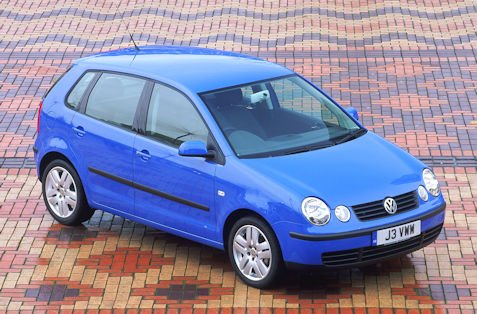
The Volkswagen Polo IV is from November 2001 to May 2009 built fourth generation of the small car model Polo of the Wolfsburg car manufacturer Volkswagen . In the spring of 2005, a visually extensively revised model was presented as part of the facelift , but its basic technical concept remained largely unchanged. Since March 2010, a visually revised model under the name Polo Vivo is offered on the South African market.
The first version of the Polo IV was on in September 2001 IAA in Frankfurt officially unveiled and built after the launch in November 2001 until its replacement by the revised model on April 30 of 2005.
Technically the vehicle based on the same platform as Seat Ibiza (6L) , Seat Cordoba (6L) and Fabia I . The body is 15.4 centimetres’ longer than the predecessor generation and thus almost reaches the outside dimensions of the Volkswagen Golf II . The 5.3 centimetres longer wheelbase adds to its legroom of passengers in the rear benefit. The enlarged boot holds also in the standard configuration 270 litres and can by folding the rear seats to be extended to 1030 Liters.
The front of the vehicle is visually oriented with its four round clear-glass headlights on the design of the Volkswagen Lupo as standard with ABS and speed-sensitive power steering . In conjunction with the optionally available ESP , the Polo IV for the first time uses a hydraulic brake assist that can shorten the stopping distance in a dangerous situation .Driver and front passenger are protected by standard front and side airbags and belt tensioners with belt force limiters . Head airbags for the front seats were available from 2002 at an additional cost. The pedals in the foot space of the driver in an accident are moved away from the body of the driver, in order to reduce the risk of injury in the leg area.
In Euro NCAP - Crash test the Polo IV four out of five stars in the evaluation of occupant safety and four stars in the evaluation of pedestrian safety peaked in of 2002.
Also from the beginning of 2004, the special model GT was available, the basic equipment including a sports suspension with about 15 millimetres’ lowering and 16-inch alloy wheels, power windows and central locking included. As engines, gasoline engines and diesel engines from 55 kW (75 hp) were available.
Over time, several variants of the first version of the Polo IV were offered, which differed from the normal production version not only by a modified basic equipment, but also had changes to the bodywork.
The Polo notchback variant of the Polo IV was built in October 2003 in Brazil and imported from there to Europe. The vehicles have on the B-pillar independent and opposite the hatchback version extended by 28 centimetre’s body. This gives the occupants in the rear more space available and the loading capacity of the trunk grows from 270 litres at the hatchback to 432 Liters. The basic equipment of the vehicles includes electrical windows and central locking.
The Polo Fun developed by Volkswagen Individual was introduced in spring 2004. This was planned as a special model with 5,000 units had been built originally, but was soon established as a separate model variant due to high demand. The available exclusively with five doors Polo Fun differed outwardly from the normal version of the Polo through to an SUV ajar off-road look with independent front and rear aprons, plastic covers on fenders, sills and doors, roof rails, standard fog lamps and 17- Inch light-alloy wheels from BBS, Roof rails and exterior mirror housings were always painted silver regardless of the exterior colour of the vehicle. The standard equipment included sports seats for driver and front passenger, leather steering wheel, central locking with radio remote control, electric windows and cassette radio . As engines, gasoline engines from 40 to 74 kW and diesel engines with 55 and 74 kW were available.
The vehicles have a standard chassis with about 15 millimetres’ more ground clearance and firmer tuning, which was also available for the standard series surcharge, are due to the lack of all-wheel drive but only partially suitable for use in the field.
Engines
At launch of the Polo IV three different engines were initially available: A newly developed 3-cylinder gasoline engine with 1.2 litter displacement and 47 kW (64 hp), the available already in the previous 4-cylinder gasoline engine with 1.4 Liters and 55 kW (75 hp), which is also already available in the previous 3-cylinder TDI - diesel engine with 1.4 Liter displacement and 55 kW (75 hp). A short time later were also a newly developed 3-cylinder gasoline engine with 1.2-liter displacement and 40 kW (55 hp) power, a 4-cylinder SDI diesel engine with 1.9 Liter displacement and 47 kW (64 hp) and A 4-cylinder TDI diesel engine with 1.9 litres and 74 kW (100 hp) power available.
From January 2002, another, known from its predecessor, gasoline engine with 1.4-liter displacement and an output of 74 kW (100 hp) was available. In April 2002, followed by a gasoline engine with FSI technology, which from a displacement of 1.4 Liters, a power output of 63 kW (86 hp) reached.
In October 2003, the most powerful TDI engine was introduced, which developed a capacity of 96 kW (130 hp) from a capacity of 1.9 litres and thus marked the top engine of the first version of the Polo IV.
All gasoline engines already met the requirements of the Euro 4 emissions standard when they were introduced . The diesel engines initially only reached a classification in the Euro 3 standard. While TDI engines have been revised over time to meet the Euro 4 rating, the 47-kW SDI engine only met Euro 3 requirements throughout its construction period.
On 14 March 2005, the pre-sale started the revised Polo IV. According to the official launch on 30 April 2005, this version was built by May 2009. The modernized version differed from its predecessor mainly by various external changes, the underlying technology while largely remained the same. The standard equipment of the vehicles was upgraded with power windows and central locking, modified the chassis and tightened.
The front of the vehicle bears the current "Group face" of the Volkswagen brand with V-shaped crest grill at the time of the market launch. The design of the clear-glass headlights is based on the Volkswagen Golf V , bonnet and front fenders have been reshaped. The side indicators were installed from the fenders in the housings of the exterior mirrors and executed in LED technology. The look of the tailgate was slightly modified with a lower down rear window, the design of the taillights completely revised and now appeared in the so-called. "Lexus design"
The interior has changed only slightly compared to the predecessor model. The third sun visor above the rearview mirror has been removed and replaced with a narrow trim strip on the windscreen. The dashboard was now generally made of hard plastic, while it was in the predecessor in the higher trim lines of foamed plastic. The extra available leather steering wheel and in later model years, the standard steering wheel have been redesigned.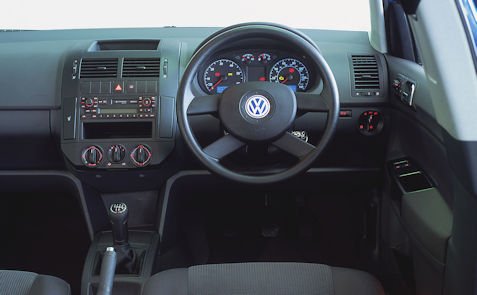
The optional extras were supplemented by Park Pilot , tire pressure monitoring system and coming home function , replacing the cassette radios available in the predecessor with a CD radio that was also available with the option of playing MP3 files. Over time, the revised model of the Polo IV different variants was brought to the market, which differed from the normal production version not only by a modified basic equipment, but partly had a modified body or not available for the normal model engine.
The CrossPolo was created under the leadership of Volkswagen Individual and was presented in November 2005 at the Essen Motor Show . This is the successor of the Polo Fun and was built from February of 2006. Like its predecessor, the CrossPolo was available exclusively with five doors and differs externally from the normal version of the Polo by the SUV based on an off-road look with independent front and rear apron, plastic covers on fenders, sills and doors, roof rails, standard fog lamps and 17-inch alloy wheels. Roof rails and exterior mirror housings are always painted silver, regardless of the exterior colour of the vehicle. The standard equipment included sports seats for driver and front passenger, leather steering wheel and central locking with radio remote control. As engines were gasoline engines with 47, 55 or 74 kW (later 51, 59 and 77 kW) and diesel engines with 51- and 74-kW power available.
The vehicles come standard with a chassis with 15 millimetres’ more ground clearance and a stiffer set, which was also available for the standard series surcharge are, however, only partly for use in terrain suitable due to the lack of all-wheel drive.
Like the Polo Fun, the CrossPolo was initially equipped with light-alloy wheels from BBS . As of the 2008 model year, which began in May 2007, the vehicles were, however, fitted as standard with 17-inch alloy wheels from Volkswagen Individual after BBS in early 2007 due to acute liquidity shortage a bankruptcy petition had asked. The BBS alloy wheels, however, were still available at no extra charge.
The Polo BlueMotion was established in early 2006 at the Geneva Motor Show presented and was available in summer of 2006. With him, the BlueMotion concept was introduced at Volkswagen , which was extended over time to all model series of the brand. The aim is to optimize the fuel consumption and pollutant emissions of the vehicles.
The Polo BlueMotion has for this purpose an aerodynamically optimized body with spoilers on the front and rear, almost closed radiator grille and about 15 mm lowering. The surcharge for the comparable standard model was 850 EUR (as of January 2009). The 5-speed manual gearbox is longer in gear ratios 3 to 5 compared to the identical motorized standard version to achieve a reduction in engine speed and thus lower fuel consumption. For the same reason, the idle speed was lowered. The coming exclusively used 3- cylinder - TDI engine with 59 kW output is to improve the emissions standard with a particulate filter equipped.
By combining these measures, the average consumption is 3.8 litres per 100 kilometres, which corresponds to a consumption advantage of 0.7 litres compared to the identical motorized production version. The CO 2 emission is 99 grams per kilometre about 20 grams under the value of the normal range.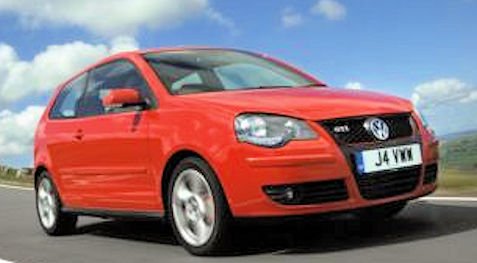
After a GTI sports version was the last in the third generation of Polo available from the spring 2006, a corresponding model variant was offered with the Polo GTI . Visually, this model differs from the normal production version by a partially black painted front end, radiator grille in honeycomb with red trim, headlights with black housing, standard fog lights, unpainted sill extensions , red painted callipers , 16-inch alloy wheels, exhaust double tailpipe made of stainless steel and a roof edge spoiler. On the technical side, the Polo GTI, equipped with a turbocharged 1.8-liter gasoline engine with 110 kW (150 hp) of power, has a sports suspension with a lowering of about 15 millimetres’ and uses the braking system also used on the 96 kW TDI engine ventilated brake discs with 288 mm diameter at the front axle and 232 mm at the rear axle. The standard safety equipment includes ESP and a tire pressure monitoring system .
As of June 2006, Volkswagen Individual also offered the even more powerful variant GTI Cup Edition with 132 kW (180 hp) in addition to the Polo GTI . Their visual appearance with aggressive front and rear aprons, widened side skirts, striking roof spoiler and 17-inch alloy wheels derive directly from the vehicles used in the ADAC Volkswagen Polo Cup . Technically, the Polo GTI Cup Edition is based on the normal Polo GTI. The biggest difference in addition to the modified appearance is the adapted to the increased performance brake system with a disc diameter of 312 millimetres at the front
The notchback variant was also subjected to a facelift in the spring of 2005 and equipped with the already known from the hatchback front with V-shaped grille and redesigned rear lights. Unlike its predecessor, however, it was not offered on the European market.
The gasoline engines were adopted unchanged from the predecessor when introducing the revised model. For diesel engines , the 47-kW SDI engine , which only complied with the requirements of the Euro 3 emission standard , was replaced by a 51 kW TDI engine with Euro 4 rating. The 55 kW TDI engine was also replaced by a more powerful 59 kW engine.
For model year 2007, which began in May 2006, accounted for the 63 kW FSI engine . The performance of the 55-kW gasoline engine in conjunction with the 5-speed manual transmission was increased to 59 kW; however, the 55-kW engine continued to be used in combination with the four- speed automatic transmission . The gasoline engine with 1.4-liter displacement and 74 kW power was replaced by a unit with 1.6-liter displacement and 77 kW, which in addition to the 5-speed manual gearbox was also combined with a six- speed Tiptronic automatic transmission. All diesel engines with the exception of the most powerful unit with 96 kW were now optionally available with particulate filter .
With the start of model year 2008 in May 2007, the output of the two 3- cylinder 1.2-liter engines with 40 kW and 47 kW respectively were increased to 44 kW and 51 kW, respectively. The 55-kW gasoline engine with four-speed automatic transmission was eliminated; instead, the 59-kW engine was now also offered with a six-speed Tiptronic automatic transmission.
Polo Vivo (South Africa, since 2010)
In March 2010, the Polo Vivo was introduced, of the South African market, the previous entry-level model Citi Golf to replace after its production was discontinued in early 2010. The Polo Vivo is based on the Polo IV, but has been visually modified, especially in the front area, to match the current design language of the Volkswagen brand. The bumper strips in the front, rear and side area were also removed in the course of the revision. Like all vehicles for the South African market, the Polo Vivo is built exclusively as a right-hand drive with kilometre tacho. The vehicles are produced in the Volkswagen factory in Uitenhage and are available as a hatchback with three or five doors and as a sedan with four doors at prices from 101,500 Rand (about 10,000 euros) available, while the current model is slightly more expensive with just over 150,000 Rand. The Polo Vivo competes in the South African market against the also built in the country Renault Sandero , the Chinese Geely LC and Chery QQ and imported from India Datsun Go , Fiat Grande Punto , Ford Figo , Toyota Etios and Honda Brio .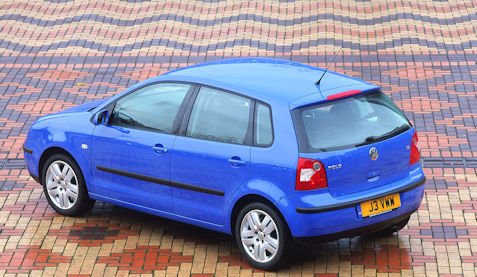
|
Featured
|
|
