
About
Technical
-
Note: Full Specifications and Service Repair Manuals available for registered users
EquipmentThe available (additional) equipment included:
Airbags for driver and front passenger
Antilock braking system (from 1994)
Power steering
Central locking (package open and closed)
electric windows (package open and closed)
Fog lights (package light and sight)
heated and electrically adjustable exterior mirrors (package light and sight)
heated windscreen washer nozzles (package light and sight)
divisible backseat 70/30
Rear headrests
pollen filter
various radio systems ("alpha" with two loudspeakers , "beta" with four loudspeakers)
Alu wheels, initially in 13 ", later in 14" and 15 "
Styling package, recognizable by one-piece bumpers, as well as darkened rear lights and white turn signals in front (standard on the GTI)
Heated seats
Glass sunroof manually
Air conditioning manually
Tinted windows
four doors
Metallic or pearlescent paints
Third Stoplight
electric folding roof (open air)
Colour-Concept equipmentTechnical data
Petrol engines
1.0
1:05
1.3
1.4 1
1.4
1.4 16V
Construction period
09 / 1996-09 / 1999
09 / 1994-07 / 1996
09 / 1994-07 / 1995
08 / 1995-09 / 1999
05 / 1996-09 / 1999
Motor characteristics
engine type
R4 petrol engine
Number of valves per cylinder
2
4
valve control
OHC , timing belt
DOHC, timing belt
mixture preparation
manifold injection
central injection
manifold injection
engine charging
-
cooling
water cooling
Engine code
ALL, ALD, AER
AEV
ADX
ANX
AEX, AKV, APQ
AFH
Bore × stroke
67.1 mm × 70.6 mm
75.0 mm × 59.0 mm
76.5 mm × 70.6 mm
76.5 mm × 75.6 mm
capacity
999 cc
1043 cc
1296 cc
1390 cm³
compression ratio
10.5: 1
10.0: 1
10.2: 1
10.5: 1
Max. Power at min -1
37 kW
(50 hp)
/ 500033 kW
(45 hp)
/ 520040 kW
(55 hp)
/ 520040 kW
(55 hp)
/ 470044 kW
(60 hp)
/ 470074 kW
(100 hp)
/ 6000Max. Torque at min -1
86 Nm
/ 3000-360076 Nm
/ 2800-3200100 Nm
/ 2800-3400116 Nm
/ 3000116 Nm
/ 2800-3200128 Nm
/ 4400power transmission
drive
front-wheel drive
Gearbox, standard
5-speed manual transmission
Gear, optional
-
4- speed automatic transmission 3
-
Measurements (Hatchback) 4
top speed
151 km / h
145 km / h
156 km / h
156 km / h
(150 km / h)160 km / h
(155 km / h)188 km / h
Acceleration, 0-100 km / h
18.5 s
21.4 s
16.3 s
16.4 s
(18.7 s)14.9 s
(17.0 s)10.5 s
Fuel consumption per 100 km (combined)
5.9 l s
7.0 l s
6.5 l s
6.3 l S
(7.8 l S)6.9 l SP
CO 2 emissions (combined)
142 g / km
172 g / km
k. A.
151 g / km
(187 g / km)166 g / km
Measured values (Classic) 4
top speed
-
157 km / h
-
Acceleration, 0-100 km / h
-
16.0 s
-
Fuel consumption per 100 km (combined)
-
6,7 l s
-
CO 2 emissions (combined)
-
161 g / km
-
Measurements (Variant) 4
top speed
-
155 km / h
-
Acceleration, 0-100 km / h
-
16.0 s
-
Fuel consumption per 100 km (combined)
-
6.8 l s
-
-
CO 2 emissions (combined)
-
163 g / km
-
1.6
1.6 GTI
1.8 2
Construction period
11 / 1995-09 / 1997
09 / 1994-07 / 1995
08 / 1995-09 / 1999
11 / 1995-09 / 1999
03 / 1998-09 / 1999
01 / 1997-09 / 1999
Motor characteristics
engine type
R4 petrol engine
Number of valves per cylinder
2
4
2
valve control
OHC, timing belt
DOHC, timing belt
OHC, timing belt
mixture preparation
central injection
manifold injection
Central
injectionengine charging
-
cooling
water cooling
Engine code
1F
AEA
AEE
AFT
AIYL
ADD, ADZ
Bore × stroke
81.0 mm × 77.4 mm
76.5 mm × 86.9 mm
81.0 mm × 77.4 mm
76.5 mm × 86.9 mm
81.0 mm × 86.4 mm
capacity
1595 cm³
1598 cc
1595 cm³
1598 cc
1781 cm³
compression ratio
9.0: 1
10.0: 1
9.8: 1
10.5: 1
10.6: 1
10.0: 1
Max. Power at min -1
55 kW
(75 hp)
/ 550055 kW
(75 hp)
/ 520055 kW
(75 hp)
/ 480074 kW
(100 hp)
/ 580088 kW
(120 hp)
/ 620066 kW
(90 hp)
/ 5500Max. Torque at min -1
125 Nm
/ 2800128 Nm
/ 2800-3400135 Nm
/ 2800-3600140 Nm
/ 3500148 Nm
/ 3400145 Nm
/ 2700-2900power transmission
drive
front-wheel drive
Gearbox, standard
5-speed manual transmission
Gear, optional
-
4-stage automatic
transmission 34-speed automatic
transmission-
4-speed automatic
transmissionMeasurements (Hatchback) 4
top speed
-
172 km / h
172 km / h
(167 km / h)-
200 km / h
-
Acceleration, 0-100 km / h
-
12.5 s 5
12.2 s
(14.5 s)-
9.1 s
-
Fuel consumption per 100 km (combined)
-
7.0 l s
6.9 l S
(8.6 l S)-
7.1 l SP
-
CO 2 emissions (combined)
-
k. A.
166 g / km
(206 g / km)-
170 g / km
-
Measured values (Classic) 4
top speed
170 km / h
-
170 km / h
188 km / h
(185 km / h)-
180 km / h
(173 km / h)Acceleration, 0-100 km / h
12.1 s
-
13.3 s
10.9 s
(13.0 s)-
11.9 s
(14.2 s)Fuel consumption per 100 km (combined)
7.4 l of N
-
7.2 l s
7.8 l S
(9.0 l S)-
7.9 l S
(9.2 l S)CO 2 emissions (combined)
182 g / km
-
173 g / km
187 g / km
(218 g / km)-
190 g / km
(221 g / km)Measurements (Variant) 4
top speed
-
167 km / h
186 km / h
(183 km / h)-
Acceleration, 0-100 km / h
-
13.3 s
10.9 s
(13.0 s)-
Fuel consumption per 100 km (combined)
-
7.2 l s
7.9 l S
(9.1 l S)-
CO 2 emissions (combined)
-
173 g / km
192 g / km
(221 g / km)-
1 Only for Austria
2 Only for Mexico
3 Only for hatchback
4 values in () for automatic transmission.
5 With 4 + E transmission: 12.8 s
The availability of the engines was dependent on model, equipment and market.
Diesel engines
1.7 SDI
1.9 D
1.9 SDI
1.9 TDI
1.9 TD I 1
Construction period
04 / 1997-10 / 1997
08 / 1997-09 / 1999
11 / 1995-09 / 1999
01 / 1997-09 / 1999
06 / 1998-09 / 1999
Motor characteristics
engine type
R4 diesel engine
Number of valves per cylinder
2
valve control
OHC , timing belt
mixture preparation
direct injection
Whirl chamber
injectiondirect injection
engine charging
-
Turbocharger , intercooler
cooling
water cooling
Engine code
AHG
AKU
AEF
AEY
AHU, ALE
AFN
Bore × stroke
79.5 mm × 86.4 mm
79.5 mm × 95.5 mm
capacity
1716 cm³
1896 cc
compression ratio
19.5: 1
22.5: 1
19.5: 1
Max. Power at min -1
42 kW
(57 hp)
/ 420044 kW
(60 hp)
/ 420047 kW
(64 hp)
/ 420066 kW
(90 hp)
/ 400081 kW
(110 hp)
/ 4150Max. Torque at min -1
112 Nm
/ 2200-2600115 Nm
/ 2200-3000125 Nm
/ 2000-3000124 Nm
/ 2200-2800202 Nm
/ 1900235 Nm
/ 1900power transmission
drive
front-wheel drive
transmission
5-speed manual transmission
Measurements (hatchback)
top speed
155 km / h
160 km / h
-
Acceleration, 0-100 km / h
17.7 s
15.8 s
-
Fuel consumption per 100 km (combined)
4.5 l D
5.6 l D
4.7 l D
-
CO 2 emissions (combined)
k. A.
151 g / km
127 g / km
-
Measured values (Classic)
top speed
-
155 km / h
-
158 km / h
180 km / h
193 km / h
Acceleration, 0-100 km / h
-
18.1 s
-
16.9 s
12.5 s
10.6 s
Fuel consumption per 100 km (combined)
-
4.9 l D
-
5.0 l D
4.9 l D
CO 2 emissions (combined)
-
132 g / km
-
135 g / km
132 g / km
Measurements (Variant)
top speed
-
152 km / h
-
155 km / h
176 km / h
190 km / h
Acceleration, 0-100 km / h
-
18.1 s
-
16.9 s
12.5 s
10.6 s
Fuel consumption per 100 km (combined)
-
5.0 l D
-
5.1 l D
5.0 l D
k. A.
CO 2 emissions (combined)
-
135 g / km
-
138 g / km
135 g / km
k. A.
1 The red I in the TDI lettering pointed to the 81-kW engine.
The availability of the engines was dependent on model, equipment and market.
Polo III (6N2, 1999-2001)
From October 1999 to October 2001:
more pronounced grille and clear glass headlights like the Bora
redesigned taillights
new, more modern dashboard from the Lupo compared to the 6N models
ESP now available as optional equipment.
Reinforcements in the body shell
Rear license plate offset in the rear bumper
Fully galvanized body with twelve-year warranty against rust
new polo lettering (like 9N / 9N3)
1.6-liter petrol engine with 55 kW (75 hp) from the Golf III replaced by equally powerful 1.4-16V petrol engine Golf IV and Lupo (in the Classic and Variant only from model year 2001)
Diesel engine program expanded by 1.4-liter three-cylinder TDI with pump-nozzle system and 55 kW (75 hp) from the Lupo
Again, there is again a GTI version of the Polo (recognizable by the honeycomb grill pattern), this time with 92 kW (125 hp) engine power. This version was no longer limited in production quantity. A special feature of the GTI model maintenance are the xenon headlamps with automatic headlamp levelling and headlamp washers, which were only available on the GTI .
Petrol engines
1.0
1.4
1.4 16V
1.6
1.6 GTI
Construction period
10 / 1999-10 / 2001
10 / 1999-09 / 2000
10 / 1999-10 / 2001
Motor characteristics
engine type
R4 petrol engine
Number of valves per cylinder
2
4
2
4
valve control
OHC , timing belt
DOHC, timing belt
OHC, timing belt
DOHC, timing belt
mixture preparation
manifold injection
engine charging
-
cooling
water cooling
Engine code
ALD, ANV, AUC
ACP
AKK, ANW, AUD
AHW, APE, AUA
AFK, AUB
ALM
AEH, AKL, APF,
AURARC, AVY
Bore × stroke
67.1 mm × 70.6 mm
76.5 mm × 75.6 mm
76.5 mm × 86.9 mm
81.0 mm × 77.4 mm
76.5 mm × 86.9 mm
capacity
999 cc
1390 cm³
1598 cc
1595 cm³
1598 cc
compression ratio
10.7: 1
10.4: 1
10.5: 1
9.8: 1
10.3: 1
11.5: 1
Max. Power at min -1
37 kW
(50 hp)
/ 500040 kW
(55 hp)
/ 470044 kW
(60 hp)
/ 470055 kW
(75 hp)
/ 500074 kW
(100 hp)
/ 600055 kW
(75 hp)
/ 480074 kW
(100 hp)
/ 560092 kW
(125 hp)
/ 6500Max. Torque at min -1
86 Nm
/ 3000-3600116 Nm
/ 3000126 Nm
/ 3800126 Nm
/ 4400135 Nm
/ 2800-3600145 Nm
/ 3800152 Nm
/ 3000power transmission
drive
front-wheel drive
Gearbox, standard
5-speed manual transmission
Gear, optional
-
4- speed automatic transmission 1
-
4-stage
automatic
transmission-
Measurements (Hatchback) 2
top speed
151 km / h
156 km / h
160 km / h
(156 km / h)172 km / h
(168 km / h)188 km / h
-
205 km / h
Acceleration, 0-100 km / h
18.4 s
16.0 s
14.5 s
(16.8 s)12.3 s
(14.5 s)10.4 s
-
8.9 s
Fuel consumption per 100 km (combined)
5.7 l s
6.1 l s
6.1 l S
(7.5 l S)6.2 l S
(7.5 l S)6.7 l SP
-
7.1 l SP
CO 2 emissions (combined)
137 g / km
146 g / km
146 g / km
(180 g / km)149 g / km
(180 g / km)161 g / km
-
170 g / km
Measured values (Classic) 2
top speed
-
157 km / h
170 km / h
-
170 km / h
188 km / h
(184 km / h)-
Acceleration, 0-100 km / h
-
16.0 s
12.9 s
-
13.3 s
10.9 s
(13.1 s)-
Fuel consumption per 100 km (combined)
-
6,7 l s
6.4 l s
-
7.2 l s
7.9 l S
(8.5 l s)-
CO 2 emissions (combined)
-
161 g / km
154 g / km
-
173 g / km
190 g / km
(204 g / km)-
Measurements (Variant) 2
top speed
-
155 km / h
167 km / h
-
167 km / h
186 km / h
(183 km / h)-
Acceleration, 0-100 km / h
-
16.3 s
13.4 s
-
13.6 s
11.1 s
(13.3 s)-
Fuel consumption per 100 km (combined)
-
6.8 l s
6.5 l s
-
7.3 l s
8.0 l S
(8.6 l S)-
CO 2 emissions (combined)
-
163 g / km
156 g / km
-
175 g / km
192 g / km
(206 g / km)-
1 Only for hatchback
2 values in () for automatic transmission.
The availability of the engines was dependent on model, equipment and market.
Diesel engines
1.4 T DI 1
1.4 TDI 2
1.7 SDI
1.9 D
1.9 SDI
1.9 TDI
1.9 TD I 3
Construction period
10 / 1999-10 / 2001
01 / 2000-10 / 2000
10 / 1999-10 / 2001
Motor characteristics
engine type
R3 diesel engine
R4 diesel engine
Number of valves per cylinder
2
valve control
OHC , timing belt
mixture preparation
Unit injector
Direct
injectionWhirl chamber
injectiondirect injection
engine charging
Turbocharger , intercooler
-
Turbocharger, intercooler
cooling
water cooling
Engine code
AMF
ATL
AKU
AEF
AGD, ASX
AGP, AQM
AGR, ALH
ASK, ASV
Bore × stroke
79.5 mm × 95.5 mm
79.5 mm × 86.4 mm
79.5 mm × 95.5 mm
capacity
1422 cc
1716 cm³
1896 cc
compression ratio
19.5: 1
18.5: 1
19.5: 1
22.5: 1
19.5: 1
Max. Power at min -1
55 kW
(75 hp)
/ 400066 kW
(90 hp)
/ 400044 kW
(60 hp)
/ 420047 kW
(64 hp)
/ 440047 kW
(64 hp)
/ 420050 kW
(68 hp)
/ 420066 kW
(90 hp)
/ 375081 kW
(110 hp)
/ 4150Max. Torque at min -1
195 Nm
/ 2200230 Nm
/ 1900-2200115 Nm
/ 2000-3000124 Nm
/ 2000124 Nm
/ 2200-2800 4133 Nm
/ 2200-2600210 Nm
/ 1900235 Nm
/ 1900power transmission
drive
front-wheel drive
transmission
5-speed manual transmission
Measurements (hatchback)
top speed
170 km / h
k. A.
157 km / h
160 km / h
-
Acceleration, 0-100 km / h
12.9 s
k. A.
17.3 s
15.9 s
-
Fuel consumption per 100 km (combined)
4.4 l D
k. A.
4.4 l D
5.7 l D
4.8 l D
-
CO 2 emissions (combined)
119 g / km
k. A.
119 g / km
154 g / km
130 g / km
-
Measured values (Classic)
top speed
-
161 km / h
180 km / h
193 km / h
Acceleration, 0-100 km / h
-
16.9 s
12.6 s
10.7 s
Fuel consumption per 100 km (combined)
-
5.1 l D
4.9 l D
CO 2 emissions (combined)
-
138 g / km
132 g / km
Measurements (Variant)
top speed
-
158 km / h
176 km / h
190 km / h
Acceleration, 0-100 km / h
-
17.3 s
12.8 s
10.9 s
Fuel consumption per 100 km (combined)
-
5.2 l D
5.0 l D
CO 2 emissions (combined)
-
140 g / km
135 g / km
1 The red DI in TDI lettering stands for the 55-kW motor with pump-nozzle system.
2 Available in Switzerland
3 The red I in the TDI lettering stands for the 81-kW engine.
4 engine ASX from 05/2000 (model year 2001): 124 Nm at 2000 rpm
The availability of the engines was dependent on model, equipment and market.
© Motor-car.net
Manuals
VW Polo III
|
|
|
|
Sales designation: |
polo |
|
Production period: |
1994 to 2001 |
|
Class : |
Motor Car |
|
Body versions : |
sedan , station wagon |
|
Engines: |
Gasoline : 1.0-1.6 litres |
|
Length: |
3715 mm |
|
Width: |
1655 mm |
|
Height: |
1420 mm |
|
Wheelbase : |
2400 mm |
|
Curb weight : |
880-1106 kg |
|
previous model |
VW Polo II |
|
successor |
VW Polo IV |
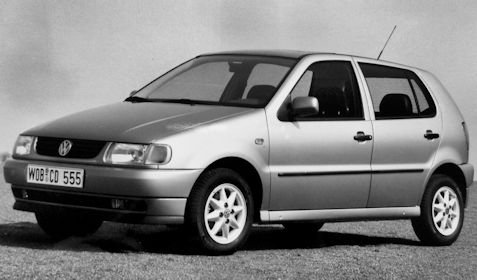
The VW Polo III (or Polo 3 ) is a passenger car from Volkswagen , which was manufactured as type 6N from September 1994 to October 2001 (from October 1999: 6N2 ) in Wolfsburg .
It has front-wheel drive and transversely mounted petrol engines from 33 kW (45 hp) to 92 kW (125 hp) and diesel engines from 42 kW (57 hp) to 81 kW (110 hp), with manual five-speed or 4-speed automatic transmission could be combined. It existed as a three- and for the first time as a five-door.
In November 1995, the "Classic" followed called notchback version , and from March 1997 the first time a combination variant with tradition designation Variant .
History
The third generation of the Polo (internally known as the Type 6N) was unveiled in September 1994 and was completely redeveloped. Early versions, however, had the engines of the Polo II. The Polo III was the first Polo, the five-door and three-door was available. It was built from 1994 to 1999. For this Polo, the Golf III and the Seat Ibiza II Volkswagen used a common part strategy. A variety of components and all suspension components were interchangeable among the three models. Although the dashboard and a number of mechanical components, including engines, were shared with the Ibiza, the Polo models were outwardly different. Initially, only three- and five-door models with rear door were available. In 1995, Volkswagen added the four-door sedan under the name "Polo Classic", "Sedan" or "Derby" and the five-door station wagon "Polo Wagon" or "Variant" added. They were internally referred to by VW as Type 6KV and shared body panels with the SEAT model.
The Polo was initially equipped with neither airbags nor belt force limiters . In Euro NCAP - Crash test it received in 1997 three out of five stars in the evaluation of occupant safety. The test of the improved model with driver and front passenger airbags and belt force limiters in 2000 gave a rating of four stars.
In the middle of 1997, the model series 6N1 was technically revised for the model year 1998, many smaller as well as larger changes were made. The main feature of this revision is the completely changed electrics (the old electrical system up to 1997 based on the Golf III platform , the new central electrics comes from the Lupo ) and the material changed, but externally almost identical, dashboard. You can distinguish them as follows:
The old version has two big round indicators in the middle: the speed on the left and the speed on the right. Underneath is a field for the single-row warning lights. Outside there are two small round indicators below: engine temperature on the left and fuel gauge on the right.The new version has a rectangular box in the middle for the multi-row warning lights. Above are two small round indicators, left for the engine temperature and right for the fuel gauge. Outside there are two large round displays, left for the speed and right for the speed. Furthermore, both the displays and the hands are illuminated by means of transillumination technology.
The easiest way to differentiate the exterior versions of the trunk lid. In the older version, the keyhole is vertically closed, the facelift horizontal, also on the roof edge of the trunk lid, a small spoiler or a curvature bordered. The key up to and including model year 1997 has external track profile, from model year 1998 inner track profile. The taillights are darker in the new version than the old Polo.
In the late summer 1999 the model series 6N1 for the model year 2000 was visually completely revised and developed technically. The designation was now 6N2 or 6N facelift .
Harlequin Polo III (6N, 1994-1999)
He has become particularly well-known as a four-color model Harlequin - originally built only with 20 vehicles (Ur-Harlequin) for advertising purposes as a symbol of the modular principle of the equipment modules. Due to the demand for the colourful Polo, the model variant was realized. Allegedly, in the period from 1995 to early 1997, only 3806 vehicles were delivered. There was the Polo Harlequin in four different colour combinations that the customer could not choose when ordering. The colour scheme was given according to a fixed pattern.
As a delivery van model , the Polo 6N was equipped without passenger seat and rear seat with the 1.9-liter diesel engine (47 kW / 64 hp). These were tax-deductible as a truck taxed. Model name 6NF, which is often mistakenly used for the facelift. From about 1997, the 6NF was equipped with a 1.7-liter SDI engine with 44 kW / 60 hp, partly with passenger airbag instead of the additional storage compartment.
As Polo Classic with notchback (type 6KV), identical to Seat Cordoba , notchback version of the Seat Ibiza , in contrast to this, however, only four and not two-door available
At Polo Variant / Classic: Identical Group platform with Seat Ibiza II The Seat Ibiza II was sold in South Africa as Polo Playa. As Caddy (box van), identical to Seat Inca .For the first time as a five-door and station wagon (Polo Variant Type 6KV5, identical to the Seat Cordoba Vario)
Since the Polo 6N, not only the Golf GTI can call itself , for the first time there was also a Volkswagen Polo GTI in a limited edition . The version is the hitherto strongest Polo model of the Volkswagen Group. A special version of the 6N GTI limited to 3000 cars was equipped with a 1.6-liter 16V engine with 88 kW (120 hp). Furthermore, he had ex works factory 15-inch alloy wheels in BBS RS2 design and sprinted to 100 km / h in 9.1 seconds.
The platforms of Seat Arosa and VW Lupo (Type 6X) are based on a shortened version of the Polo 6N, also many components were taken over.
The Polo Open Air was built with an electrically powered sunroof .
The Polo Classic is still being built in the Argentine plant Pacheco, since 2005 with small aesthetic changes. Together with the Caddy he should be built until September 2008. It is also offered in Mexico - under the classic name VW Derby .
The Polo 6N Colour Concept (in the car colours jazz blue, flash-red, yellow, salsa-green or black-magic) was an optional extra, available with 44 kW (60 hp), 55 kW (75 hp) or 74 kW (100 hp) PS). Among other things, this vehicle received Recaro leather seats and a leather interior in black / body colour. The Colour Concept was also available as OpenAir.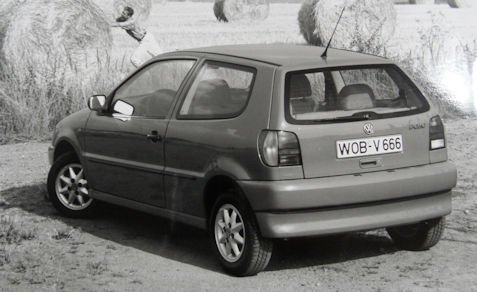
|
Featured
|
|
