
Toyota Supra 3rd generation
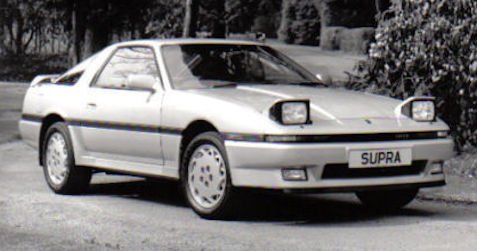 |
|
| Production period: | 1986 to 1992 |
| Class: | Sports Car |
| Body versions : | Coupé |
| Engines: | Gasoline : 2.0-3.0 liters (150-206 kW) |
| Length: | 4620 mm |
| Width: | 1745 mm |
| Height: | 1301-1310 mm |
| Wheelbase : | 2595 mm |
| Curb weight : | 1530-1595 kg |
In early 1986, the third generation of the Supra was introduced. It is also the first that has not been marketed with the suffix Celica, intended to serve as the brand's prestigious flagship. Its luxury, performance, technical specifications, and driving dynamics are meant to symbolize the very best the company has to offer. Moreover, the Supra is not merely a reworked version of the Celica but a completely new model in its own right; the Celica has shifted to front-wheel drive, whereas the Supra remains true to rear-wheel drive.
Toyota's chief designer faced a significant challenge. Mr. Kunihiro Uchida had to work with an inline-six engine that necessitated a very long hood. Furthermore, since the Supra is a 2+2 coupé, he had to design a generally more spacious cabin without compromising comfort for the driver and front passenger. He also had to create the most aerodynamic bodywork possible; in this regard, the Supra boasts a drag coefficient (Cd) of 0.33, comparable to many cars in its class. It must be said that Mr. Uchida handled the initial constraints admirably.
Toyota has always excelled at designing very comfortable cabins that meet most ergonomic standards. The Supra is no exception. While the interior might appear sparse at first glance, this is due more to its presentation than its content, as the car is equipped with everything needed to satisfy even the most demanding drivers. The wraparound dashboard extends into the door panels, placing the driver in an ultra-functional environment and dials are present, with a simple glance,
In the autumn of 1987, the turbo engine with 173 kW (235 hp) appeared The turbo engine had to deal with technical problems because of the often defective cylinder head gasket and was therefore not very stable and reliable. The turbocharger had been mounted on the existing engine without correspondingly reinforcing the remaining components. Many owners of the turbo models therefore had engine problems and blown seals up to engine damage due to overheating. .
A first facelift at the front and at the rear (three-piece rear wing) was carried out in August 1988. At the same time, the naturally aspirated engine was removed from the program. A second revision took place in the spring of 1991. Engine technology, the engine received hardly appreciable 2 kW (3 hp) and 6 Nm more and "strengthened" so that 175 kW (238 hp) and 350th nm.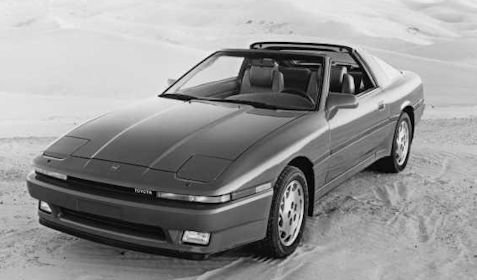
From this generation there was also a variant with Targa , which was offered in certain markets alternatively, but also as the only body version. In Japan and the United States also have a version with a sunroof available.
There was also a limited to 500 pieces homologation model of the MA70 with the designation Turbo-A (7M-GTE Turbo A). This was necessary because the then Group A regulations required this if a modified turbocharger and / or other assemblies were to be used. The Turbo A models produced 204 kW (270 hp) and were only sold in Japan.
Options: ABS, 25% locked differential, oil cooler, headlight washer system, central locking, fog lamps and, seat heating (as an option), cruise control, Targa roof (in turbo series), sunlight-dependent automatic air conditioning, electrically adjustable driver's seat, power windows, power mirrors, adjustable steering wheel ,
End of 1992, the production of the third series ended.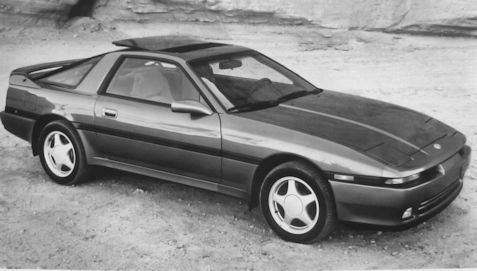
Related
Technical
-
Engines
- 1G-GTE: 2.0 l twin-turbo, 6-cylinder, 153 kW / 208 hp (strongest version of the 1G-GTE)
- 1JZ-GTE: 2.5 l twin turbo, 6 cylinders, 206 kW / 280 hp; Version for Japan
- 7M-GE: 3.0 l, 6 cylinders, 150 kW / 204 hp (01.1986-08.1988)
- 7M-GTE: 3.0 l turbo, 6 cyl., 173 kW / 235 hp (09.1987-01.1991)
- 7M-GTE: 3.0 l turbo, 6 cyl., 175 kW / 238 hp (01.1991-12.1992)
- 7M-GTE Turbo A: 3.0 l turbo, 6 cyl., 204 kW / 277 hp; Limited special edition in Japan
Engine 7M-GTE (09.1987-01.1991)
- Engine: 6-cylinder turbocharged in-line engine with two overhead camshafts
- Bore × stroke: 83.0 × 91.0
- Cylinder head: 24 valves
- Displacement: 2954 cc
- Compaction: 8.4: 1
- Power: 173 kW (235 hp) at 5600 rpm
- Torque: 344 Nm at 3200 rpm
Engine 7M-GTE (01.1991-12.1992)
- Engine: 6-cylinder turbocharged in-line engine with two overhead camshafts
- Bore × stroke: 83.0 × 91.0
- Cylinder head: 24 valves
- Displacement: 2954 cc
- Compaction: 8.5: 1
- Power: 175 kW (238 hp) at 5600 rpm
- Torque: 350 Nm at 3200 rpm
Gearbox Manual
- 5 gears manually
- Toyota Transmission Code: R154 (Turbo)
- Toyota transmission code: W 58 (without turbo)
- Translation:
- 1st gear: 3,251
- 2nd gear: 1,955
- 3rd gear: 1,310
- 4th gear: 1,000
- 5th gear: 0.753
- Reverse: 3,180
- Clutch: hydraulically operated single-disc dry clutch
- Drive: rear axle, 25% locked differential
Transmission automatic
- 4-speed automatic (turbo)
- Toyota transmission code A340
- Translation:
- 1st stage 2,804
- 2nd stage 1.531
- 3rd level 1.000
- 4th stage 0.705
- Reverse: 2,393
Weights
- Curb weight: 1550 kg (manual) | 1630 kg (automatic)
- permissible total weight: 2070 kg
- Payload 530 kg (manual) | 505 kg (automatic)
- Axle load front: 1120 kg
- Rear axle load: 1120 kg
- Trailer load braked: 1700 kg
- Trailer load unbraked: 600 kg
- Roof load: 100 kg
Bodywork
- Concept: four-seater coupe with two doors and tailgate
- Dimensions
- Length: 4630 mm
- Width: 1745 mm
- Height: 1310 mm
- Tank capacity: 70 liters
Suspension
Rear-wheel drive, all-round independent suspension with double support; Rack and pinion steering with power assistance, hydraulic dual-circuit brake with brake booster, ventilated disc brakes front and rear, ABS.
- Rim size front and rear: 7J × 16 "
- Tire size: 225/50 R 16
(turbo model)
- Top speed: 245 km / h
Acceleration:
- 0-60 km / h: 3,4 s
- 0-80 km / h: 5.0 s
- 0-100 km / h: 6.3 s
- 0-120 km / h: 9.5 s
- 0-140 km / h: 12.4 s
- 0-160 km / h: 16.4 s
- 0-200 km / h: 28.4 s
- 400 meters (standing start): 14.8 s
- 1 kilometer (standing start): 26.9 s
- Elasticity 60-100 km / h (4th gear): 6.2 s
- Elasticity 80-120 km / h (5th gear): 9.9 s
