
About
Technical
-
DIMENSIONS AND WEIGHT SEDAN
wheel base: 112.01 in, 2,845 mm
front track:58.82 in, 1,494 mm
rear track: 59.45 in, 1,510 mm
overall length: 194.88 in, 4,950mm
overall width: 74.88 in, 1,902 mm
overall height: 57.05 in, 1,449 mm
ground clearance: 7.68 in, 195 mm
dry weight: 3,385 1b, 1,535 kg
ENGINE 4.6L
front, 4 stroke; cylinders: 8, Vee-slanted at 90°
bore and stroke: 3.87 x 3 in, 98.4 x 76.2 mm
engine capacity: 283.01 cu in, 4,638 cu cm
compression ratio: 9.2
cylinder block: cast iron
cylinder head: cast iron
crankshaft bearings: 5
valves: 2 per cylinder, overhead, in line, push-rods and rockers, hydraulic tappets
camshafts: 1, at centre of Vee
lubrication: gear pump, full flow filter
carburation: 1 Rochester downdraught 4-barrel carburettor
fuel feed: mechanical pump
cooling system: waterENGINE 5.4L
front. stroke cylinders: 8. Vee-slanted
bore and stroke: 4 x 3.25 in. 101.6 82.6 mm
engine capacity: 326.70 cu in, 5,354 cu cm
cylinder block:cast iron
cylinder bead: cast iron
crankshaft bearings: 5
valves: 2 per cylinder. overhead, an line. push-rods and rockers, hydraulic tappets
camshafts: 1 at centre
carburation: I Carter downdraught 4-barrel carburettor;
fuel feed: mechanical pump
cooling system: water
TRANSMISSION
driving wheels: rear
gearbox: automatic, hydraulic torque convertor with 3 elements and planetary gears with 2 ratios + reverse
max ratio of convertor at stall 2
gearbox ratios 4.6L: I 1.810, II 1, rev 1.810
gearbox ratios 5.4L: I 1.760, II t. rev 1.760;
selector lever: steering column
final drive: hypoid bevel
axle ratio 4.6L: 3.080.
axle ratio 5.4L: 2.790.CHASSIS
integral
front suspension: independent, wishbones, coil springs,anti-roll bar, telescopic dampers
rear suspension: rigid axle, coil springs, anti-roll bar, telescopic dampers.STEERING
recirculating ball, servo
turns of steering wheel lock to lock: 3.50.
turning circle (between walls): 39 ft, 11.9 mBRAKES
front disc (diameter 10.67 in, 271 mm)
rear drum, 2 separate circuits,servo
lining area: front 24.65 sq in, 159 sq cm, rear 69.77 sq in, 450 sq cm
total 94.42 sq in, 609 sq cm.ELECTRICAL EQUIPMENT
voltage: 12 V
battery: 60 Ah
alternator: 555 W
ignition distributor: Delco-RemyVARIATIONS AND OPTIONAL ACCESSORIES
7.00 x 15 tyres
4-speed mechanical gearbox fully synchronized (I 2.559, II 1.908, III 1,483, IV I, rev 2.634),
central gear leverEngine comparison
Opel Captain / Admiral / Diplomat A (1964-1968)
Opel KAD:
Cape / Adm / Dipl 4.6
Cape / Adm / Dipl 5.4
engine
8-cylinder V-engine (four-stroke)
capacity
4638 cc
Chevrolet 283 (283cubic inches )5354 cc
Chevrolet 327 (327cubic inches )Bore × stroke
98.4 × 76.2 mm
101.6 × 82.6 mm
Power
(hp)
at 1 / min140 kW
(190 hp)
4600169 kW
(230 hp)
4700Max. Torque
at 1 / min347 Nm
3000427 Nm
3100compression
9.25: 1
10.5: 1
mixture preparation
a Carter four-way downdraft carburetor
valve control
OHV, a lower central camshaft with chain drive
cooling
water cooling
transmission
Powerglide two-speed automatic transmission (GM), selector lever on steering column (captain and admiral) or center console (diplomat)
Front suspension
Independent suspension on double wishbones , coil springs
Rear suspension
Rigid axle with semi-elliptic leaf springs
body
Sheet steel, self-supporting
Gauge front / rear
1494/1510 mm
wheelbase
2845 mm
length
4948 mm
tare
1380-1630 kg
top speed
198 km / h
200 km / h
0-100 km / h
11 s
10 s
Consumption (liters / 100 kilometers)
19.0 s
20.0 s
Note:
All engines and full specifications available for registered users© Motor-car.net
Service
-
greasing: every 31,100 miles, 50,000 km, 8 points;
tyre pressure (medium load):front 26 psi, 1.8 atm, rear 28 psi, 2 atm.
width of rims: 5"
tyres: 185 x 15
fuel tank capacity: 15.4imp gal, 18.5 US gal, 70 1.
carrying capacity:1,058 1b, 480 kg
4.6Lfuel: 95-100 oct petrol
engine sump oil: 9.15 imp pt 10.99 US pt. 5.2 1, SAE 10-20, change every 3,100 miles, 5,000 km
lubricating system capacity: 9.50 imp pt, 11.42 US pt, 5.4 1
cooling system capacity: 24.99 imp pt, 30.09 US pt, 14.2 1.
gearbox oil: 2.46 imp pt, 2.96 US pt. 1.4 1, automatic transmission fluid
final drive oil: 2.64imp pt, 3.17 US pt, 1.5 1, SAE 90
valve timing: inlet opens 32°30' before tdc and closes 87°30' after bdc, exhaust opens 74°30' before bdc and closes 45°30' after tdc
Note: Full Specifications and Service Repair Manuals available for registered users
© Motor-car.net
Manuals
Opel Diplomat A
 |
|
|
Production period: |
1964 to 1968 |
|
Class: |
Luxury Car |
|
Body versions: |
Sedan, coupe |
|
Engines: |
Gasoline : 2.6-5.4 litres (74-169 kW) |
|
Length: |
4948 mm |
|
Width: |
1902 mm |
|
Height: |
1494-1510 mm |
|
Wheelbase: |
2845 mm |
|
Curb weight: |
1350-1610 kg |
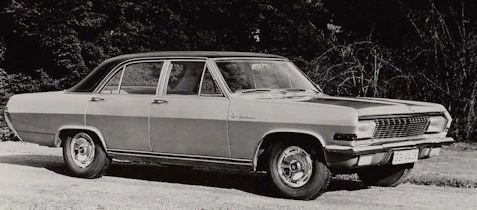
The built from spring 1964 to autumn 1968 at the Adam Opel AG in Rüsselsheim luxury class models captain, admiral and diplomat, short: Opel KAD A, successor to Captain P 2.6, had the same newly developed body with a straight shape. Cheapest model was the captain, the model Admiral as successor to the captain "L" had a better equipment and the top formed the diplomat. The A indicates that this is the first version of the model.
In June 1964, the Diplomat A came as a luxury model of the KAD series on the market. In addition to the classic sedan there was the diplomat (in contrast to the captain and admiral) from February 1965, a coupe version, which should serve as an image carrier. The vehicles were manufactured by the bodywork specialist Karmann. Only engine of the two-door was a V8 engine with 5354 cc displacement and 169 kW (230 hp).
The sedan was initially available with a smaller V8 engine with 4.6 litres and 140 kW (190 hp). Only starting from September 1966 came also for surcharge the larger V8 engine from the coupe to the employment. With a wheelbase of 2845 mm, the sedans were 4948 mm long, 1902 mm wide and 1454 mm high. The empty weight was given as 1590 kg. The coupe was slightly flatter with 1432 mm and weighed 1630 kg.
History
The Opel Diplomat was the top model in the luxury class of the Adam Opel AG and was built between spring 1964 and summer 1977. He based on the six-cylinder vehicles captain and admiral and offered a further increased equipment. The cars, named after the initials of Captain, Admiral and Diplomat also known as "KAD" models were produced in the first series as KAD A from February 1964 to November 1968. As a special feature, the diplomat was offered from February 1965 as a coupe, of which until July 1967 only 347 vehicles were made.
After the end of the 1920s briefly offered Opel Regent with eight - cylinder inline engine was at Opel again an engine with eight cylinders in the program. The V8 engine was derived from the Chevrolet - Division of parent company General Motors. The trio was replaced in the spring of 1969 by the KAD B series, whose bodies were a little smaller and smooth-surfaced.
The Captain A had a horizontally accented grille and chrome trim less, than the other two models. Initially, it was offered with a 2.6-liter inline six-cylinder engine and a power output of 74 kW (100 hp). In September 1965, this was replaced by the newly designed inline engine Opel CIH with six cylinders, 2.8 litres displacement and 92 kW (125 hp). In addition, there was from September 1965 the " Captain A V8 " with a 4.6-liter Chevrolet V8 engine with 140 kW (190 hp). From this version only 113 vehicles were built. For tax purposes, the Austrian market also had a 2.5-liter version with 82 kW (112 hp).
Also from September 1965 accounted for the Opel lettering on the front fenders, at the same time the name Opel appeared in the radiator grille. In September 1967, the captain's logos were moved from the rear roof posts to the front fenders and the captain got side guards. Captain A with his front seat was the last Opel passenger car with six seats. This was a purchase argument at the time.
It was also possible to choose between 92 kW variant (S engine) or the 500 DM more expensive 103 kW HL engine (HL for high performance) with two Zenith carburettors from 1967 onwards. In the 2.8-liter six-cylinder engines Opel first used hydraulic tappets, which made a control and adjustment of the valve clearance unnecessary. All models were equipped with a standard four-speed manual transmission.
A total of 24,249 copies were built from February 1964 to November 1968, of which alone 15,030 models with the 2.6-liter engine until August 1965.
The Admiral A was an upgraded in various details execution of Captain A, almost the "L" model as before the captain P "L". The name was taken from the pre-war model Admiral, which was built from the spring of 1937 until the fall of 1939.
Admiral A had a grille-like grille. While Captain A had only chrome-plated door sills, the Admiral A offered chrome-plated wheel arches. From September 1967 there was also a chrome-plated side protection strip.
The engine range corresponded to that of Captain A. From March 1965, the Admiral V8 with the 140 kW (190 hp) and 4.6-liter Chevrolet V8 engine was offered, the over 1.5 t heavy car in just under 10 Accelerated seconds from 0 to 100 km / h and made 200 km / h fast. However, only 623 specimens were delivered by this model, which was more expensive than the Admiral with six-cylinder engine.
With the beginning of the model year 1966 accounted for starting from September 1965 the Opel lettering on the front fenders, at the same time the name Opel appeared in the radiator grille. In September 1967, the Admiral lettering was moved from the rear roof posts to the front fenders.
The Admiral A was produced from April 1964 to November 1968 in 55,876 copies, of which 31,318 units accounted for until August 1965 offered 2.6-liter engine, the best-selling model of the KAD A-series.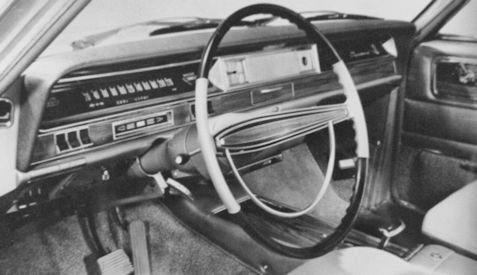
The Sedan exclusively offered with eight-cylinder engine Diplomat A was the Opel top model of the time. He distinguished himself from his sibling captain and admiral siblings with the standard 4.6-liter V8 engine, power steering, 15-inch wheels, front and rear power windows, vinyl roof, more elegant wood-trimmed interior, large centre console with automatic selector lever and other details. All KD V8 models have two exhaust strands that terminate left and right under the rear end panel. Unlike the captain and admiral, the diplomat wore the lateral type lettering on the front fenders right from the start. When model year change in September 1967, the Diplomat A got side protection strips.
The V8 engine with 4638 cc and 140 kW (190 hp) power was delivered together with the two-stage "Powerglide" automatic transmission from the USA by the Opel parent company General Motors. There was this engine (in the US with the cubic capacity 283 cubic inches) the standard equipment of the Chevrolet V8 cars and there generally known as a " small block ".
As of September 1966, the 5.4-liter engine with 230 hp (169 kW) from the Diplomat Coupé and its 250 km / h speedometer under the name Diplomat 5.4 was also for the sedan for an additional charge of about 960 DM offered. This version could be recognized by the additional emblem "5.4" on the trunk lid next to the diplomat logo instead of the V8 symbol. A total of 8,848 copies of the sedan were built from June 1964 to November 1968, but only 330 units with the 5.4-liter engine.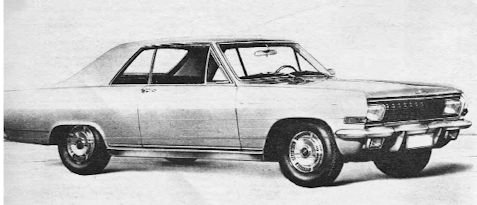
The Coupé variant of the Diplomat existed only with the 5.4-liter engine, which also motorized the successor Diplomat B (1969-1977). The Diplomat V8 Coupe was the crown of the Opel program. However, sales fell short of expectations. Most vehicles were delivered without vinyl roof, but many with leather trim.
From February 1965 to July 1967 347 copies were produced by Karmann in Osnabrück, leather upholstery cost extra charge. The Diplomat Coupe was thus priced over comparable sports models such as the Mercedes 280 SL or the Porsche 911.
The engine power of 190 hp or 230 hp was at that time unusual even in this class. With an acceleration of 0 to 100 km / h in less than 11 seconds and a top speed of about 200 km / h, the diplomat counted at that time among the fastest high-volume vehicles in Europe.
Apart from the drive, however, the diplomat was equal to the other models in this series. All KAD models had a dual-circuit brake system with front disc brakes and a brake booster. The Diplomat's landing gear was designed for high speeds with reinforced springs and larger tires (15-inch radial tires) and a rear brake force regulator. A power steering was also standard.
The bodywork was given some luxurious and technical details that emphasized the sophisticated character of this model. Externally recognizable was the standard vinyl roof, inside were veneer inserts on door panels, instrument panel and steering wheel. The centre tunnel console with chrome-plated automatic transmission selector lever was equipped with a storage compartment. There was also the switch panel of the standard power windows, then also in the upper class still an exclusive feature.
Initially, the diplomat received quite a lot of good feedback in the press and in public. Even roadholding, smoothness and bodywork were praised. Criticism earned only the mediocre suspension comfort and the high consumption in short-distance operation.
After some time, however, it turned out that the unchanged adopted from the USA Chevrolet V8 engine was not up to the harsh thermal requirements for permanent full throttle on German motorways. This deficiency was corrected in 1965 by the introduction of an even larger 5.4-liter V8 with 169 kW (230 DIN PS). This engine was a special version of the "327 Cid small block" from the Chevrolet Corvette, which had been modified for racing purposes and therefore also suitable for highway operation easily. However, this engine was initially exclusively in the Diplomat Coupe to have and was later offered alternatively for the limousine. The initial technical shortcomings damaged the diplomat's reputation as well as the extreme fuel consumption of over 20 litres / 100 km at high speed or short distance traffic.
In nearly five years almost 9200 copies of the Diplomat A were produced, including the 347 units of the hardtop coupe, which was manufactured from early 1965 to mid-1967 at Karmann in Osnabrück.
series
- Four-door notchback sedan (Captain, Admiral and Diplomat)
- Two-door coupe (only Diplomat, 347 pieces manufactured) - developed by Karmann in Rheine and Osnabrück under the direction of Johannes Beeskow and also built by Karmann.
Single pieces
- Long version, built by Vogt Auto Technik in Unterschneidheim, the company no longer exists.
- Convertible on a coupe basis, built by Karmann in Osnabrück for the IAA 1965 (not included in the Coupé's production figures).
Engines
Initially, captain and admiral were offered with the advanced from the predecessor Captain P 2,6, advanced six-cylinder 2.6-liter inline engine with four-bearing crankshaft, side camshaft and 74 kW (100 hp), combined with a four-speed manual transmission.
This was replaced in 1965, as often criticized as underachieving, the new Opel CIH, a six-cylinder in-line engine with 2.8 Liter displacement, seven-bearing crankshaft, overhead camshaft and maintenance-free hydraulic tappets. With a register carburettor he made as "2.8 S" 92 kW (125 hp). From 1967 it was equipped as "2.8 HL" ("high-performance engine") with two Zenith Register carburettors and reached 103 kW (140 hp).
Unlike the later Diplomat B, the Diplomat A was delivered exclusively with high-performance and high-torque Chevrolet V8 engines. First, the sedan was offered with the 4.6-liter engine (engine 283V) and the coupe with the 5.4-liter engine (327V). Later it was also possible to order the diplomatic sedan with the larger engine (model: Opel Diplomat A 5.4). The larger displacement had an effect mainly on the acceleration, less on the maximum speed (comparison V max: Diplomat A 4.6 200 km / h, diplomat A 5.4 206 km / h).
- 283 in 3 (4638 cm 3) displacement, 140 kW (190 hp) at 4600 / min
- 327 in 3 (5354 cm 3) displacement, 169 kW (230 hp) at 4700 / min
PERFORMANCE: 4.6L
Engine capacity: 283.01 cu in, 4,638 cu cm
Fuel consumption: 18.4 ml imp gal, 15.4 ml US gal, 15.3 1 x 100 km
Max speed: 124.2 mph, 200 km/h
max power (SAE): 223 hp at 4,800 rpm
max torque (SAE): 295 1b ft, 40.7kg m at 3,200 rpm
max number of engine rpm: 5,000
specific power: 48.1 hp/l
max speeds: 69.6 mph, 112 km/h in 1st gear; 124.2 mph, 200km/h in 2nd gear; power-weight ratio: 15.2 lb/hp, 6.9 kg/hp
acceleration: 0—50 mph (0—80 km/h) 8 sec; speed in direct drive at 1,000 rpm: 25.2 mph, 40.5 km/h.
PERFORMANCE: 5.4L
Engine capacity: 826.70 cu in. 5344 cu cm
Fuel consumption: 15.7 m/imp gal. 13.1 m/US gal. 18 x 100 km
Max speed: 128 mph, 206 km/h
max power (SAE) ; 270 hp at 4.800 rpm
max torque (SAE): 350 1b ft. 48-3 kg m
max engine rpm: 5,000
specific power: 50.4 hp l
acceleration: 0—-50 mph (0 —80 km/h) 7.2 sec
Transmission
Captain and Admiral were equipped as standard with a steering wheel circuit and 4-speed transmission; against surcharge was a middle shift or the two-speed Powerglide automatic with shift lever on the steering wheel available. This automatic from General Motors was standard in the Diplomat A, with centre selector lever.
Advertisements described a combination of the V8 with four-speed manual transmission, top speed 210 km / h, but this version was not offered after a few test vehicles due to overuse of the clutch and the transmission. Nevertheless, some copies were privately owned.
The sale of the Diplomat Coupe ended in July 1967 after only 347 units, while the sedan was manufactured until November 1968.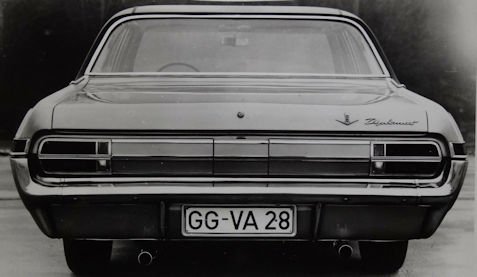
|
Featured
|
|
