
About
Technical
-
Technical data
Opel Captain / Admiral / Diplomat B (1969-1977)
Opel KAD:
Dipl. V8
Dipl V8 long
engine
8-cylinder four-stroke V engine ( Chevrolet 327 )
capacity
5354 cc
(327 cubic inches )Bore × stroke
101.6 × 82.6 mm
Power
(hp)
at 1 / min169 kW
(230 hp)
4700Max. Torque
at 1 / min427 Nm
3100compression
10.0: 1
mixture preparation
A double downdraft registrar
(Rochester Quadrajet)valve control
Hanging valves, bumpers and rocker arms (central lower camshaft, toothed chain)
cooling
water cooling
transmission
TH-400 Turbo-Hydramatic-three-speed automatic transmission (GM)
Front suspension
Independent suspension on double wishbones , coil
springs torsion bar stabilizerRear suspension
rigid De Dion tube at two trailing arms drawn down and a pushed wishbone above, coil springs, torsion bar stabilizer
body
Sheet steel, self-supporting, tank: 80 liters
Gauge front / rear
1505/1512 mm
wheelbase
2845 mm
2995 mm
length
4907 mm
5070 mm
tare
1475-1690 kg
1720 kg
top speed
202 km / h
200 km / h
0-100 km / h
10 s
10 s
Consumption (liters / 100 kilometers)
21.0 liters
21.0 liters
Opel KAD:
Cape / Adm / Dipl 2800 H
Adm / Dipl. 2800 E
engine
6-cylinder four-stroke in-line engine ( Opel CIH )
capacity
2784 cc
Bore × stroke
92 × 69.8 mm
Power
(hp)
at 1 / min103-107 kW
(140-145 hp)
5200118-121 kW
(160-165 hp)
5600Max. Torque
at 1 / min222 Nm
3700228 Nm
4350compression
9.5, later 9.0: 1
mixture preparation
Two register carburettors Zenith 35/40 INAT
electronic intake manifold injection BoschD-Jetronic
valve control
Hanging valves, hydraulic tappets and rocker arms (overhead camshaft, duplex chain)
cooling
water cooling
transmission
Four-speed gearbox, steering wheel or stick control
( a.W. Opel / GM three-speed automatic transmission)Front suspension
Independent suspension on double wishbones , coil
springs torsion bar stabilizerRear suspension
rigid De Dion tube at two trailing arms drawn down and a pushed wishbone above, coil springs, torsion bar stabilizer
body
Sheet steel, self-supporting, tank: 80 liters
Gauge front / rear
1505/1512 mm
wheelbase
2845 mm
length
4907 mm
tare
1475-1690 kg
top speed
177-185 km / h
185-190 km / h
0-100 km / h
11.5-12.5 s
11.5 s
Consumption (liters / 100 kilometers)
16-17 liters
17-18 liters
Manuals
Opel diplomat B
 |
|
|
Production period: |
1969 to 1977 |
|
Class: |
Luxury Car |
|
Body versions: |
Saloon |
|
Engines: |
Gasoline : 2.8-5.4 litres |
|
Length: |
4907-5070 mm |
|
Width: |
1835-1852 mm |
|
Height: |
1450 mm |
|
Wheelbase: |
2845-2995 mm |
|
Curb weight: |
1475-1720 kg |
|
previous model |
Opel KAD Series A |
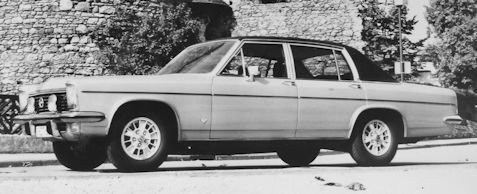
The models Captain, Admiral and Diplomat Series B, also referred to as KAD B, were built from March 1969 to July 1977 and not imported to right hand drive for British markets (Vauxhall).The only four-door notchback sedans were with six-cylinder or the V8 petrol engines available with a capacity from 95 to 169 kW (129 to 230 HP). With a wheelbase of 2845 mm, the vehicle was 4907 to 4920 mm long, 1835 to 1852 mm wide and 1450 mm high. The mid-1973 to summer 1977 offered long version had 15 cm more wheelbase and therefore more length. The curb weight was given as 1495 to 1695 kg (long version 1720 kg). The choice was a six-cylinder engine with 2784 cc displacement and 103 to 107 kW (140-145 hp) with carburettor or 118 to 121 kW (160-165 hp) with intake manifold injection and a V8 engine with 5354 cc displacement and 169 kW (230 PS).
History
As with the predecessor KAD A series, all KAD-B models have the same body shape. The simplest, simply equipped model was until May 1970 - as in the KAD-A series - the captain. The admiral was the middle version. The flagship model Diplomat also supplied Opel with the V8 engine from Chevrolet.
The new cars were a few inches shorter and narrower than the KAD-A series. The body was smooth and bulky with unmistakable US influences, which did not appeal to the potential buyers in Germany and Europe. The captain and admiral maintained the wide rectangular headlamps in the radiator grille, while the diplomat received headlights in portrait format. After the manner of the Mercedes W111 sat the turn signals behind their nearly square, curved spreading discs and the headlights in the somewhat advanced fenders. Also, the taillights of the diplomat were smaller and narrower than the other two models. All have sunken wipers.
The safety equipment includes crumple zones, the stable passenger compartment and the generously clad interior as well as the equipment with safety steering column as well as dual-circuit brake system with front disc brakes and brake booster. In addition, the luxury class cars got a complex and expensive De Dion rear axle. Although this construction weighed about 20 kg more than a simple rigid axle, but the unsprung masses were lower. This should be ensured with slightly responsive suspension good wheel alignment. On request, all three models with a pneumatic level control be equipped, whereby the permitted trailer load rose to 2,000 kg (braked).
The rated power of the well-known from the KAD-A models 2.8-liter six-cylinder in-line engine was equipped with a Register carburettor by two to 97 kW (132 hp) and in the version with two Register carburettors by four to 107 kW (145 PS) increased.
The Admiral B was like its predecessor, the middle trim line of the KAD-B series. This also had it with the intake manifold injection D-Jetronic from Bosch, with which he made 121 kW (165 hp) with a displacement of 2.8 Liters. In September 1972, Opel retouched the radiator grille of the Admiral with horizontal ribs and Opel emblem. In April 1976, the dashboard was revised (with glare-free instruments, four-spoke steering wheel and changed switch arrangement). The admiral remained as 2.8 S and 2.8 E with automatic transmission and power steering to July 1976 in the program, but was then renamed Diplomat.
The diplomat was further mixed with the 2.8-liter straight-six-cylinder engine having intake manifold injection and a power of 121 kW (165 hp) and the 5.4 Liter Chevrolet- V-type engine provided with 169 kW (230 hp), the opposite the predecessor has been slightly improved. According to the high-speed achievable versions with V8 engine were equipped with four ventilated disc brakes.
In April 1970, the Diplomat V8 with three-speed automatic. The standard equipment included automatic transmission and power steering, as accessories were air conditioning, electric sunroof, leather interior and power windows and mirrors adjustable from the inside, H4 halogen headlights and an integrated into the windscreen electronic antenna (standard in the Diplomat from summer 1971).
In September 1972, the diplomat was given a slight revision, in which the Opel emblem into the radiator grille. From mid-1973 the Diplomat V8 was also available as a long version. In early 1976, it was upgraded with light-alloy wheels, tinted glass and wiper-washer system for the headlights.
After the name Admiral was given up in July 1976, this trim level continued with the 2.8-liter in-line six-cylinder engine as a diplomat, but with the exterior of the admiral. So, Opel wanted to continue to distinguish the diplomat V8 from the six-cylinder model. In July 1977 ended the production of Diplomat B.
Special versions
- In 1971, Opel had four Diplomat Cabriolets for VIP transport; the modifications were done by the companies Carrozzeria Fissore and Karmann. All four convertibles are still well preserved and privately owned.
- For transmission teams of the ZDF transformed the bodywork Vogt in Bad Neuenahr some cars in fastback saloons with hatchback and large tailgate.
- In addition, Vogt also had a number of KAD-based estate conversions and funeral wagons, as well as several ambulances whose floor groups had initially been extended in Bad Neuenahr before the bodywork structures at Miesen in Bonn were manufactured. In addition to these special body versions, some stand-alone vehicles have been realized on the undercarriage and with the KAD series drive technology:
Over the course of 1969, Opel's design team, led by Charles "Chuck" Jordan, realized a two-door hatchback coupe with a low, elongated front end and a large glass tailgate. A special feature of this coupe was a fold-up pulpit, which replaced conventional doors: a unit of windscreen, roof parts and side panels was attached to hinges and could be opened to release access to the passenger compartment. Within a few months of this coupé, a prototype with the drive technology and chassis of the Diplomat V8 was produced. The coupe was presented at the International Motor Show 1969 in Frankfurt and caused a sensation there. It is considered a conceptual predecessor of the Bitter CD; the vehicle was used for private purposes many years after its Chuck Jordan exhibition. Frua Diplomat Coupé for the International Motor Show 1969 in Frankfurt, the Italian design studio Pietro Frua designed a conventionally drawn notchback coupe with the suspension and the drive technology of a Diplomat 2.8. The line of the coupe reminded as a whole of the (also designed by Frua) glass V8. From this interim model Fruas new design differed primarily by a simpler front end with round twin headlights. The obvious similarity of both models was repeatedly used by the press as an occasion to call Fruas Opel's design "Glasomat". special coupe was made only in one copy.
One year after Chuck Jordan's sensational Diplomat Coupé, Pietro Frua commissioned Opel to produce a revised version of the design that, unlike the original, was designed for mass production. Technical basis was the Diplomat V8. Frua took over the basic layout, but changed numerous details such as the waistline and the rear end, which received additional side windows. Above all, the elaborate pulpit, which was replaced by conventional doors, was dropped. The silver painted vehicle was presented to the public at the Paris Motor Show in 1970. Frua made two copies of this model; both vehicles still exist.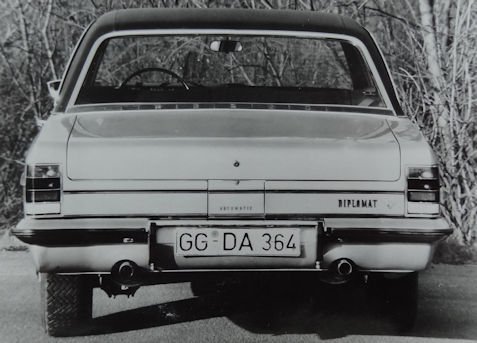
|
Featured
|
|
