
Austin 1800 Mark 1
|
|
|
|
Production |
1964 to 1968. |
|
Class |
Motor Car |
|
wheel base: |
106 in, 2,692 mm |
|
length: |
164.20 in, 4,171 mm |
|
width: |
66.75 in, 1,695 mm |
|
engine: |
1800cc |
|
gearbox: |
4 speeds |
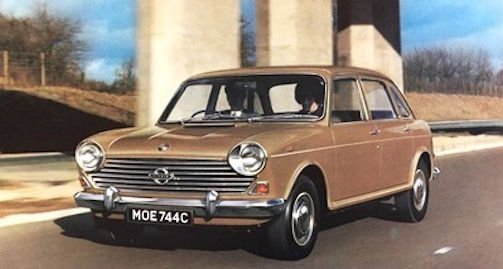
BMC ADO17 was the model code used by the British Motor Corporation (BMC) for a range of cars produced from September 1964 to 1975 and sold initially under its Austin marque as the Austin 1800. The car was also sold as the Morris 1800 and Wolseley 18/85.
Development
It was developed at BMC as the large-car follow-up to the successful Mini and Austin 1100 under the ADO17 codename. Additional badge-engineered Morris 1800 and Wolseley 18/85 variants were launched, in 1966 and 1967, catering for BMC dealerships selling these marques, and their loyal customers. The 18/85 name had previously been used on the Wolseley 18/85 of 1938 to 1948
The car was unconventional in its appearance in 1964, with its large glasshouse and spacious, minimalist interior including leather, wood, and chrome features plus an unusual instrument display with ribbon speedometer and green indicator light on the end of the indicator stalk. There was a chrome "umbrella handle" handbrake under the dashboard parcel shelf, and the two front seats met in the middle and could be used, on occasion, as a bench seat. Both Alec Issigonis and Pininfarina worked on its exterior. The technology "under the skin" was also unconventional and ahead of its time, including Hydrolastic suspension and an example of inertia-controlled brake proportioning, in the form of a valve which transferred braking force between front and rear axles as a function of sensed deceleration rather than as a function of fluid pressure. The bodyshell was exceptionally stiff with a torsional rigidity of 18032 Nm/degree, this was greater structural rigidity than many modern cars up to the end of the century.
Coachwork: 5-seater, 4-door Saloon of all-steel unitary construction; full-width facia incorporating instruments, switches and warning lights, the upper surface is trimmed in black Vinyl-coated fabric to eliminate glare and incorporates an upper and lower padded crash roll; a third crash roll is on the full-width parcel shelf below the facia; an ashtray is fitted in the facia top panel and 2 are provided in the front seat backs for rear passengers; single interior tinted mirror; single padded sun visor; separate front seats, both adjustable for leg reach; cushions and squabs comprise rubber diaphragms with polyether pads trimmed in Vinyl-coated fabric; rear seat has metal seat pan with full-depth polyether pad; rear squab is spring case with polyether pad, trimmed in Vinyl-coated fabric; parcel shelf of large dimensions behind rear seat squab; doors hung at forward edges by concealed hinges; all doors fitted with curved wind-down safety-glass windows; both front doors fitted with out- side private locks; rear doors have children's safety-catches; large open pockets on front doors and smaller ones to rear doors; door casings trimmed in Vinyl-coated fabric; roof lining of molded Fiberglass faced with Vinyl-coated fabric; floor covered with molded carpets; curved, toughened plate glass for windscreen and back- light, both mounted in rubber moldings with bright plastic exterior finishes; provision for fitting radio; seat belt anchorage points built-in; lockable 17 cu. ft. (0.48 m.3) boot at rear, fully lined; lift-up spring-assisted lid with concealed hinges; boot interior lamp; spare wheel carried in wind-down tray below boot floor; chromium-plated bumpers front and rear.
De Luxe Saloon is available which includes the following items: dual wind tone horns; passenger's sun visor; hide facings for seats; armrests on rear doors; opening quarter lights; sill tread plates; cant-rail grab handles; wheel trims; heater/demister; bumper overriders front and rear. Optional extras: '1800' Saloon: heater/demister, fully reclining seat squabs; folding center armrest in rear seat. '1800' De Luxe Saloon: fully reclining front seat; rear seat folding center armrest. 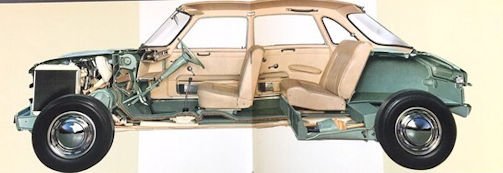
Gearbox: 4-speed with synchromesh on first, second, third and top, central gear lever rubber insulated from body floor operates gearbox by flexible cables; final drive casing in unit with engine and gearbox, standard ratio 3.882:1 (17/66); drive to front wheels via helical spur gears and open drive shafts with universal joints.
Suspension. independent with upper and lower arms and locating tie rods, swivel axles mounted on ball joints, Hydrolastic displacers (interconnected front to rear) are mounted horizontally in front suspension tube across front of bulkhead, rear, independent with trailing arms incorporating Hydrolastic displacers and anti-roll bars.
Progressive improvement was a feature of most cars in this period, but the number and nature of the changes affecting the early years of the Austin 1800 looked to some as though the car had been introduced without sufficient development work. A month after its launch, in December 1964, reclining front seats and the option of an arm rest in the middle of the back seat were added to the specification schedule. A month later, in January 1965, the final drive ratio reverted to the 3.88:1 value used in the prototype, from the 4.2:1 ratio applied at launch: this was described as a response to "oil-consumption problems": January 1965 also saw the indicator switch modified. At the same time, higher gearing and reduced valve clearances cut the published power output by 2 bhp but cured the "valve-crash" reported by some buyers when approaching top speed on one of Britain's recently constructed motorways. The manufacturer quietly replaced the "flexible, flat-section dipstick" which, it was said, had caused inattentive owners to overfill the sump after inserting the dipstick back to front so that the word "Oil" could not be seen on it. Subsequent modifications included changing, repositioning and re-angling, the handbrake in October 1965, removing the rear anti-roll bar and rearranging the rear suspension at the end of 1965, at the same time adjusting the steering to address a problem of tire scuffing, and fitting stronger engine side covers in January 1966 along with modified engine-mounting rubbers which now were "resistant to de-bonding". February 1965 saw water shields fitted to the rear hubs and the car's steering rattle cured by the judicious fitting of a spacer, while the propensity of early cars to jump out of first and second gears was addressed by the fitting of a "synchronizer”. Further improvements followed the launch of the Morris 1800 early in 1966. Gear cables were revamped to deal with "difficult engagement" of first and third gears in cold weather, and the seat mountings were adapted to increase rake in May 1966.
Engine: water-cooled, overhead valve, 4-cylinder, 5-bearing crankshaft, counter. balanced and fitted with vibration damper, in unit with clutch, gearbox and final drive, installed transversely at front of car, cubic capacity 109.75 cu. in. (1,798 c.c.), fuel system: S.U. carburetor, type HS6 with paper element air cleaner and warm air 'intake; S.U. electric fuel pump, type S.P.; fuel filter in pump and tank. lubrication system: full pressure feed; sump forms oil bath for gearbox and final drive; internal gear type pump driven by camshaft; external flow filter; gauze filter in sump with internal magnet.
In June 1967, without any fanfare of press releases, a modified version of the 1800 started turning up in domestic market show rooms with repositioned heater controls, a strip of 'walnut veneer' on the fascia and separate bucket seats replacing the former split bench seat at the front. Various other criticisms seem to have been quietly addressed at the same time, including the announcement of more highly geared steering which now needed only 3.75 rather than 4.2 turns between locks, although the actual modification had applied to cars produced since September 1966 (and, in the case of Australian cars, sometime before that). This was also the point at which the car received a differently calibrated dipstick, giving rise to rumors that engine problems on some of the early models had resulted from nothing more complicated than the wrong calibration of the dipstick causing the cars to run with the wrong level of engine oil; the manufacturers insisted that the "recalibration" of the dipstick was one of several (unspecified) modifications, and urged owners not to use the new dipsticks with older engines.
The Mark I's doors were later used on the Austin Maxi and larger Austin 3-Litre (ADO61) model.
PERFORMANCE
Engine capacity: 109.75 cu in, 1,798.47 cu cm
Fuel consumption: 23.7 m/imp gal, 19.8 m/US gal, 11.9 1 X 100 km
Max speed: 90 mph, 144.9 km/h
max power (SAE): 86 hp at 5,300 rpm
max torque (SAE): 99 1b ft, 13.7 kg m at 2,100 rpm
max engine rpm: 5,300
specific power: 47.8 hp/l
power-weight ratio: 29.5 lb./hp, 13.4 kg/hp
acceleration: standing 1/4 mile 20.5 sec, 0—50 mph (0—80 km/h) 11.9 sec
max speeds: 28.5 mph, 45.9 km/h in 1st gear; 42 mph, 67.6 km/h in 2nd gear; 68 mph, 109.5 km/h in 3rd gear; 90 mph, 144.9 km/h in 4th gear
Australia
By 1966 Australia was described as BMC's leading world market. The 1800 was introduced in Australia in November 1965as the Austin 1800, with a Mark II version being introduced in 1968. Australian-produced vehicles started out with a claimed local content of 65–70% along with an undertaking from the manufacturers to raise the level to 95% in line with government requirements by the end of 1968. Initially the cars were generally identical to their British contemporaries, however the local production was quickly modified to suit the harsher roads and climate of Australia. Modifications to the British Mark I design included raised suspension trim height, the provision of a large, heavy sump guard and better sealing against dust. The Australian Mark II was notable in retaining the lower final drive ratio of the Mark I's manual transmission (but not the lower second gear), and, with the exception of the initial production run, was fitted with a dual-circuit hydraulic braking system manufactured locally by Paton's Brake Replacements (PBR) Pty. Ltd. Despite offering the safety of a dual-circuit system, it was generally held to be inferior in performance to the earlier Girling equipment. 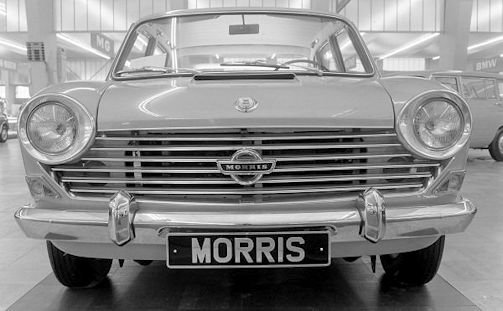
Related
Technical
-
ENGINE
front, 4 stroke, transverse
cylinders: 4, in line
bore and stroke: 3.16 x 3.50 in, 80.3 x 88.9 mm
engine capacity: 109.75 cu in, 1,798.47 cu cm
compression ratio: 8.2
cylinder block: cast iron
cylinder head: cast iron
crankshaft bearings: 5
valves: 2 per cylinder,overhead, push-rods and rockers
camshafts: 1, side
lubrication: eccentric pump,magnetic metal gauze filter in sump and full flow
carburation: 1 SU type HS 6 carburettor
fuel feed: electric pump
cooling system: waterTRANSMISSION
driving wheels: front
clutch: single dry plate, hydraulically controlled
gearbox: mechanical, in unit with engine
gears: 4 + reverse; synchro-mesh gears: I,II, III, IV
gearbox ratios: I 3.292, II 2.217, III 1.384, IV 1, rev 3.075
gear lever: central
final drive: spiral bevel
axle ratio: 3.880.CHASSIS
integral
front suspension : independent, wishbones, lower trailing links,hydrolastic (liquid) rubber cone springs, hydraulic connecting pipes to rear wheels
rear suspension: independent, swinging longitudinal trailing arms, hydrolastic (liquid) rubber cone springs, hydraulic connecting pipes to front wheels, anti-roll
bar.STEERING
rack-and-pinion
turns of steering wheel lock to lock: 4.40.
turning circle (between walls): 40.5 ftp 12.4 mBRAKES
front disc (diameter 9.28 in, 236 mm)
rear drum, servo
area rubbed by linings: front 183 sq in, 1,180.35 sq cm, rear 99 sq in, 638.55 sq cm, total 282 sq in, 1,818.90 sq cm.ELECTRICAL EQUIPMENT
voltage: 12 V
battery: 50 Ah
generator type: dynamo, 22 Ah
ignition distributor: LucasDIMENSIONS AND WEIGHT
wheel base: 106 in, 2,692 mm
front track: 56 in,1,422 mm
rear track: 55.50 in, 1,410 mm
overall length: 164.20 in, 4,171 mm
overall width: 66.75 in, 1,695 mm
overall height: 56.25 in, 1,429 mm
ground clearance:6.50 in, 165 mm
dry weight: 2,536 1b, 1,150 kg
distribution of weight: 63% front axle,37% rear axle-Note: More Specifications and Repair Manuals available for registered users-
© Motor car History
Service
-
fuel: 96-98 oct petrol
engine sump, gearbox and final drive oil: 13.20 imp pt, 15.85 US pt, 7.5 1, SAE 10W-30, change every 6,000 miles, 9,700 km
lubricating system capacity:15 imp pt. 17.97 US pt, 8.5 1
cooling system capacity: 9.50 imp pt, 11.42 US pt, 5.4 1.
greasing: every 6,200 miles, 10,000 km, 1 point
tappet clearances:inlet 0.015 in, 0.38 mm, exhaust 0.015 in, 0.38 mm
valve timing: inlet opens 5° before tdc and closes 45° after bdc, exhaust opens 51° before bdc and closes 21° after tdc;
normal tyre pressure: front 28 psi, 2 atm, rear 22 psi, 1.5 atm.
width of rims: 4.5";
tyres: 175 x 13
fuel tank capacity: 10.8 imp gal, 12.9 US gal
carrying capacity: 882 1b, 400 kg-Note: More Specifications and Repair Manuals available for registered users-
© Motor car History

