
Hyundai Elantra Lantra Second generation (J2 / RD)
|
|
|
|
Model code |
|
|
Also called |
Hyundai Avante (South Korea) |
|
Production |
1995–2000 |
|
Assembly |
South Korea: |
|
Body style |
4-door sedan |
|
Engine |
|
|
Transmission |
5-speed manual |
|
Wheelbase |
2,550 mm (100.4 in) |
|
Length |
4,420 mm (174.0 in) (1995–1998 sedan) |
|
Width |
1,700 mm (66.9 in) (1995–1998) |
|
Height |
1,395 mm (54.9 in) |
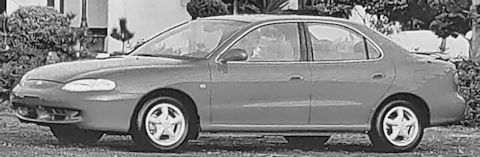
In autumn 1995, the second generation of the Hyundai Lantra came on the European market. This differed clearly from the predecessor and received now exclusively engines from own development.
From spring 1996 Hyundai also offered a wagon version of the Lantra. This platform divides the Lantra now for the first time, because as of summer 1996 was based on the basis of the Hyundai Coupe , with which has the internal abbreviation J2, but not the suspension tuning by Porsche has in common. The chassis was the first time developed computerized and consists of MacPherson struts up front and a multilink rear suspension behind, this gives well-filtered ride over rough bumps. However, driving comfort is reduced by the short leg rests of the front seats. Positively the controllability of the vehicle and the (not standard) strong air conditioner are good.
End of 1998 was a facelift, in which especially the front end and the interior underwent a revision. The rear was hardly changed except for details. This variant bears the internal abbreviation RD , often referred to by drivers as J3 in reference to the previous count.
Reliability
As with its predecessor, the overheating that is more common in the Lantra J2 / RD is usually due to leaking hose connections and marten damage to the cooling water circuit. For the joints, Hyundai has developed improved clamps. Start problems and poor engine operation, however, corroding plug connections are likely also mention defective exhaust manifolds as a more common problem. Chassis side, the rear axle is more affected by rust, Hyundai, however, made changes to it .The frequency of significant deficiencies in the TÜV report is on the average of the same age cars.
For vehicle safety, the passenger now also received an airbag.
frontal tests
- US-NCAP 1995-1998 Driver side: Passenger side:
- US-NCAP 1998-2000 Driver side: Passenger side:
- IIHS 1995-2000: Acceptable
At the US NCAP, driving is tested at 46 km / h on a concrete wall. The IIHS test, on the other hand, simulates a vehicle driven by 40% at 64 km / h. The upper torso protection for driver and front passenger is rated well, all other areas receive the second best, acceptable rating level. Thus, the vehicle moves at the level of the then Japanese competition and surpasses the VW Jetta / Golf by one stage.
page tests
- US-NCAP 1995-1998 Driver side: Passenger side:
- US-NCAP 1998-2000 Driver side: Passenger side:
The upper body load is tested on a deformable barrier that drags sideways at 63 km / h and is modeled on a saloon. In the head and leg area is not measured. Page tests of other organizations were not conducted.
Bumper test
The damage to a parking bumps at 8 km / h very cost unfavorably before the facelift, but was down significantly improved.
Engines
The engine included the so-called beta engine of Hyundai in three displacement variants. Also, the transmission is now an in-house development, which is described as goodd, but In some markets the Lantra was also equipped with a 1.5 liter petrol engine and since 1997 also a 1.9 liter Peugeot diesel. The engines meet the emission standard Euro 2 , from the facelift Euro 3, D3 .
In the summer of 2000, the production of the Lantra was completed. Successor was the Elantra .
Related
Technical
-
Technical data
1.5
1.6
1.8
Construction period
1995-2000
Motor characteristics
motor identification
Alpha
G4EKBeta
G4GRBeta
G4GMengine type
R4 petrol engine
Number of valves per cylinder
3
4
valve control
OHC , timing belt
DOHC, timing belt
mixture preparation
manifold injection
engine charging
-
cooling
water cooling
Bore × stroke
75.5 mm × 83.5 mm
77.4 mm × 85.0 mm
82.0 mm × 85.0 mm
capacity
1495 cc
1600 cc
1796 cm³
compression ratio
10.0: 1
9.7: 1
10.0: 1
Max. power
65 kW
(88 hp)
at 5500 rpm85 kW
(116 hp)
at 6100 rpm94 kW
(128 hp)
at 6100 rpmMax. torque
126 Nm
at 4300 rpm146 Nm
at 4900 rpm165 Nm
at 5000 rpmpower transmission
drive
front-wheel drive
Gearbox, standard
5-speed manual transmission
Gear, optional
-
4- speed automatic transmission
Measured values [M2 1]
top speed
k. A.
193 km / h
196 km / h
(192 km / h)Acceleration, 0-100 km / h
k. A.
11.2 s
9.4 s
(11.1 s)Fuel consumption per 100 km (combined)
k. When
6.7 l S
(7.9 l S)7.2 l S
(8.0 l S)2.0
1.9 D
Construction period
1998-2000
1997-2000
Motor characteristics
motor identification
Beta
G4GFPSA XUD
XUD9 Aengine type
R4 petrol engine
R4 diesel engine
Number of valves per cylinder
4
2
valve control
DOHC, timing belt
OHC, timing belt
mixture preparation
manifold injection
Swirl chamber injection
engine charging
-
cooling
water cooling
Bore × stroke
82.0 mm × 93.5 mm
83.0 mm × 88.0 mm
capacity
1975 cm³
1905 cc
compression ratio
10.3: 1
23.0: 1
Max. power
102 kW
(139 hp)
at 6000 rpm50 kW
(68 hp)
at 4600 rpmMax. torque
182 Nm
at 4900 / min120 Nm
at 2000 rpmpower transmission
drive
front-wheel drive
Gearbox, standard
5-speed manual transmission
Gear, optional
4- speed automatic transmission
-
Measured values [M2 1]
top speed
202 km / h
(187 km / h)k. A.
Acceleration, 0-100 km / h
k. A.
Fuel consumption per 100 km (combined)
k. When
k. A. l D
-
- ↑ Values in parenthesis ("()" for automatic transmission.
-

