
Hyundai Elantra Lantra 1st generation (J1)
|
|
|
|
Model code |
J1 |
|
Also called |
Hyundai Lantra (Australia, Europe) |
|
Production |
1990–1995 |
|
Assembly |
South Korea: |
|
Body style |
4-door sedan |
|
Engine |
|
|
Transmission |
5-speed manual |
|
Wheelbase |
2,500 mm (98.4 in) |
|
Length |
4,375 mm (172.2 in) (1990–1993) |
|
Width |
1,675 mm (65.9 in) (1990–1993) |
|
Height |
1,395 mm (54.9 in) (1990–1993) |
|
Curb weight |
1,064–1,187 kg (2,346–2,617 lb) |
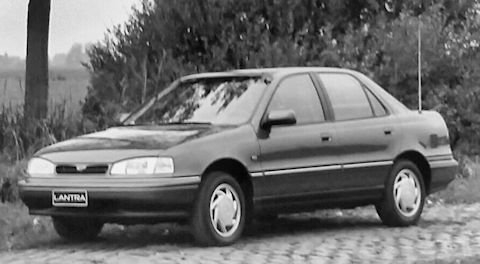
The Elantra also called Lantra in Europe was built from October 1990 Lantra as a notchback with a comparatively rich equipment level but relatively inexpensive. Fog lights, air conditioning and a part leather trim were available as optional extras.
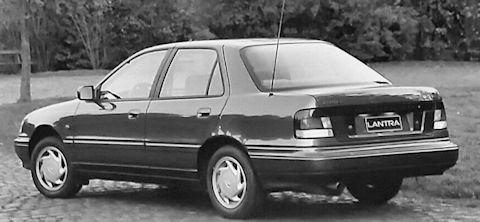
In early 1994, the Lantra J1 was subjected to a comprehensive facelift, in which the rear and front end was modified and the interior was upgraded. For the first time ABS was available and a driver airbag as standard. This improved the crash test result.
Reliability
Frequent repairs on the Lantra type J1 are caused by the small-sized brake system and the cooling systems of the engines, which are not dimensioned for full load. With the facelift therefore a modified cooling water thermostat and a stronger oil pump were used. Due to age, however, the cooling water hoses can now be porous. The result of overheated engines is damage to the cylinder head gasket .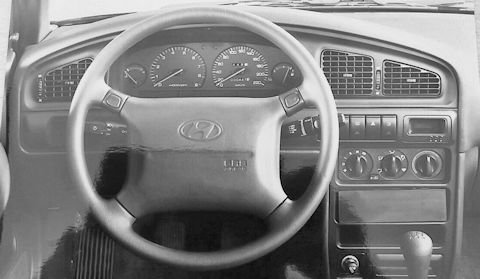
Defective timing belts were another source of engine damage to the model maintenance, which then decreased by reinforced timing belt; Statistics are not available for this. The chassis has an early through leaky sleeves weary drive shaft , which is recognizable by crackling noises during steering and load changes . The joints on the front and rear axles also frequently show considerable deficiencies. The body is partially galvanized, but hardly conserved. Rust is therefore slightly above average, even on the brake lines.
In its inspections, the TÜV finds at three percent more Lantra significant deficiencies than the average of the same age vehicles. Elantra's only real standout feature is generous passenger space for the class trunk space is ample, though some rear leg room is sacrificed to achieve it.
The only crash test performed on the vehicle is the US NCAP front-end test. Driving is tested at 46 km / h on a concrete wall.
- US-NCAP 1990-1994 Driver's side: Passenger side:
- US-NCAP 1994-1995 Driver side: Passenger side:
Engines
The motorization of this generation was still licensed from Mitsubishi engines, but may contain minor changes. They meet the Euro 1 standard .
Related
Technical
-
Technical data
1.5
1.6
1.8
Construction period
1990-1995
1992-1995
Motor characteristics
motor identification
Orion 4G15 / G4DJ
Sirius 4G61 / G4CR
Sirius 4G67 / G4CN
engine type
R4 petrol engine
Number of valves per cylinder
2
4
valve control
OHC , timing belt
DOHC, timing belt
mixture preparation
manifold injection
engine charging
-
cooling
water cooling
Bore × stroke
75.5 mm × 82.0 mm
82.3 mm × 75.0 mm
81.5 mm × 88.0 mm
capacity
1468 cc
1596 cm³
1836 cc
compression ratio
9.4: 1
9.2: 1
Max. power
63 kW
(86 hp)
at 5500 rpm84 kW
(114 hp)
at 6200 rpm78 kW
(106 hp)
at 6200 rpm93 kW
(126 hp)
at 6000 rpmMax. torque
129 Nm
at 3000 rpm139 Nm
at 4500 rpm133 Nm
at 4500 rpm165 Nm
at 4400 rpmpower transmission
drive
front-wheel drive
Gearbox, standard
5-speed manual transmission
4- speed automatic transmission
5-speed manual transmission
Gear, optional
4-speed automatic transmission
-
4-speed automatic transmission
Measured values [M1 1]
top speed
170 km / h
(158 km / h)185 km / h
(175 km / h)
190 km / h
(187 km / h)Acceleration, 0-100 km / h
13.0 s
(14.0 s)11.1 s
(13.2 s)
10.6 s
(12.3 s)Fuel consumption per 100 km (combined)
6.8 l of N
(6.4 l of N)7.4 l of N
(7,6 l N)
8.2 l of N
(7.3 l of N)Remarks
From year 1992 E10 fuel suitable [5]
- ↑ Values in parenthesis ("()" for automatic transmission.

