
About
Technical
-
BRAKES
System Dual diagonal split circuit. Power assisted braking system with anti-lock brakes and Electronic Brake Force Distribution.
Front 15 inch ventilated discs, floating calliper with pad warning device
Rear 11 inch solid discs, floating calliper with pad warningSUSPENSION
Front MacPherson struts with coil springs
Rear Dual link type, anti-roll stabiliser barSTEERING
System Power assisted, rack and pinion steering column
Lock to lock turns 3.06
Fuel economyUrban
Extra Urban
Combined
2.0 (2WD)
27.1
42.8
35.3
2.0 (4WD)
26.6
41.5
34.4
2.0 CRTD manual
31.7
45.6
39.8
2.0 CRTD auto
27.4
42.8
35.3
2.7 V6
21.4
34.4
28.2
All figures in mpg
Fuel tank capacity
2.0 petrol/diesel models, 2WD and 4WD
58 litres
2.7 V6
65 litres
Dimensions
Dimensions
Length
4,325 mm
Height (with roof rails)
1,730 mm
Width
1,830 mm
Wheelbase
2,630 mm
Track (front)
1,540 mm (GSI models)
1,550 mm (CDX models)
Track (rear)
1,540 mm (GSI models)
1,550 mm (CDX models)
Turning circle
10.8 m/35 ft 4 ins radius
Tyre size
215/65 R16 (GSI models)
235/60 R16 (CDX models)
Cargo capacity, cu.ft (seats upright/reclined)
22.7/65.5
Weights and measures
Kerb weight (kg) 2.0 manual 2WD
1,537
Kerb weight (kg) 2.0 manual 4WD
1,617
Kerb weight (kg) CRTD manual
1,685
Kerb weight (kg) CRTD auto
1,616
Kerb weight (kg) 2.7 V6
1,668
Gross vehicle weight (kg) 2.0 manual 2WD
2,050
Gross vehicle weight (kg) 2.0 manual 4WD
2,140
Gross vehicle weight (kg) CRTD manual/auto
2,210
Gross vehicle weight (kg) auto 2.7 V6
2,190
Max towing weight (kg) braked – 2WD
1,400
Max towing weight (kg) braked – 4WD
1,600
Max towing weight (kg) unbraked – 2WD
500
Max towing weight (kg) unbraked – 4WD
500
Nose weight (kg) all models
75
Roof load (kg) all models
75
ENGINESmodel
capacity
cylinder
Power
at 1 / minTorque
at 1 / minConsumption according to ECE
drive
construction
gasoline engines
2.0
1975 cm³
4
104 kW (141 hp) / 6000
184 Nm / 4500
8.0-8.2 l / 100 km
2WD / 4WD
08 / 2004-03 / 2010
2.7 V6
2656 cc
6
129 kW (175 hp) / 6000
241 Nm / 4000
10.0 l / 100 km
4WD
08 / 2004-03 / 2010
diesel engines
2.0 CRDi
1991 cm³
4
83 kW (113 hp) / 4000
245 Nm / 1800-2500
7.0-8.0 l / 100 km
2WD / 4WD
08 / 2004-01 / 2006
2.0 CRDi VGT
1991 cm³
4
103 kW (140 hp) / 4000
305 Nm / 1800-2500
7.0-8.0 l / 100 km
2WD / 4WD
01 / 2006-10 / 2008
2.0 CRDi
1991 cm³
4
110 kW (150 hp) / 3800
305 Nm / 1800-2500
7.1-7.5 l / 100 km
2WD / 4WD
11 / 2008-03 / 2010
Note: Full Specifications and Service Repair Manuals available for registered users
© Motor-car.net
Manuals
Hyundai Tucson First Generation (JM)
|
|
|
|
Production period: |
2004 to 2010 |
|
Body versions : |
station wagon |
|
Engines: |
Gasoline : 2.0-2.7 Liters (104-129 kW) |
|
Length: |
4325 mm |
|
Width: |
1795 mm |
|
Height: |
1730 mm |
|
Wheelbase : |
2630 mm |
|
Curb weight : |
1537-1848 kg |
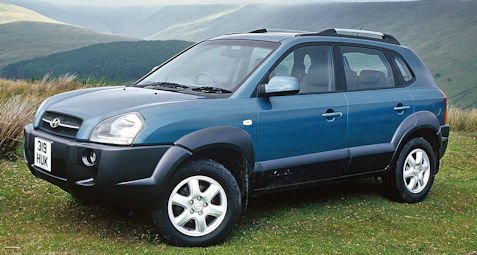
The Hyundai Tucson is an introduced in August 2004 Sport Utility Vehicle of the car brand Hyundai , which was replaced in 2009 by the ix35 .
With a length of about 4.30 m and a list price from 19,890 € (as of August 2008), the Hyundai Tucson is one of the cheap compact SUV. The vehicle was available with both front and four-wheel drive. This shares the technical base with the Kia Sportage . Meanwhile, the cars are sold worldwide under the name Tucson.
There are eight Tucson models to choose the 2.0 16v GSI 2WD to the powerful 2.7 V6 CDX .The Tucson has a monocoque construction sits on a highly modified Coupe platform.
Engines
The 2.0 litre engine, which is a CVVT unit, develops 140bhp@6000rpm, has 184Nm/136 lbs ft of torque on tap at 4500rpm, reaches a top speed of 108mph and performs the 0-62mph run in 11.3 seconds. The diesel version of Tucson, with a new six speed gearbox is especially popular in a segment where more drivers are switching to diesel. It produces 138bhp of power at 4,000rpm, has a torque figure of 305Nm/225 lb ft at 1,800 to 2,500rpm, reaches a top speed of 110mph and does the 0 to 62mph dash in 12 seconds.The top of the range 2.7 V6 CDX has 173bhp on tap at 6,000rpm, delivers 241Nm/178 lbs ft of torque at 4,000rpm and has a top speed of 112mph. Its 0-62mph figure is a competitive 10.5 seconds.the diesel achieving 31.7mpg Urban, 45.6mpg Extra Urban and 39.8mpg Combined. The 2.0 litre petrol variant returns 26.6mpg Urban, 41.5mpg Extra Urban and 34.4mpg Combined.
The 2.0 litre engine, which is the CVVT (continuous variable valve timing) unit as seen in the Coupe, develops 139bhp at 6,000rpm, has 184 Nm/136 lbs ft of torque on tap at 4,500rpm, enough to propel the Tucson to a top speed of 112mph and from 0-62mph in just 10.4 seconds – nearly a second quicker than the four-wheel drive 2.0 litre variant. The two-wheel drive Tucson 2.0 GSI t fuel economy, achieving 42.8mpg Extra Urban, 27.1mpg Urban and 35.3mpg combined.
The 2.7 V6 CDX, which uses the 2,656cc Delta engine seen in the Santa Fe and Coupe. The 2.7 is an all aluminium engine, making it lighter, and uses a three phase variable intake system to improve torque at lower speeds. The 2.7 V6 has 173bhp on tap at 6,000rpm, delivers 241Nm/178 lb ft of torque at 4,000rpm, has a top speed of 112mph and does the 0-62mph dash in 10.5 seconds.
The Tucson comes with either a five speed manual transmission, six speed manual transmission (available on diesel models) or four speed ‘H-matic’ automatic gearbox.The Tucson employs a ‘torque on demand’ four-wheel drive system, developed by Borg Warner. The car runs in front-wheel drive until it detects loss of traction, then the 4WD cuts in. It will then revert to two-wheel drive when adequate traction is detected. Additionally, at speeds up to 21mph, the driver can select permanent four-wheel drive for extra control when required with a button.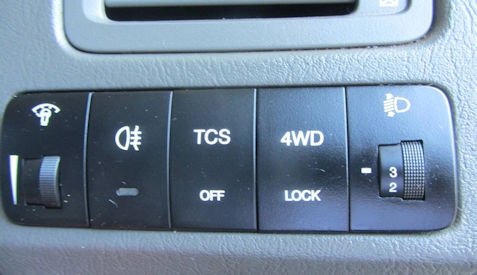
standard equipment feature s air conditioning (climate control on CDX models), electric sunroof, double folding 60/40 split rear seats, CD player, alloy wheels and roof rails.CDX models have in addition: cruise control, leather seat facings, electric heated door mirrors, heated front seats and metal grain centre console.All models feature power steering, air conditioning, electric sunroof, double folding 60/40 split rear seats, CD player, alloy wheels and roof rails.CDX models are also equipped with a front windscreen de-icer. Front and rear fog lamps, plus a high level rear brake light are standard on all models.
Safety
The Tucson has five full three point seatbelts (two in the front, three in the rear) with pre-tensioners to tighten the belt and ensure the passenger doesn’t slide under it. Load limiters on the belt prevent extra pressure being applied to the occupant's torso, thus preventing secondary injuries.
The monocoque body structure uses a high tensile sub frame and has door impact bars to ensure the safety of occupants, features six airbags; front airbag for driver and passenger, side airbags in the front, and also side curtain airbags which deploy from the roof trim. The airbags are depowered, so only remain inflated at the time of impact, and employ a two stage inflator, so deployment of the airbag can be matched to the type and severity of the collision.
All Tucsons have electronically controlled anti-lock brakes as standard as is Traction control which detects when there is tyre slippage, and controls the engine torque and wheel rotation to ensure predictable handling.The five seats have head restraints to prevent whiplash in the event of a collision. The driver’s and passenger’s seat and the two front seatbelts are height adjustable. There are also ISOfix child seat anchors in the rear and child proof door locks as standard across the range.
Interior
All Tucsons are equipped with a stereo RDS radio/CD player with four speakers. A DVD multimedia system is available as an option.
The speedometer, rev counter, fuel and temperature gauges directly ahead cruise control (CDX models) to the right of the steering wheel; the steering is power assisted with a height adjustable column.Electric door mirrors (heated/electric on CDX models), electric front and rear windows, and electric tilt and slide sunroof. CDX models also feature an electric chromatic rear view mirror with in-built digital compass. All models feature an overhead console with sunglasses holder. There are two 12 volt power outlets in the Tucson, one in the front and another in the rear. Front windscreen deicer and heated front seats (CDX models).All models have standard air conditioning (CDX models with climate control).
Front and rear can adjust their head restraints , while the driver’s seat is height adjustable. In addition, both front seatbelts can be altered for height. Leather seat facings are standard on CDX models, and are available as an option on GSI models. The front armrest is height adjustable, while there is also an armrest in the centre of the rear seat. There are a number of cup holders around the Tucson’s interior, in the centre and rear consoles. Front door pockets, and map pockets on the back of the front seats provide even further storage space. The Tucson has a locking glovebox, and a storage tray under the front passenger seat. There is also a storage hook on the side of the front footwell. There is a 60/40 split to the rear seats, and a double folding mechanism for a completely flat floor. There are also seat back hooks on the rear seats.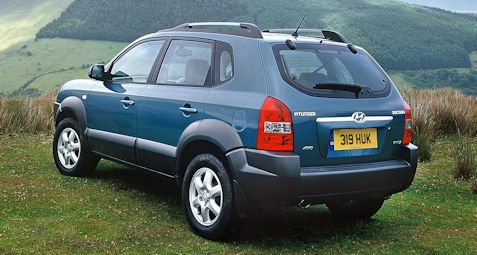
|
Featured
|
|

