
About
Technical
-
Dimensions
Overall length (mm)
4,700
Overall width (mm)
1,860
Overall height (mm)
1,840
Wheelbase (mm)
2,750
Track, front (mm)
1,530
Track, rear (mm)
1,530
Turning circle (m)
11.8
Tyres
BF Goodrich Macadam T/A 255/65R16
Cargo capacity seats upright/down (litres)
1,170/1,955
Fuel tank capacity (l)
75
Weights, measures and angles
WEIGHTS
2.9 CRTD manual
2.9 CRTD automatic
Kerb weight (kg)
2,265
2,255
Gross Vehicle Weight (kg)
2,620
2,620
Max. towing weight, braked (kg)
2,800
2,800
Max. towing weight, unbraked (kg)
700
700
Nose weight (kg)
112
112
Max. roof weight
34
34
Front axle (mm)
225
225
Underbody
216
216
Rear axle
205
205
ANGLES
Approach (degrees)
30
30
Ramp angle (degrees)
22
22
Departure – without towbar (degrees)
25
25
Interior
Length (mm)
1,860
Width (mm)
1,500
Height (mm)
1,245
Leg room – front (mm)
1,050
Leg room – rear (mm)
907
Head room – front (mm)
1,037
Head room – rear (mm)
1,017
Shoulder room – front (mm)
1,487
Shoulder room – rear (mm)
1,472
BrakesSystem, Dual diagonal split circuit, power assisted.
ABS with EBD (Electronic Brakeforce Distribution
Front
16” Ventilated discs with floating callipers
Rear
16” ventilated discs with floating callipers and parking brake mechanism
Suspension
Front
Independent double wishbone with torsion bar spring and anti roll bar
Rear
5 link rigid axle with coil spring and anti-roll bar
Steering
System
Ball and nut steering, power assisted. Energy absorbing collapsible column
Turns lock to lock
3.8
Engines
3.5
2.5 TD
2.9 CRDi
Year of construction
2001–2006
2001–2004
2004–2006
Engine type
V6 gasoline engine
R4 diesel engine
Number of valves per cylinder
4
2
4
Valve control
2 × DOHC, timing belt
OHC, timing belt
DOHC, timing belt
Mixture preparation
Suction pipe injection
Vortex chamber injection
Common rail injection
Engine charging
—
Turbocharger, intercooler
cooling
Water cooling
Engine identifier
G6AU
D4BH
J3 CR
Drilling × Hub
93.0 × 85.8 mm
91.1 × 95.0 mm
97.1 × 98.0 mm
engine
3497 cm³
2477 cm³
2902 cm³
Compression ratio
10.0:1
21.0:1
19.3:1
max. Performance
143 kW
(195 hp)
at 5500 rpm74 kW
(100 hp)
at 3800 rpm110 kW
(150 hp)
at 3800 rpm120 kW
(163 hp)
at 3800 rpmmax. torque
294 Nm
at 3000 rpm240 Nm
bei 2000/min333 Nm
bei 2000/min345 Nm
bei 1750/mindrive
Rear-wheel drive with selectable all-wheel drive
Transmission, standard
5-speed manual transmission
Transmission, optional
4-speed automatic transmission
Measured values
Maximum speed
185 km/h
145 km/h
166 km/h
[164 km/h]172 km/h
[168 km/h]Acceleration, 0–100 km/h
9.5 s
[10.7 s]19.1 s
[20.1 s]13.7 s
[14.8 s]13.0 s
[13.4 s]Fuel consumption over 100 km combined
11.0 l S
[12.1 l S]8.7 l D
[9.1 l D]7,5 l D
[8,6 l D]7,4 l D
[7,5 l D]CO2-Emission
333 g/km
[365 g/km]k. A.
227 g/km
[260 g/km]222 g/km
[241 g/km]Note: Full Specifications and Service Repair Manuals available for registered users
© Motor-car.net
Manuals
Hyundai Terracan
 |
|
|
Production period: |
2001 to 2006 |
|
Class : |
Off Road |
|
Body versions : |
SUV station wagon |
|
Engines: |
Gasoline : 3.5 liters (143 kW) |
|
Length: |
4700-4710 mm |
|
Width: |
1860 mm |
|
Height: |
1790-1795 mm |
|
Wheelbase : |
2750 mm |
|
Curb weight : |
2118-2162 kg |
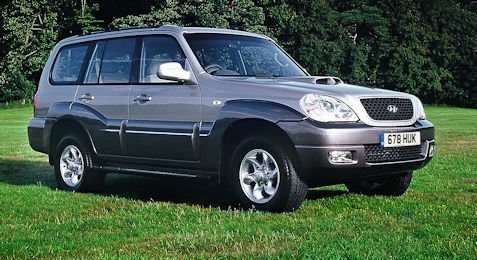
The Hyundai Terracan is a car model built by the South Korean car manufacturer Hyundai from late 2001 to autumn 2006 . It was developed by Hyundai based on the Mitsubishi Pajero (V20) as a medium-sized five-door SUV and was the successor of the three-door available Galloper , which still built on the Mitsubishi Pajero (L040) . Hyundai’s 4x4 capable of talking serious off-road terrain, while retaining a high level of refinement on the road. Unlike the Santa Fe and Tuscon, the Terracan has a body on frame construction and is designed for full off-road use.The ‘can’ part of the name Terracan is derived from ‘khan’ meaning king, while the ‘terra’ means ‘of the land’.
After the Terracan one in September 2004 facelift received, production in South Korea was set in October of 2006. The successor to Europe is the available since May 2009 SUV Hyundai ix55 .
In the People's Republic of China , the Terracan was built under the brand name Huatai-Hyundai until the summer of 2008. As Hawtai Terracan , the model of the Rongcheng Hawtai Automobile in Beijing but still built under license.
The Hyundai Terracan built like his predecessor on a ladder frame . While the rear suspension was designed as a rigid axle , the front wheels were hung individually. Equipment includes: driver and front passenger airbags, anti-lock brakes with electronic brake force distribution, side steps, rear limited slip differential, climate control, electric front and rear windows, electric heated door mirrors, stereo radio/CD player, alloy wheels, remote central locking with anti-theft alarm immobiliser and fog lamps.
Engines
Kia Carnival derived 2.9-liter inline four-cylinder - diesel engine with common rail injection there was also a 2.5-liter diesel engine without D4BH-common rail system. The 2.9 CRTD features a new 2.9 common-rail turbo-diesel engine It is capable of 160 bhp @ 3,800 rpm, and has 343 Nm/253 lb ft of torque at 3,000 rpm. It does the 0-62 mph dash in 13 seconds, and has a top speed of 104 mph.It returns 38.1 mpg on the extra urban run, 25.9 mpg in urban situations and 32.4 mpg combined.
A 3.5-liter V6 gasoline engine (G6AU) with 143 kW (194 hp). Both are modified licensed designs of Mitsubishi engines. The Haw Tai Terracan received a 2.4-liter four-cylinder (4G64) instead of the smaller diesel directly from Mitsubishi .
Transmission
There are two transmission options for the Terracan; five speed manual or four speed automatic. The Terracan uses a system called Electrical Shift Transfer (EST) developed by Borg Warner, which allows drivers to change between high ratio four-wheel drive and two-wheel power transmission was either via a five-speed manual or a four-speed automatic transmission to a transfer case with reduction . While the four-wheel drive could only be switched rigidly, other versions had either an electronically controlled multi-plate clutch, which automatically controlled the power distribution.The Terracan features part time four-wheel drive, with a ‘shift on the move’ facility which allows the driver to switch between high ratio four-wheel drive and two-wheel drive at speeds of up to 50 mph. There is also a low ratio four-wheel drive setting.There is also a low ratio mode in four-wheel drive, which generates maximum traction for slow manoeuvring in poor conditions. The car must be stationary to transfer between high and low ratio four-wheel drive. These three settings can be chosen via a dial near the parking brake.
Instead of having a freewheeling hub, the Terracan uses a Centre Axle Disconnect System (CADS) to switch between two-wheel drive and four-wheel drive using the engine’s negative pressure. The CADS system also prevents noise and vibration from the propeller shaft and gear ring set, as the front wheels and axle would be rotating idly in two-wheel drive mode. When in four-wheel drive mode, the power is transferred 50/50 between front and rear. In two-wheel drive mode, the power transfers to the rear wheels completely.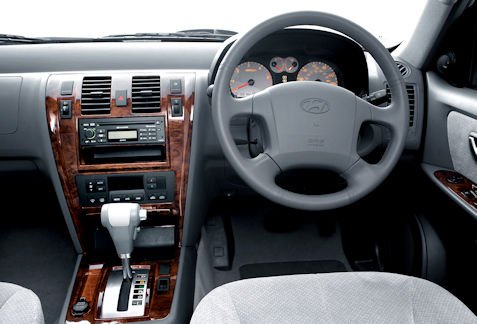
Inside
The main instrument binnacle, with speedometer, rev counter, fuel and engine temperature gauges contained within. Between the speedo and rev counter is the main bank of warning lights.steering is power assisted is the centre console containing the radio/CD unit and climate control panel. The climate control allows the occupants to set the exact temperature in half degree units to the cabin. The unit also displays the ambient (outside) temperature.Other switchgear is conveniently located in the centre console, such as the hazard warning lights, headlamp levelling switch and dashboard illumination dimmer.
Stalks either side of the steering wheel contain the controls for lights, windscreen wipers and indicators.By the handbrake the rear wash/wipe, and the dial for transfer between high and low ratio four-wheel drive and two-wheel drive. A 12 volt power outlet is located at the base of the centre console.
Electric window controls are placed in the armrest for each door. The driver’s door has controls for all four windows. The driver will find above the rear view mirror controls for the map reading lights.The steering column is adjustable for height, while the driver’s seat is adjustable for lumbar and height. Front seat head restraints are adjustable, as are front seat belts for height.There are also a number of grab handles to assist in entry to the vehicle.
There is a single cup holder at the base of the centre console, as well as wide and deep door pockets. There are also pockets on the back of the front seats.In the boot area there is a second 12 volt power outlet, and a load cover for keeping small items in place. The rear seats are split 60/40 and can be folded individually.The radio aerial into the rear window heating element.
Safety
The co-joined body/frame construction means crash energy is dispersed evenly across the car’s length. Terracan’s single piece bumper unit has a chassis-mounted steel back beam to provide better protection to the vehicle’s structure and its occupants. In addition the specially reinforced cowl/A-pillar bond helps reduce the risk of cabin deformation in the event of a collision.There are ten mountings attached to the frame, while there are side member reinforcements to make the structure even more secure.
To ensure body stiffness, Hyundai use high-tensile strength steel body mountings, added to centre-cowl bulkhead, front door vertical cross members, a horizontal backbone and rear floor lattice-type members.
The Terracan comes with seatbelt pre-tensioners as standard. The instant a collision takes place, the seatbelt pre-tensioner reduces seatbelt slack to hold the occupant in place. The load limiter absorbs any extra energy placed upon the occupant when the pre-tensioners are activated. Driver and front passenger airbags are standard, which are depowered to reduce the risk of injury.
The Terracan other features to enhance safe vehicle handling. Anti-lock brakes combined with electronic brake force distribution (EBD) provide better stability and shortened braking distances through the large capacity two port calliper front brake discs. This system provides the most effective distribution of brake force based on the vehicle’s weight.Stability is further provided by double wishbone front and five-link coil rear suspension combined with a wide wheelbase.
Limited slip differential on the rear axle means efficient and safe traction under any road conditions. It transfers driving torque to the wheel with the best traction, thus improving stability in icy or wet conditions.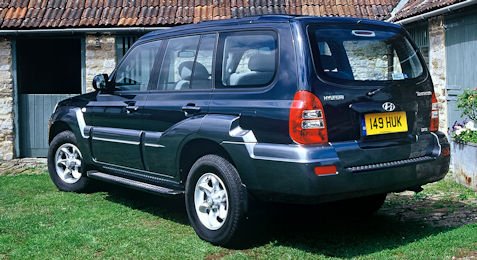
|
Featured
|
|

