
Britain
- Details
- Parent Category: Motor car History
- Category: Britain
Fergus Engineering
Automotive Manufacturer of Kingsbridge , Devon; United Kingdom from 1986 to 1999

Fergus Engineering was a British manufacturer of replica automobiles in the 1980s and again later in the 1990s . The brand name was Fergus .
History
The tiny Devonshire firm of Fergus Engineering is one of those rare enterprises who survived almost exclusively on word-of-mouth business.
1986 Robert Kennedy Ping founded the company in Kingsbridge in the county of Devon . There he started producing automobiles and kits . In total, more than six copies were created.By 1987 ended production. AIMS from the same place under the direction of Charles Smith took over the project in 1991, but did nothing. Projects of Distinction from Redditch in Worcestershire , led by Bob Lewis, continued production from 1992 to 1999 while maintaining the brand name.
First, there was the model Wren . This was a replica of the Aston Martin Ulster and only available as a complete vehicle.
With the Mosquito, a new model, the company has at last been gaining national interest. Designed as a very close copy of the 'thirties Aston Martin Ulster , Fergus' Mosquito will cost you £8,500 fully built and will include a tough box section chassis into which a Morris Marina 'B' series engine can be installed. The thick GRP main body section is supplemented by aluminium bonnet, side panels and valance. The sharp rear end hinges up for access to the boot and spare wheel whilst at the front' Morris Minor springs act as dummy replica front suspension! Though hardly a car to appeal to the mass market, there can be no denying that to the diehard original examples of which sell today for enthusiast the Fergus Mosquito Offers a to an earlier, altogether more glorious, motoring era.
Top speed 100 mph- 0-60 mph 11.5 seconds - BHP 94 - Engine 1798 CC 4 Cyl
- Details
- Parent Category: Motor car History
- Category: Britain
Hutson Motor Company
Automotive manufacturer of Rothley , Leicestershire.Great Britain from 1986 to 1999

Hutson Motor Company Limited is a British company in the kit car automotive and automobile manufacturer .
History
Maurice Arthur Hutson launched the company in Bradford, West Yorkshire, on April 8, 1986. Janet Hutson and his son Mark Andrew Hutson are also directors. They began producing autos and kits after adopting the Naylor Brothers model. Hutson for complete automobiles and Mahcon for kit cars were the brand names. The production of automobiles ceased in 1999. A total of 61 copies were produced. The company relocated to Leicester in Leicestershire on January 27, 2006, and to Rothley in Leicestershire on January 23, 2008.
On offer was the model 1700 TF . It was the replica of the MG TF from the 1950s . The base was a special chassis. In the original cars many parts came from the Morris Ital , for the kits also from the Morris Marina .Later cars adapted for more modern parts with better road holing and safety.Special and limited editions also avaliable.
Produced as the Naylor T F until the Hutson Motor Company assumed control of the project in 1986, this beautifully crafted replica of the MG T F is enjoying a new lease of life from a company already heavily engaged in vintage car restoration. The Hutson can be regarded as an update of the '50s MG, with wishbone/ coil front suspension, Morris Ital rear axle and 'O' series engine and such modern fitments as rocker switches and recessed door handles. Otherwise, the T F is handbuilt in the traditional way with its sheet-steel- over-ash frame bodywork and beaten steel wings. The T F has passed all UK crash tests, enabling it to be sold in fully-built form. It is fitted out most luxuriously in leather trim with a polished walnut fascia, a new M16 engined version with Rover 820 Si power is planned. A kit version, called the Mahcon T F, can also be specified.
Top speed 105 mph-Torque 93- Engine 1698 CC 4 CYL

- Details
- Parent Category: Motor car History
- Category: Britain
E.R.F. Ltd.
Commercial vehicles manufacturer , Sun Works, Sandbach, Cheshire, England.GREAT BRITAIN

ERF was a British truck manufacturer first established in 1933 by Edwin Richard Foden, from whose initials E.R.F. come from
the company closed in 2002, and it was discontinued as the ERF name by MAN later in 2007.
History
The first E.R.F., the model CI 4, debuted in 1933, and was followed by the model CI 5, which included a Gardner 4LW diesel engine and hydraulic vacuum servo brakes. During the years 1933 and 1934, these two chassis were developed as platform and tipper vehicles.
In 1935, six- and eight-wheeled chassis were launched, with Gardner 4LW, 5LW, and 6LW engines. In 1937, ERF launched the world's first twin-steered, six-wheeled vehicle, and in 1938, all versions received a streamlined cab. The annual production pace had risen to 480 automobiles.
war years
During the war years a slightly modified version of the CI 4 was in production for the Ministry of Supply and in 1942 the A.E.C. 7.7 litre engine was offered as an alternative to the Gardner. 1943 saw the production of the first E.R.F. tractor units built for the Forestry Commission.
A Lockheed continuous flow braking system was introduced in 1948 together with the V-type driving cab. Full hydraulic, air-assisted braking was made
available in 1954 and the KV type cab appeared. Rolls Royce engines were first used during this year, in the model 66R tractor.
Powered steering was introduced in 1958 and in 1960 Perkins engines were used for the first time. The 88R with a Rolls Royce petrol engine appeared in 1962 and the American Cummins diesels were first used during this year.
ERF was also marketed under the Western Star badge in some countries that later brought the company by the mid-1990s by 2000, ERF became part of the MAN group.

- Details
- Parent Category: Motor car History
- Category: Britain
GARNER MOTORS Ltd
Commercial vehicle manufacturer of Birmingham;United Kingdom From 1908 to 1968

Garner Motors Limited a early commercial vehicle industry for 60 years from 1908 to 1968 Henry Garner, was the founder.
In 1907, Henry was an automobile salesperson who specialised in Argylls and Humbers. Herbert Berger Graham founded the Moseley Motor Company Works Limited in the same year. In 1908, Henry made an offer to Graham to buy the Moseley Motor Works. Garner began his automotive career by securing a highly successful deal with the Austin Motor Company to handle its Midlands sales.
The name of the company was changed to Henry Garner Limited from Moseley Motor Company Works Limited. Garner realised there were enormous potential ahead in the commercial vehicle business at the start of WWI, and in order to sell as many trucks as possible, he received an order for 200 Vulcans from an outside country. Unfortunately, no British vehicles are available to fulfil that order, so Henry Garner travelled to America in the hopes of finding another vehicle to purchase as a substitute.He found a source, but would never reveal the name of the American manufacturer. Henry Garner would obtain orders for trucks and import them from the USA selling them with the 'Garner'badge on the front of the radiator as Garner commercial vehicles. The range was; two, three, four and six tonners all powered by a well known Continental petrol engine.
At the end of the war Henry Garner continued to import his trucks and was doing well.in 1924 a re-designed 2 tonner appeared, of light construction, with forward control.Then came the Garner built in England in 1925, although it was to use well known components such as Kirkstall axles and David Brown gearboxes, Thompson made the frames, all assembled with the Dorman 2Shp, petrol engine. Garner had now moved to a new factory at Kings Road, in Birmingham.
In early 1927 the business was transferred from Henry Garner Limited to a new company of Garner Motors Limited. This left the old company to concentrate on selling cars of various makes.2 and 3 ton capacity payloads trucks were the main production, including municipal vehicles operating on small wheels with solid tyres. The operator had now the choice of a normal control or a forward control chassis with both four or six cylinder petrol engines.
In 1929 Garner built a six wheeler to War Office specifications with a payload of tons, Whilst most of their chassis were produced with Dorman petrolengines, there was an increasing number being powered by the Meadows 4EL petrol engine.
1931 introduced a six cylinder petrol engined 2 tonner, a 3 ton six wheeler with a single drive rear axle and the rearmost axle trailing, and a low loader 3 tonner for municipal operation.
1934 came and the interest shown in Garner Motors Limited by Sentinel Wagon Works Limited came to fruition and it was then that Sentinel announced that the production of Garner commercial
vehicles would be built at Sentinel works in Shrewsbury in the future. The result of this so called merger was a new range of vehicles, the 'Sentinel-Garner'.New sources of supply of engines appeared, that of the Austin and the Perkins Leopard diesel. The range advanced to three, four ton four wheeled vehicles and5 ton six wheelers. Whilst Sentinels were in difficulties and were trying to find a solution, Garner was to continue under its own name and companymanufacturing within the Sentinel works on a rental basis. 1935 found Garner Motors Limited also in financial troubles, and the receiver was called in.
Several businesspeople and Chrysler employees saved Garner, raised funds, and purchased a new factory in Acton, London. Thompson frames, Kirkstall axles, Woodhead springs, Meadows petrol engines and gearboxes were all being constructed once more. Several unusual four-wheel-drive military vehicles were created, each powered by two Ford V8 petrol engines mounted side by side and driving the front and rear axles through a transfer box and gearbox. The second world war broke out, and while the Ministry of Supply placed multiple orders for the Garner G3, construction of the four-wheel-drive military truck chassis was slow. As a result, Garners was redirected to the production of trailers, torpedo compressors, generator sets, and other items. Garner has manufactured and delivered over 10,000 truck bodywork for a variety of applications.
It was after the war when undecided which way to re-start civilian operations Garner eventually turned to the manufacture of truck bodies, although they did develop and build agriculturaltractors and towing tractors. Eventually the body side was acquired by Hawes & Company the body builders, forming the Hawson Garner.
1968 found the company in a position where it could no longer trade and it went out of business. It has been thought in the past that if Sentinel had shown moreinterest in the Garner concern they might have survived, one can never know.

- Details
- Parent Category: Motor car History
- Category: Britain
Larmar Engineering Company Limited
Automotive Car manufacturer of Ingatestone, Essex United Kingdom From 1946 to 1951.
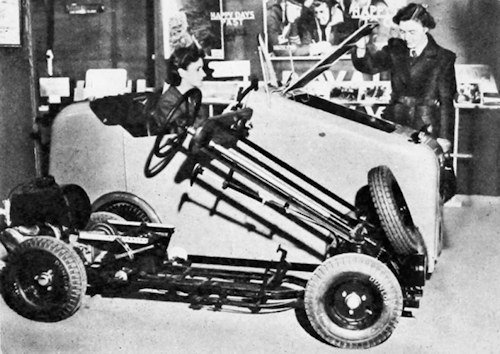
Larmar Engineering Company Limited is a British company in the mechanical engineering and former manufacturers of automobiles . The brand name was Larmar .
History
Mr. Larcombe founded the company in Ingatestone in 1919 . On July 9, 1942, it became a Limited company. After the war in the summer of 1946 began production of automobiles. By 1951 ended the car production.
The cas on offer included microcars that were specially designed for the physically disabled, especially useful after the world war.
The vehicles were small only 80 cm wide. The body was light and made of plywood and aluminum . It had a side door, a seat, windscreen and hood. A small single cylinder - two-stroke 2 and a half horsepower engine of BSA with 249 cc displacement and 8 PS performance was mounted in the rear, driving through a chain of one of the rear wheels the car was meant for local use only with only a 35mph top speed but 65 miles per gallon range. By 1949 the Model B was introduced this now larger car, eight inches wider to accommodate a folded wheelchair.From 1950, a two-cylinder four-stroke engine with 350 cc and 10 hp was available.
There was also a small commercial vehicle the model Lorret . This van had a 490 cc engine.