
Britain
Team Modena (Modena Wycombe Ltd)
Automotive manufacturer of High Wycombe, England;United Kingdom From 1975 on.
Modena Wycombe Ltd. (Team Modena) is a car workshop and a car racing team in High Wycombe, England . The family business was founded in 1975.
History
Modena Wycombe is engaged in the sale and maintenance of high quality sports cars and supercars. The Modena team is independent in the Le Mans Series in which it competes with an adapted for the class "LMGT1" Aston Martin DB9 .
For motor sports, the company manufactures accessories, such as carbon fiber , itself. Based on their experience in this area, companies such as McLaren , Alfa Romeo , BMW and Yamaha also worked together with Modena Wycombe.
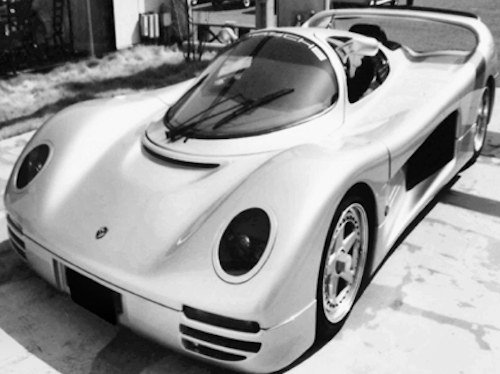
In 1994 Modena Wycombe built the Schuppan 962CR under the direction of the Australian racing driver Vern Schuppan . A Japanese car dealership acted as lender, because Schuppan was successful especially in Japan.The Schuppan 962CR is a street-legal super sports car based on the Porsche 962 racing car , from which only the engine was taken over largely unchanged. Only six examples of the extraordinary vehicle were built, with a list price of 1.5 million US dollars. Other sources even speak of 2.5 million US dollars, which would have made this vehicle one of the most expensive new cars of its time.
After the payments for two cars delivered to Japan failed to materialize and the total costs of the project exceeded the proceeds, Schuppan had to file for bankruptcy. The "962CR" remained the only car designed by him.
R.L.T. (Real Life Toys)
Automotive Car manufacturer of Sheffield , South Yorkshire;United Kingdom From 1991 to 1995.
Real Life Toys was a British manufacturer of kit type automobiles in the 1990s .The brand name was RLT
History
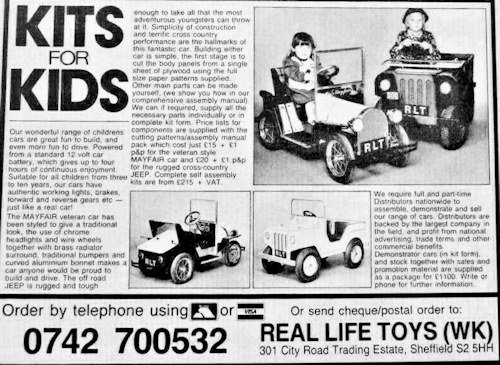
John Cowperthwaite founded the company in 1991 in Sheffield , Co. South Yorkshire . They started producing automobiles and kits with also miniature electric cars for kids The cars have authentic working brakes. Forward and reverse gears etc just like a real car . White Rose Vehicles continued production under its own brand name. In total, about 100 copies were made. By 1995 ended the production
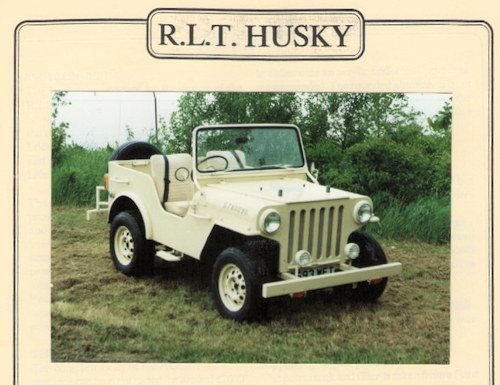
One larger size model was called the RLT Husky . This was in the range from 1991 to 1995 and was similar to the Willys Jeep .Unusual was the body was made of MDF type wood . Many parts came from Ford cars from the time.
The company also presented the 1991-1992 Midge brand Midge .
GRD (Group Racing Developments)
History
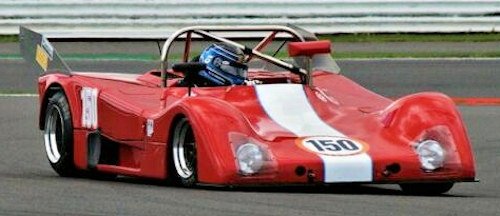
GRD began as a subsidiary of the Norfolk Light Engineering Company in 1971. Formula 3, Formula 2, and Formula Atlantic cars. GRD, unlike its competitors, did not have a permanent factory team. GRD was a precursor of Van Diemen, a racing vehicles . Lotus, one of the most successful racing car manufacturers in the 1960s, withdrew from Formulas 2 and 3 in 1971, prompting the formation of the team.
The GRD founders expected that the remaining manufacturers March Engineering and Lola Cars would not be able to cover the demand for new racing cars alone. GRD should therefore close the gap left by Lotus. GRD has acquired many former Lotus employees, including Mike Warner, Dave Baldwin and Derek Wild. From Huron also came the designer Jo Marquart. Regardless, GRD received no factory support from Lotus. In 1972, Lotus factory driver Dave Walker secretly performed test drives for GRD. After this became known, Walker was suspended by Chapman for a Formula One race.
During the year 1974, the economic situation of the company deteriorated. The projected sales figures for 1975 led to a further negative development. In November 1974, GRD then stopped the production of new vehicles. Three previous employees took over the business. A constructed by them racing car was sold in 1975 to Van Diemen. In 1975, the company offered a few kits. At the end of the year, the operation was closed.
Formula 3
GRD's Formula 3 vehicles have been successful at times. 1972 ruled Roger Williamson with a GRD of Tom Wheatcroft Racing, the British Formula 3 Championships . In this class, three separate championships were held in 1972. Williamson participated in all championships. He won the Shell Super Oil British F3 Championship with 78 points and a lead of 34 points to runner-up Colin Vanderwell . The BARC Forward Trust British F3 Championship won Williamson two points ahead of Opel's Rikky , in the BRSCC Lombard North Central British F3 Championship Williamson finished fourth.By 1973 and 1974, the company could not build on the successes of 1972. GRD attributed this to the lack of performance by Renzo Zorzi .
The following vehicles were created for Formula 3:GRD 372,GRD 373,GRD 374 and GRD 375
Formula 2
The Formula 2 GRD were less successful than the Formula 3 models. Tom Walkinshaw , Tetsu Ikuzawa and Hiroshi Kazato drove in 1972 a GRD 272 for the GRS team, which was independent, but received factory support. They did not score points. In particular, Ikuzawa repeatedly had difficulty qualifying for the races.In 1973, three teams used cars from GRD. Roger Williamson started for Tom Wheatcroft Racing with a GRD 273. He played the first five rounds of the championship. He did not finish in the points in any race, his best result being eighth in the Jochen Rindt Memorial Trophy at Thruxton . Wheatcroft's involvement ended after Williamson's fatal accident killed in a Formula One race in the Netherlands . Other GRD teams included GRS, DART Racing and the Swedish team Pierre Robert from Reine Wisell . In addition, some private drivers used GRD cars, including Jo Vonlanthen . From 1974 GRD no longer appeared in Formula 2.
Formula 2 vehicles from GRD:GRD 272 and GRD 273
Formula Atlantic
In 1972, GRD converted two copies of the 272 according to the regulations of the Formula Atlantic. Martin Watson drove one of the cars in six of the 24 rounds of the British Formula Atlantic Championship . His best result was sixth at the race at Brands Hatch on April 16, 1972. David McConnell drove the car once, as did Roger Williamson, who finished sixth in the final race of the season, also held at Brands Hatch. 1973, Tom Walkinshaw drove a modified 273. His best result was sixth place at the Mallory Park race on June 24, 1973. Other GRD drivers were Bev Bond andRobin Smythe ; the latter drove a revised 372, d. H. a Formula 3 car from 1972. Also in 1974 appeared a few cars of GRD in Formula Atlantic; most prominent driver was Dave Walker.
Ranger Automotive Company Limited
Automotive Car manufacturer of Essex United Kingdom From 1972 to 1982.
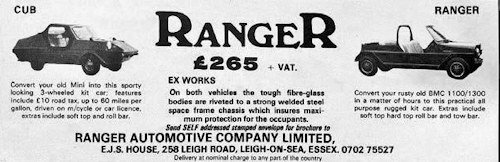
Ranger Automotive Company Limited was a British manufacturer of kit car type automobiles in the 1970s and 1980s . The brand name was Ranger .
History
Eric Salmons operated the used car trade EJS Products in Romford . In 1971 he started producing cheap kit type automobiles there .
In 1972 Salmons founded the new Ranger Automotive Company at Leigh-on-Sea near Southend-on-Sea in Essex and continued production. 1976 ended production. By 1982, the company was dissolved.Ranger Limited of Llangefni , Wales revived the project between 1984 and 1985. In total, about 500 copies were created.
The Model 80 was on offer throughout the production period. It was inspired by the Mini Moke . A spaceframe frame formed the base. Many parts such as front and rear subframe, windshield , dashboard , seats and headlights came from the Austin 1100 1300 . In addition to open and closed bodies options, there was also a pick-up .This model created about 303 copies.
The 1974 The Cub was a three-wheel tricycle with rear single wheel. It was based on the mini with steel spaceframe. In the first sales year, there were 20 buyers, in the second and last year of production after a revision in 1975 another 180 buyers with a low road tax bracket. A vehicle for testing purposes was also fitted with a electric motor .
The Cub 4 , a four-wheeled version of the Cub as a pick-up created between 1975 and 1976, only four copies. John Thomas, who previously worked at Broadspeed , presented in 1975 the Cub 6 , a six-wheeled version of the Cub 4 , which, however, remained a unique piece.
The Jeep was a recreational car based on Austin 1100, appeared in 1976 and also remained a prototype .
MC Kit cars (Mark Clarkson)
Automotive Car manufacturer of Sheffield,South Yorkshire;United Kingdom From 1984 to 1995.

MC was a British kit car brand made from the mid 1980s to the mid 1990s . The brand name was MC .
History
Mark Clarkson, his wife Joy Clarkson and Phil Booth founded the MC Cars business in Sheffield in South Yorkshire in 1984 . They started with the production of automobiles and kits . Carlton Automotive of Barnsley , South Yorkshire continued production from 1989 to 1995.
The last to be made in 1995 was by Ian Birks Car Care from Sheffield. In total, eight copies were created.
The main model was the Acer sports car . This car resembled the light Turner Sports of Turner Sports Cars from the 1960s.
The base of the car was a chassis made of steel . On it a body made of fiberglass was mounted in the kit car fashion. The open car offered either space for two or 2 + 2 persons.
Various make engines used such as the four-cylinder pinto and crossflow engines from Ford Escorts , Vauxhall Viva , Hillman Avenger , Datsun 120 Y , Morris Marina , Triumph Spitfire and Triumph Dolomite also powered the vehicles.
