
Britain
Bushbury Electric History
Founded Wolverhampton in 1897

The Bushbury Electric was an English automobile manufactured by the Star Cycle Factory of Wolverhampton in 1897. An electric car, it came in three- and four-wheeled models, some of which were controlled by reins. Power was provided by two large three-speed electric motors placed under the seat; also under the seat was the location for the battery. The vehicle's range was limited
1896 Thomas Hugh Parker, son of Thomas Parker, has been credited with the design and manufacture of "E.C.C.'s most famous motor car - the Electric Dog Cart of 1896". The car was entered in a race for self-propelled road vehicles, from the Crystal Palace to Birmingham, organised by 'The Engineer' magazine but only five runners turned up at the start, so the event was cancelled but the car was highly commended. This is presumed to be the vehicle for which the running gear was made by Star Cycle Co. E.C.C. experimented with prototype cars for a number of years, with the idea of producing cars commercially but no further prototypes were built
1897 One of 4 companies which offered vehicles for trials organised by the Engineer magazine at Chelsea .
1898 South Staffordshire Tramways Co had been experimenting with a system of "auto-traction" for 2 years but the system had proved a failure so the operations continued to use steam engines. An agreement between Electric Construction Co and South Staffordshire Tramways Co (June 1897) had been reassigned to British Electric Traction Co (successor to British Electric Traction Pioneer Co) and had been completed.
1899 The company was registered on 29 May, for the purpose of supplying all kinds of electrical machinery for lighting, traction and other purposes.
1900 June. Tramways and Light Railways Exhibition at Islington. Showed variable ratio transformers and tramcar motors.
1914 Manufacturers of all kinds of electrical plant, including dynamos, motors and switchboards
1937 Manufacturing electrical engineers
Post WWII: a separate factory was built in Shaw Road for the manufacture of transformers, and later included a rectifying plant.
1959 Two associate companies - E.C.C. (Moulded Breakers) Ltd, and Federal Electric Ltd, were set up in a factory in Fordhouse Road, Wolverhampton, to manufacture a range of medium voltage switchgear for electrical distribution in industry, commercial buildings, hospitals, shops and flats. Production began in 1959. These included fuse switches and moulded case air circuit breakers.
1960s Over 2000 people were employed, producing medium and heavy electrical equipment including motors, generators, control gear, rectifiers and transformers, and components for the communications industries.
1961 Electrical engineers, manufacturing all kinds of rotating electrical machinery, static transformers, rectifiers, switch and automatic control gear
1968 Supplied batteries and rectifiers for the Winfrith power station
Late 1960s and 1970s brought considerable competition from cheaper foreign components. The E.C.C. were taken over by South Wales based Aberdare Holdings who manufactured modern truck and metal clad switchgear.
Became part of the Hawker Siddeley Group
1985 Closed in September, 1985. The works were demolished in 1986.
Busbury Dog Cart
The Electric Construction Company's dog-cart was designed to carry two persons seated side by side. The motive power was derived from accumulators. It could travel at up to 12 mph on a level tarmac surface. The accumulators would carry it no more than twenty miles without re-charging. There were two driving wheels, and one steering wheel in front. The two-pole motor was geared by means of a Renold chain to the driving axle. The switch gear consisted of a reversing and a controlling switch, placed under the driver's seat, the former manipulated by a vertical lever on the right; the controlling switch allowing several different arrangement of cell connection. The reversing facility could be used for checking the speed of the cart on long descents.
The motor is carried by a frame, articulated at one end to the road axle-bearing cases and at the other end slung by an elastic attachment to the under stde of the foot board.
In working, the distance between the motor and road axles could be adjusted to compensate for wear in the chain. The driving wheels were 39in. diameter and the steering wheel 45in., made of steel with solid rubber tires.
The motor bearings received continuous lubrication from an endless chain dipping into a reservoir of oil. The motor was series-wound, with a slotted armature, drumwound, with Eickemeyer coils and used carbon brushes. The accumulators were of the Faure-King type, manufactured by the Electrical Power Storage Co Ltd, in total 40 cells, total weight about 5 cwt. The rated capacity was 40 ampere hours at a discharge rate of 5 amps. Terminals were provided for charging them in place, for which current at 100 volts was required. They required about 7 hours to re-charge.

Marauder Cars History
 |
|
| Manufacturer | Marauder Cars |
|---|---|
| Production | 1950–1952 15 made |
| Body style | 2-door convertible 2-door coupé |
| Engine | Rover 2103 cc straight 6 (A model) 2392 cc (100 model) |
| Transmission | 4-speed manual with optional overdrive |
| Wheelbase | 102 in (2591 mm) |
| Length | 166 in (4216 mm) |
| Curb weight | 2,576 lb (1,168 kg) |
| Designer(s) | George Mackie, Spencer King, Peter Wilks |
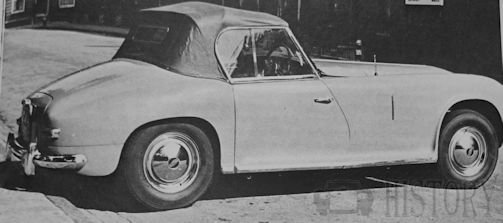
The components it used, and the personalities behind it. The Marauder story actually began with the formation of Wilks, Mackie & co. in 1950, though the thinking behind it dates back to the Rover special racing car. This had been designed on a real financial shoestring by Peter Wilks, Spencer King and George Mackie, all of whom worked for Rover. Having succeeded with this car, the three decided to set up their own company.
King opted to stay with the Rover concern (he is now Deputy Chairman of B.L. Technology), while Wilks and Mackie left to design the new car. As they all had had a great deal of involvement with the birth of the new P4 Rover 75 luxury saloon, it was decided to build the Marauder around that car's chassis and running gear, and to evolve a sporting tourer body in which some 75 body panels would also figure. If the Marauder, therefore, reminds the reader of a Rover 75 with its roof chopped off and the bonnet lengthened, he should not be at all surprised. Mechanically, in fact, there were many minor differences, including the use of a separate remote control gearchange and the fact that the engine/transmission assembly was moved back along the chassis, but one major change was that the wheelbase itself was shortened from 9ft. 3in. to 8ft. 6in. Initially, the car was to be assembled at Dorridge, near Birmingham, in the premises of Richard Mead's body-building factory, and this concern was also responsible for the first four bodies; Abbey Panels of Coventry built the rest, which were unfortunately somewhat heavier than the originals, which did nothing for the performance.
The Marauder, in truth, never achieved the sales its sponsors had hoped, and in later years they also admitted to persistently underpricing the machine to generate more interest. A move was made from Dorridge to new premises in nearby Kenilworth at the end of 1951, but it was all too late, as no profits were being made. Rapid price increases could do nothing, and the firm closed down in 1952. Peter Wilks and George 1952 Mackie both eventually returned to work at Rover, where Peter Wilks eventually became technical director, responsible among other products for the P6 Rover 2000, and with overall responsibility for the Range Rover, but there was never another attempt by the trio to build a replacement for the Marauder.
Specification
Engine and transmission: Six-cylinders, in-line, with pushrod operated overhead inlet, and side exhaust, cylinder head, built by Rover. Bore, stroke and capacity
65.2 x 105mm., 2103cc. Maximum power 80bhp (net) at 4200rpm.; maximum torque 1101b.ft at 2500rpm. Four-speed manual gearbox with freewheel or optional Laycock overdrive, in unit with engine. Spiral bevel final drive.
Chassis: Front engine, rear drive. Separate pressed-steel chassis frame, with box section sidemembers. Independent front suspension by coil springs and wishbones. Worm and nut steering. Suspension of rear live axle by half-elliptic leaf springs. Frontand rear drum brakes.
Bodywork: Coachbuilt, in steel and some light-alloy panels, in two-door two/three-seater open sports tourer style. First cars by Richard Mead, others by Abbey Panels of Coventry. Length 13ft. 10in.; width 5ft. 6in.; height 4ft. 6in. Unladen weight 28851b. (31001b. with Abbey Panels bodyshell).
Performance: (Early car): Maximum speed 89mph. 0-60mph 18.4sec. Typical fuel consumption 24mpg.
Note: From spring 1951, there was also a '100' specification, in which the engine was enlarged to 2.3-litres and given a triple-SU carburettor layout. One car was built like this, and a further example was subsequently converted.
Evante car history
Spalding, Lincolnshire UK

 |
|
| Manufacturer | Evante Cars Ltd Fleur de Lys Automobile manufacturing |
|---|---|
| Production | 1983-1994 |
| Class | sports car |
| Body style | 2-door convertible |
| Layout | FR layout |
| Engine | 1.6 or 1.7 L straight-4 Vegantune 1.8 L Ford Zeta |
| Transmission | 5-speed manual |
| Wheelbase | 2,140 mm (84.3 in) |
| Length | 3,720 mm (146.5 in) |
| Width | 1,490 mm (58.7 in) |
| Height | 1,130 mm (44.5 in) |
| Curb weight | 720 kg (1,587 lb) |
The Evante is an English automobile which began production in 1987 in Spalding, Lincolnshire, England. Engine tuning company Vegantune had been restoring Lotus Elan cars and making some improvements to them. They decided to build a complete new car and set up a separate company, Evante Cars Ltd, to make them.
The car's looks were heavily inspired by the Lotus Elan and it was powered by the Ford Kent based Vegantune VTA 1.6 and later 1.7 litre twin overhead cam engine 170 bhp with twin Dellortos carburetors driving the rear wheels through a 5 speed gearbox and diff originally from a Ford Sierra. The fibreglass body and carbon-fibre was mounted onto a space frame chassis with independent double wishbones suspension all round. Disc brakes were fitted front and rear. The car was also fitted with a Ford Zetec 1.8 Litre engine .
Fitted with Vegantune's DOC four-cylinder engine driving the rear wheels through a five-speed gearbox and a Ford Sierra differential unit, it is also quicker than the legendary Elan Sprint S4 and sports fine handling and roadholding. Its interior benefits from modern design thinking and is both spacious and unexpectedly comfortable. The car was fully built in limited quantities.
1.6L Top speed 138 mph - 0-60 mph 6.1 seconds - BHP 140

The cars were intended to be available as either complete or in kit form but all cars were supplied fully built and were produced at a rate of about one a week. The bodies were well fitted out with leather seats, walnut dashboard and electric windows. Modern twist on the original Elan using electric pop up headlights rather than vacuum headlights on the original. and VDO gauges. keeping a more accurate account.with switch gear from the mk4 Ford escort of the time.

Production stopped in 1991 when the original company failed but the design was bought by Fleur de Lys who specialised in making retro styled vans.
An attempt was made to revive the car in 2001, but this was unsuccessful.

Land Master car history
St Dennis, Cornwall UK

The Land Master is a civilian all-terrain utility vehicle produced in the late 1970s and early 1980s as a competitor to the Land Rover.It incorporated design features that were not then available on the contempory Series 3 and were only introduced some years later on the Land Rover Defender.
It was tested by the British Army and was actually used by the Devon and Cornwall Constabulary. Money was promised by the Ministry of Defence but the deal fell through. Eventually, the rights to the Land Master were sold to a company called C.K. Farnworth of Crumlin, Caerphilly, Wales.
The prototype vehicles were made at Trelavour Road Garage, St Dennis, Cornwall, and were based on Dodge pickup truck parts. The chassis was made of tubular steel so that when it went over bumps and steep angles, dirt on top of the chassis rails would fall off, unlike Land Rovers of the time.
Surviving vehicles are very rare, at least one Land Master is still on the road in use in Kent, England, and another is kept by the original builders at St. Dennis.
Engines available included a 3.8 L Perkins diesel I4 rated at 82 bhp (61 kW; 83 PS), a 4.0 L Perkins diesel V6 rated at 101 bhp (75 kW; 102 PS), or a 5.9 L Chrysler petrol V8 rated at 170 bhp (127 kW; 172 PS).
Land Master prototype on trial in cornwall

Tourette Car history
London, England From 1956 to 1958.
| Manufacturer | Progress Supreme Co Ltd. |
|---|---|
| Production | 1956–1958 (26 produced) |
| Class | Microcar |
| Body style | Roadster |
| Engine | 197 cc |
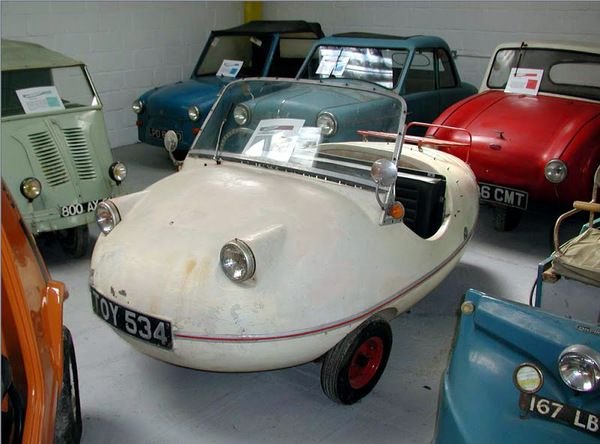
The Tourette was a microcar by Carr Brothers (later Progress Supreme Co Ltd) of Purley, London, England between 1956 and 1958.
It had a three-wheeled, rounded body that was available either in alloy on an ash frame, or in fibreglass. The car was powered by a two-stroke 197 cc Villiers engine driving through a four-speed gearbox with optional Dynastart reverse. Top speed was claimed to be 55 mph (89 km/h). The single rear wheel was mounted in a pivotel fork. Front-wheel movement was controlled by hydraulically damped spring units. Final drive was by chain. A single bench seat provided accommodation for two adults and a child with some luggage space behind the seat.
Approximate weight, fully equipped, was 500 lb (230 kg). Fuel tank capacity was 2.25 imperial gallons (10.2 L; 2.7 US gal).
In 1958, the purchase price (including purchase tax), was £386 10s 5d (£386.52). Only 26 are believed to have been produced.
